Magin-Lachmann Christine, Kotzamanis George, D'Aiuto Leonardo, Wagner Ernst, Huxley Clare
Boehringer Ingelheim Austria GmbH, A-1121 Vienna, Austria.
BMC Biotechnol. 2003 Feb 3;3(1):2. doi: 10.1186/1472-6750-3-2.
Bacterial artificial chromosomes (BACs) have been used extensively for sequencing the human and mouse genomes and are thus readily available for most genes. The large size of BACs means that they can generally carry intact genes with all the long range controlling elements that drive full levels of tissue-specific expression. For gene expression studies and gene therapy applications it is useful to be able to retrofit the BACs with selectable genes such as G418 resistance, reporter genes such as luciferase, and oriP/EBNA-1 from Epstein Barr virus which allows long term episomal maintenance in mammalian cells.
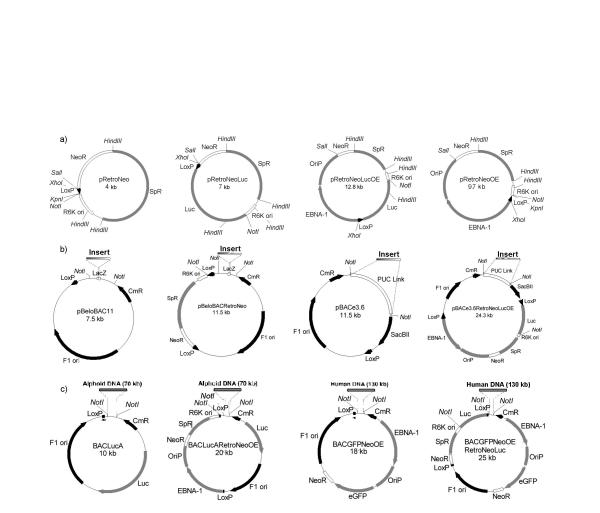
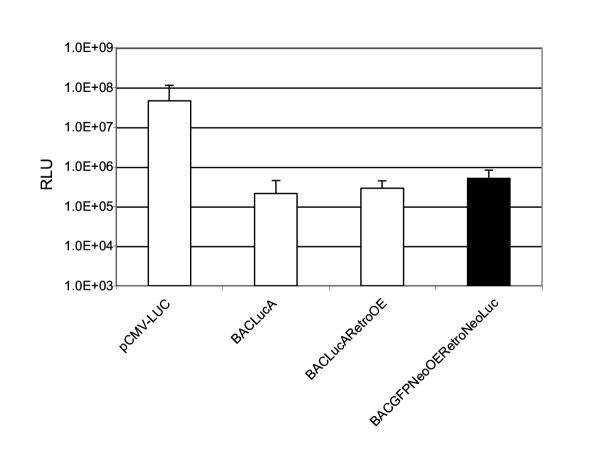
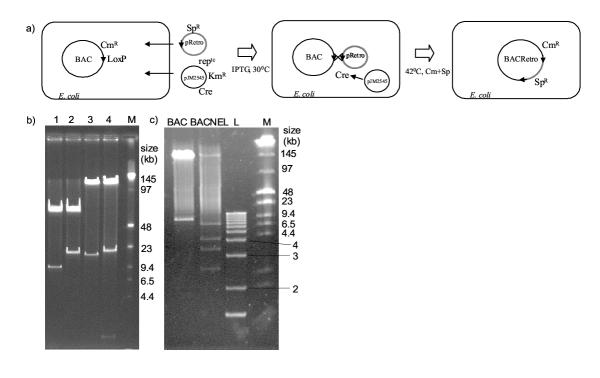
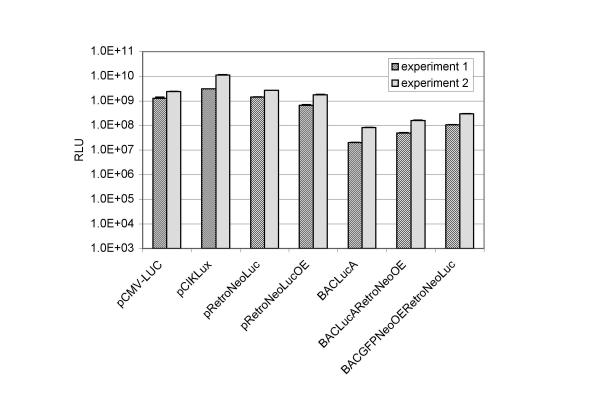
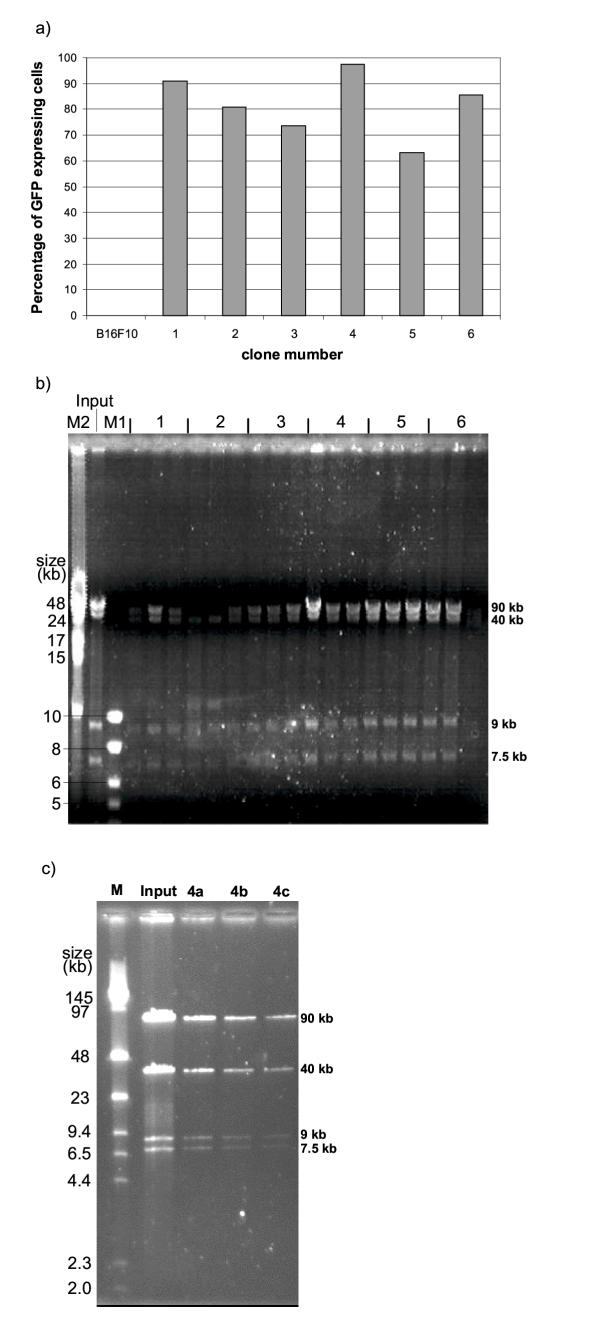
We describe a series of retrofitting plasmids and a protocol for in vivo loxP/Cre recombination. The vector pRetroNeo carries a G418 resistance cassette, pRetroNeoLuc carries G418 resistance and a luciferase expression cassette, pRetroNeoLucOE carries G418 resistance, luciferase and an oriP/EBNA-1 cassette and pRetroNeoOE carries G418 resistance and oriP/EBNA-1. These vectors can be efficiently retrofitted onto BACs without rearrangement of the BAC clone. The luciferase cassette is expressed efficiently from the retrofitting plasmids and from retrofitted BACs after transient transfection of B16F10 cells in tissue culture and after electroporation into muscles of BALB/c mice in vivo. We also show that a BAC carrying GFP, oriP and EBNA-1 can be transfected into B16F10 cells with Lipofectamine 2000 and can be rescued intact after 5 weeks.
The pRetro vectors allow efficient retrofitting of BACs with G418 resistance, luciferase and/or oriP/EBNA-1 using in vivo expression of Cre. The luciferase reporter gene is expressed after transient transfection of retrofitted BACs into cells in tissue culture and after electroporation into mouse muscle in vivo. OriP/EBNA-1 allows stable maintenance of a 150-kb BAC without rearrangement for at least 5 weeks.
细菌人工染色体(BACs)已被广泛用于人类和小鼠基因组测序,因此大多数基因都很容易获得。BACs的大尺寸意味着它们通常可以携带完整的基因以及所有驱动组织特异性表达全水平的长程调控元件。对于基因表达研究和基因治疗应用,能够用诸如G418抗性等选择基因、诸如荧光素酶等报告基因以及来自爱泼斯坦 - 巴尔病毒的oriP/EBNA-1对BACs进行改造是很有用的,oriP/EBNA-1可使BACs在哺乳动物细胞中进行长期附加型维持。
我们描述了一系列改造质粒和体内loxP/Cre重组的方案。载体pRetroNeo携带G418抗性盒,pRetroNeoLuc携带G418抗性和荧光素酶表达盒,pRetroNeoLucOE携带G418抗性、荧光素酶和oriP/EBNA-1盒,pRetroNeoOE携带G418抗性和oriP/EBNA-1。这些载体可以有效地改造到BACs上而不改变BAC克隆的结构。在组织培养中对B16F10细胞进行瞬时转染后以及在体内电穿孔导入BALB/c小鼠肌肉后,荧光素酶盒能从改造质粒和改造后的BACs中高效表达。我们还表明,携带GFP、oriP和EBNA-1的BAC可以用Lipofectamine 两千转染到B16F10细胞中,并在5周后完整拯救出来。
pRetro载体允许利用Cre的体内表达用G418抗性、荧光素酶和/或oriP/EBNA-1对BACs进行高效改造。改造后的BACs瞬时转染到组织培养细胞中以及体内电穿孔导入小鼠肌肉后,荧光素酶报告基因都会表达。oriP/EBNA-1可使150 kb的BAC稳定维持至少5周而不发生重排。