Warden Charles, Tang Qiyi, Zhu Hua
Department of Molecular Medicine, City of Hope National Medical Center and Beckman Research Institute, Duarte, CA 91010, USA.
J Biomed Biotechnol. 2011;2011:124595. doi: 10.1155/2011/124595. Epub 2010 Oct 27.
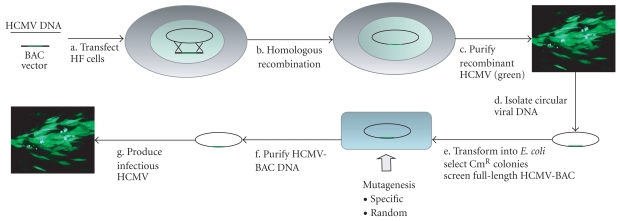
The herpesviridae are a large family of DNA viruses with large and complicated genomes. Genetic manipulation and the generation of recombinant viruses have been extremely difficult. However, herpesvirus bacterial artificial chromosomes (BACs) that were developed approximately 10 years ago have become useful and powerful genetic tools for generating recombinant viruses to study the biology and pathogenesis of herpesviruses. For example, BAC-directed deletion mutants are commonly used to determine the function and essentiality of viral genes. In this paper, we discuss the creation of herpesvirus BACs, functional analyses of herpesvirus mutants, and future applications for studies of herpesviruses. We describe commonly used methods to create and mutate herpesvirus BACs (such as site-directed mutagenesis and transposon mutagenesis). We also evaluate the potential future uses of viral BACs, including vaccine development and gene therapy.
疱疹病毒科是一类拥有庞大而复杂基因组的DNA病毒大家族。基因操作和重组病毒的产生一直极为困难。然而,大约10年前开发的疱疹病毒细菌人工染色体(BAC)已成为用于产生重组病毒以研究疱疹病毒生物学和发病机制的有用且强大的遗传工具。例如,BAC定向缺失突变体常用于确定病毒基因的功能和必要性。在本文中,我们讨论了疱疹病毒BAC的创建、疱疹病毒突变体的功能分析以及疱疹病毒研究的未来应用。我们描述了创建和突变疱疹病毒BAC的常用方法(如定点诱变和转座子诱变)。我们还评估了病毒BAC未来的潜在用途,包括疫苗开发和基因治疗。