Romby P, Brunel C, Caillet J, Springer M, Grunberg-Manago M, Westhof E, Ehresmann C, Ehresmann B
UPR du CNRS no. 9002, Institut de Biologie Moléculaire et Cellulaire, Strasbourg, France.
Nucleic Acids Res. 1992 Nov 11;20(21):5633-40. doi: 10.1093/nar/20.21.5633.
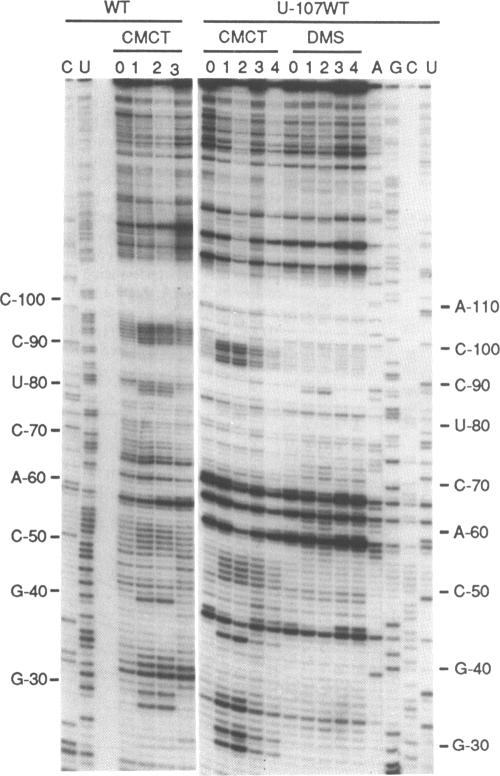
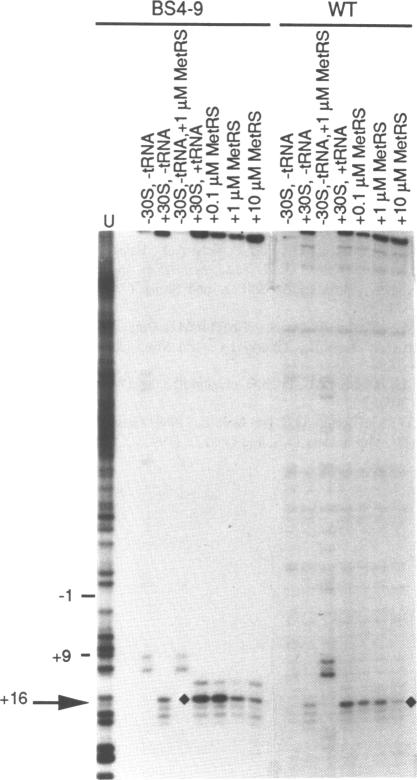
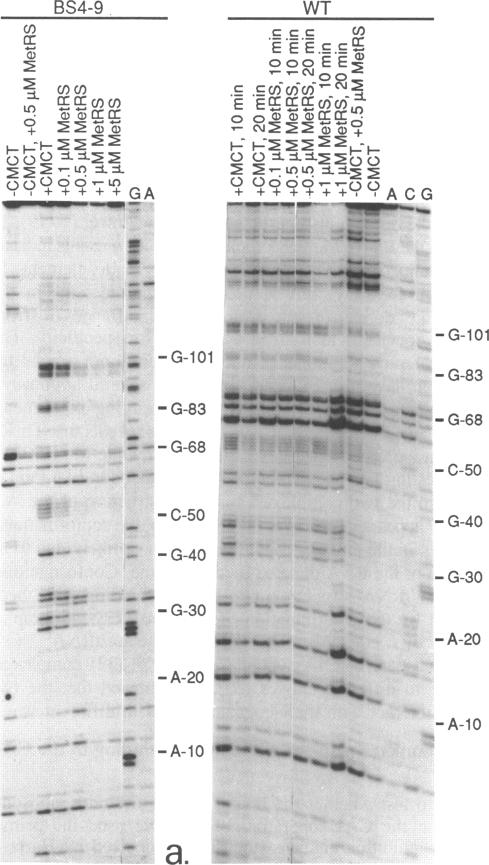
We previously showed that: (i) E.coli threonyl-tRNA synthetase (ThrRS) binds to the leader of its mRNA and represses translation by preventing ribosome binding to its loading site; (ii) the translational operator shares sequence and structure similarities with tRNA(Thr); (iii) it is possible to switch the specificity of the translational control from ThrRS to methionyl-tRNA synthetase (MetRS) by changing the CGU anticodon-like sequence to CAU, the tRNA(Met) anticodon. Here, we show that the wild type (CGU) and the mutated (CAU) operators act as competitive inhibitors of tRNA(Thr) and tRNA(fMet) for aminoacylation catalyzed by E.coli ThrRS and MetRS, respectively. The apparent Kd of the MetRS/CAU operator complex is one order magnitude higher than that of the ThrRS/CGU operator complex. Although ThrRS and MetRS shield the anticodon- and acceptor-like domains of their respective operators, the relative contribution of these two domains differs significantly. As in the threonine system, the interaction of MetRS with the CAU operator occludes ribosome binding to its loading site. The present data demonstrate that the anticodon-like sequence is one major determinant for the identity of the operator and the regulation specificity. It further shows that the tRNA-like operator obeys to tRNA identity rules.
(i)大肠杆菌苏氨酰 - tRNA合成酶(ThrRS)与其mRNA的前导序列结合,并通过阻止核糖体结合其装载位点来抑制翻译;(ii)翻译调控元件与tRNA(Thr)具有序列和结构相似性;(iii)通过将CGU反密码子样序列改变为CAU(tRNA(Met)反密码子),可以将翻译控制的特异性从ThrRS切换为甲硫氨酰 - tRNA合成酶(MetRS)。在此,我们表明野生型(CGU)和突变型(CAU)调控元件分别作为大肠杆菌ThrRS和MetRS催化的氨酰化反应中tRNA(Thr)和tRNA(fMet)的竞争性抑制剂。MetRS/CAU调控元件复合物的表观解离常数(Kd)比ThrRS/CGU调控元件复合物高一个数量级。尽管ThrRS和MetRS分别屏蔽了各自调控元件的反密码子样和受体样结构域,但这两个结构域的相对贡献差异显著。与苏氨酸系统一样,MetRS与CAU调控元件的相互作用会阻止核糖体结合其装载位点。目前的数据表明,反密码子样序列是调控元件识别和调控特异性的一个主要决定因素。它进一步表明,tRNA样调控元件遵循tRNA识别规则。