Bolla K I, Eldreth D A, London E D, Kiehl K A, Mouratidis M, Contoreggi C, Matochik J A, Kurian V, Cadet J L, Kimes A S, Funderburk F R, Ernst M
Department of Neurology, Johns Hopkins University School of Medicine, Baltimore, MD, USA.
Neuroimage. 2003 Jul;19(3):1085-94. doi: 10.1016/s1053-8119(03)00113-7.
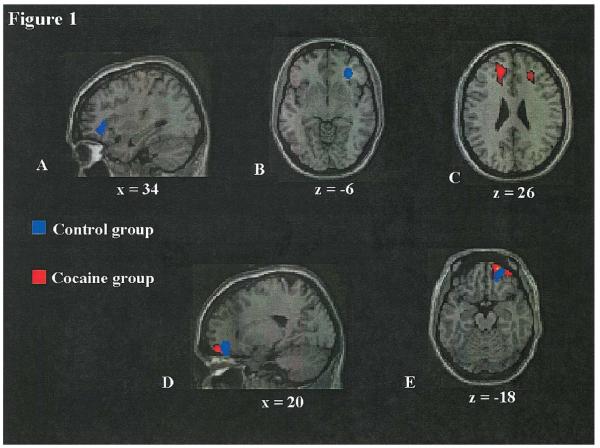
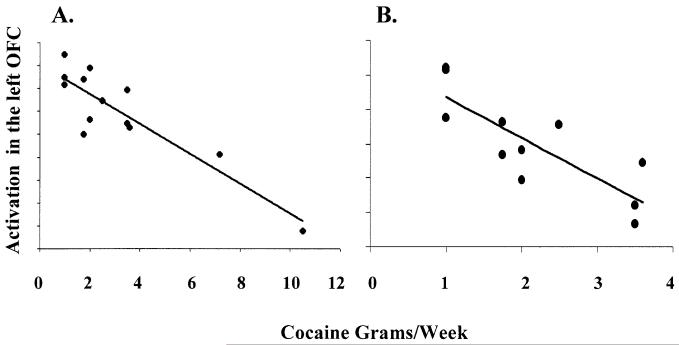
Cocaine abusers demonstrate faulty decision-making as manifested by their inability to discontinue self-destructive drug-seeking behaviors. The orbitofrontal cortex (OFC) plays an important role in decision-making. In this preliminary study we tested whether 25-day-abstinent cocaine abusers show alterations in normalized cerebral blood flow (rCBF) in the OFC using PET with (15)O during the Iowa Gambling Task (a decision-making task). This task measures the ability to weigh short-term rewards against long-term losses. A control task matched the sensorimotor aspects of the task but did not require decision-making. Cocaine abusers (N = 13) showed greater activation during performance of the Iowa Gambling Task in the right OFC and less activation in the right dorsolateral prefrontal cortex (DLPFC) and left medial prefrontal cortex (MPFC) compared to a control group (N = 13). Better Iowa Gambling Task performance was associated with greater activation in the right OFC in both groups. Also, the amount of cocaine used (grams/week) prior to the 25 days of enforced abstinence was negatively correlated with activation in the left OFC. Greater activation in the OFC in cocaine abusers compared to a control group may reflect differences in the anticipation of reward while less activation in the DLPFC and MPFC may reflect differences in planning and working memory. These findings suggest that cocaine abusers show persistent functional abnormalities in prefrontal neural networks involved in decision-making and these effects are related to cocaine abuse. Compromised decision-making could contribute to the development of addiction and undermine attempts at abstinence.
可卡因滥用者表现出决策失误,表现为他们无法停止自我毁灭的觅药行为。眶额皮质(OFC)在决策中起重要作用。在这项初步研究中,我们使用正电子发射断层扫描(PET)和(15)O,测试了25天戒毒期的可卡因滥用者在爱荷华赌博任务(一项决策任务)期间眶额皮质的标准化脑血流量(rCBF)是否有变化。该任务衡量权衡短期奖励与长期损失的能力。一个对照任务匹配了该任务的感觉运动方面,但不需要决策。与对照组(N = 13)相比,可卡因滥用者(N = 13)在执行爱荷华赌博任务期间,右侧眶额皮质激活更强,右侧背外侧前额叶皮质(DLPFC)和左侧内侧前额叶皮质(MPFC)激活较弱。在两组中,更好的爱荷华赌博任务表现都与右侧眶额皮质更强的激活相关。此外,在强制戒毒的25天之前使用的可卡因量(克/周)与左侧眶额皮质的激活呈负相关。与对照组相比,可卡因滥用者眶额皮质更强的激活可能反映了奖励预期的差异,而背外侧前额叶皮质和内侧前额叶皮质较弱的激活可能反映了计划和工作记忆的差异。这些发现表明,可卡因滥用者在参与决策的前额叶神经网络中表现出持续的功能异常,这些影响与可卡因滥用有关。受损的决策可能导致成瘾的发展,并破坏戒毒的尝试。