Porritt Helen E, Gordon Kristie, Petrie Howard T
Memorial Sloan-Kettering, New York, NY 10021, USA.
J Exp Med. 2003 Sep 15;198(6):957-62. doi: 10.1084/jem.20030837.
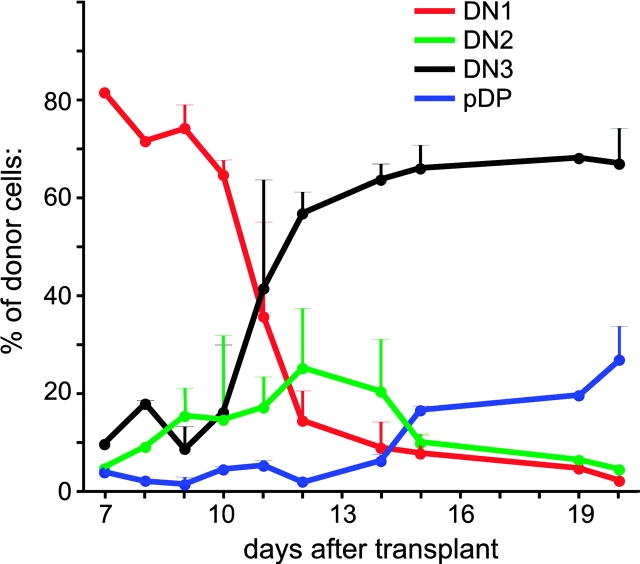
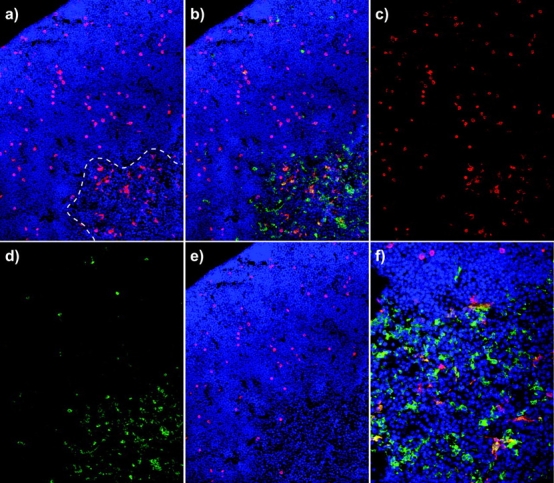
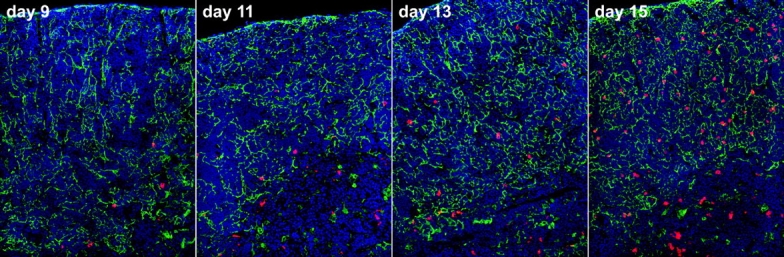
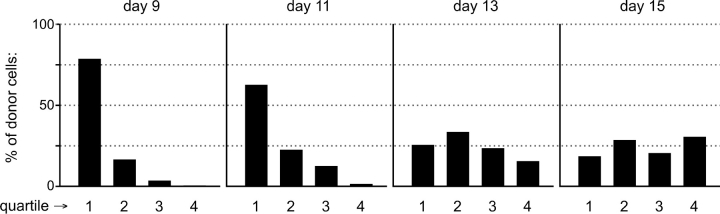
Upon thymus entry, thymic-homing progenitors undergo distinct phases of differentiation as they migrate through the cortex to the capsule, suggesting that the signals that induce these differentiation steps may be stratified in corresponding cortical regions. To better define these regions, we transplanted purified stem cells into nonirradiated congenic recipients and followed their differentiation with respect to both tissue location and time. The earliest progenitors (DN1) remained confined to a very narrow region of the cortex for about the first 10 d of intrathymic residence; this region virtually overlaps the sites of thymic entry, suggesting that DN1 cells move very little during this lengthy period of proliferation and lineage commitment. Movement out of this region into the deeper cortex is asynchronous, and corresponds to the appearance of DN2 cells. Differentiation to the DN3 stage correlates with movement across the midpoint of the cortex, indicating that stromal signals that induce functions such as TCR gene rearrangement reside mainly in the outer half of the cortex. The minimum time to reach the capsule, and thus transit to the DP stage, is approximately 13 d, with the average time a few days longer. These findings reveal for the first time the kinetics of steady-state progenitor differentiation in the thymus, as well as defining the boundaries of cortical regions that support different phases of the differentiation process. We also show that the first lineage-positive progeny of transplanted stem cells to appear in the thymus are dendritic cells in the medulla, suggesting that each new wave of new T cell production is preceded by a wave of regulatory cells that home to the medulla and ensure efficient tolerance and selection.
进入胸腺后,归巢至胸腺的祖细胞在从皮质迁移至被膜的过程中经历不同的分化阶段,这表明诱导这些分化步骤的信号可能在相应的皮质区域分层分布。为了更好地界定这些区域,我们将纯化的干细胞移植到未受照射的同基因受体中,并根据组织位置和时间追踪它们的分化情况。最早的祖细胞(DN1)在胸腺内驻留的最初约10天内,一直局限于皮质的一个非常狭窄的区域;该区域实际上与胸腺入口部位重叠,这表明DN1细胞在这段漫长的增殖和谱系定向期内移动很少。从这个区域向更深层皮质的迁移是异步的,与DN2细胞的出现相对应。向DN3阶段的分化与跨越皮质中点的迁移相关,这表明诱导TCR基因重排等功能的基质信号主要位于皮质的外半部分。到达被膜并因此过渡到双阳性(DP)阶段的最短时间约为13天,平均时间要长几天。这些发现首次揭示了胸腺中稳态祖细胞分化的动力学,同时也界定了支持分化过程不同阶段的皮质区域边界。我们还表明,移植干细胞在胸腺中出现的首批谱系阳性后代是髓质中的树突状细胞,这表明每一波新的T细胞产生之前都有一波归巢至髓质的调节性细胞,以确保有效的耐受性和选择。