Cho Y W, Yang D H, Oh D Y, Baick S H, Kim S K, Kim S J, Hong S Y
Department of Internal Medicine, Soonchunhyang University College of Medicine, Chunan, Korea.
Korean J Intern Med. 1992 Jul;7(2):81-6. doi: 10.3904/kjim.1992.7.2.81.
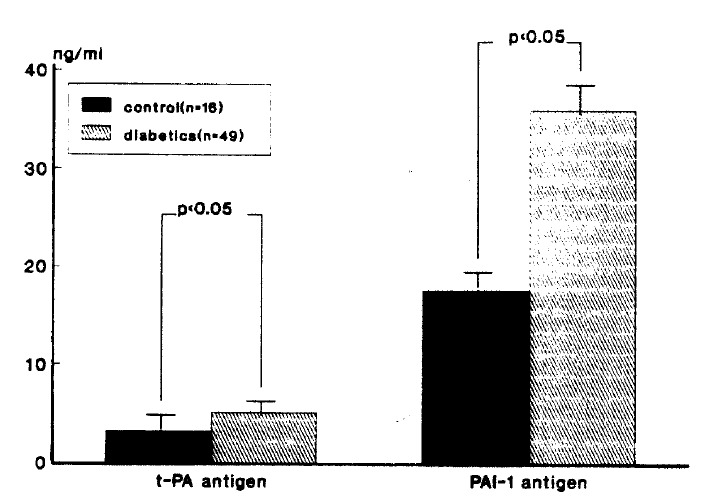
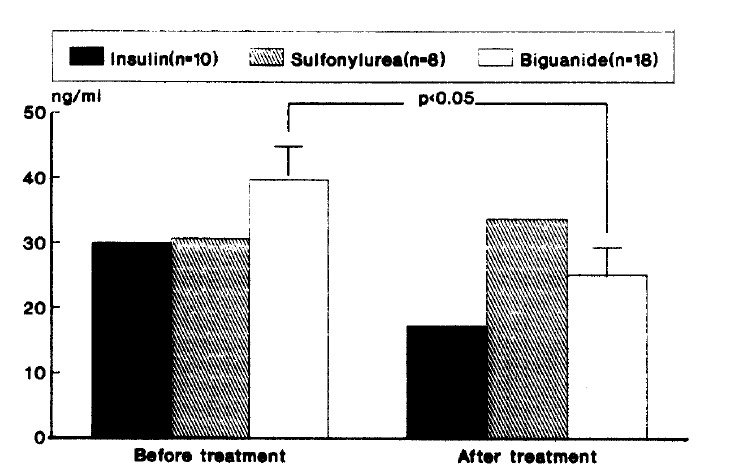
Basal plasma tissue type plasminogen activator (t-PA) and plasminogen activator inhibitor type 1 (PAl-1) antigen levels were studied in 49 non-insulin dependent diabetic patients (23 men, 26 women: ages 51.3 +/- 14.9 years) and 16 age matched non-diabetic subjects (9 men, 7 women: ages 49.8 +/- 12.2 years) as a control group. Compared to a control group, the diabetic patients had a significantly higher mean t-PA antigen (5.15 +/- 3.02 vs 3.20 +/- 2.30 ng/ml) and PAl-1 antigen (35.89 +/- 18.59 vs 17.60 +/- 15.36 ng/ml) levels (p < 0.05). Plasma t-PA antigen level was not influenced by each treatment modality. There was a significant decrease of plasma PAl-1 antigen level after Metformin administration compared to that of before Metformin administration (39.74 +/- 19.39 vs 25.14 +/- 16.18 ng/ml) (p < 0.05), and the insulin-treated group showed a tendency for a decrease of plasma PAl-1 antigen levels after insulin administration but this did not reach statistical significance (29.93 +/- 15.37 vs 17.32 +/- 10.60 ng/ml). Sulfonylurea did not change both plasma t-PA and PAl-1 antigen levels. In conclusion, diabetic patients have high t-PA and PAl-1 antigen levels. Biguanide reduced plasma PAl-1 antigen levels, which might play some helpful role in the improvement of chronic complications in NIDDM.
对49例非胰岛素依赖型糖尿病患者(23例男性,26例女性;年龄51.3±14.9岁)和16例年龄匹配的非糖尿病受试者(9例男性,7例女性;年龄49.8±12.2岁)作为对照组,研究了基础血浆组织型纤溶酶原激活物(t-PA)和纤溶酶原激活物抑制剂1型(PAI-1)抗原水平。与对照组相比,糖尿病患者的平均t-PA抗原水平(5.15±3.02对3.20±2.30 ng/ml)和PAI-1抗原水平(35.89±18.59对17.60±15.36 ng/ml)显著更高(p<0.05)。血浆t-PA抗原水平不受每种治疗方式的影响。与服用二甲双胍前相比,服用二甲双胍后血浆PAI-1抗原水平显著降低(39.74±19.39对25.14±16.18 ng/ml)(p<0.05),胰岛素治疗组在胰岛素给药后血浆PAI-1抗原水平有下降趋势,但未达到统计学意义(29.93±15.37对17.32±10.60 ng/ml)。磺脲类药物未改变血浆t-PA和PAI-1抗原水平。总之,糖尿病患者具有较高的t-PA和PAI-1抗原水平。双胍类药物降低了血浆PAI-1抗原水平,这可能对改善非胰岛素依赖型糖尿病的慢性并发症起到一定的有益作用。