Tigyi Z, Kishore A R, Maeland J A, Forsgren A, Naidu A S
Department of Medical Microbiology, Malmö General Hospital, Sweden.
Infect Immun. 1992 Jul;60(7):2619-26. doi: 10.1128/iai.60.7.2619-2626.1992.
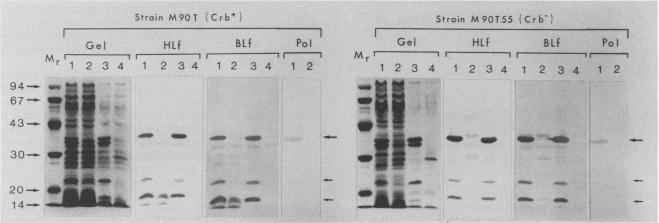
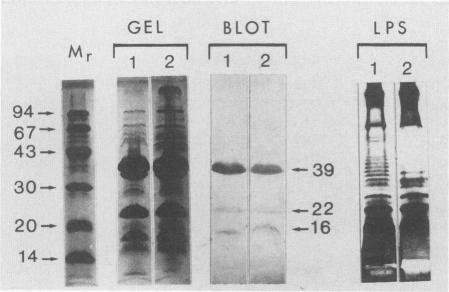
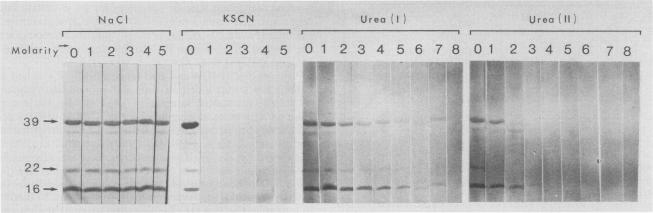
The ability of Shigella flexneri to interact with lactoferrin (Lf) was examined with a 125I-labeled protein-binding assay. The percent binding of human lactoferrin (HLf) and bovine lactoferrin (BLf) to 45 S. flexneri strains was 19 +/- 3 and 21 +/- 3 (mean +/- standard error of the mean), respectively. 125I-labeled HLf and BLf binding to strain M90T reached an equilibrium within 2 h. Unlabeled HLf and BLf displaced the 125I-HLf-bacteria interaction in a dose-dependent manner. The Lf-bacterium complex was uncoupled by KSCN or urea, but not by NaCl. The interaction was specific, and approximately 4,800 HLf binding sites (affinity constant [Ka], 690 nM) or approximately 5,700 BLf binding sites (Ka, 104 nM) per cell were estimated in strain M90T by a Scatchard plot analysis. The native cell envelope (CE) and outer membrane (OM) did not reveal Lf-binding components in sodium dodecyl sulfate-polyacrylamide gel electrophoresis. However, after being boiled, the CE and OM preparations showed three distinct horseradish peroxidase-Lf reactive bands of about 39, 22, and 16 kDa. The 39-kDa component was also reactive to a monoclonal antibody specific for porin (PoI) proteins of members of the family Enterobacteriaceae. The Lf-binding protein pattern was similar with BLf or HLf, for Crb+ and Crb- strains. The protein-Lf complex was dissociable by KSCN or urea and was stable after treatment with NaCl. Variation (loss) in the O chain of lipopolysaccharide (LPS) markedly enhanced the Lf-binding capacity in the isogenic rough strain SFL1070-15 compared with its smooth parent strain, SFL1070. These data establish that Lf binds to specific components in the bacterial OM; the heat-modifiable, anti-PoI-reactive, and LPS-associated properties suggested that the Lf-binding proteins are porins in S. flexneri.
利用¹²⁵I标记的蛋白质结合试验检测了福氏志贺菌与乳铁蛋白(Lf)相互作用的能力。人乳铁蛋白(HLf)和牛乳铁蛋白(BLf)与45株福氏志贺菌的结合百分比分别为19±3和21±3(平均值±平均标准误差)。¹²⁵I标记的HLf和BLf与M90T菌株的结合在2小时内达到平衡。未标记的HLf和BLf以剂量依赖的方式取代了¹²⁵I-HLf与细菌的相互作用。Lf-细菌复合物可被硫氰酸钾(KSCN)或尿素解离,但不能被氯化钠解离。这种相互作用具有特异性,通过Scatchard作图分析估计,M90T菌株中每个细胞约有4800个HLf结合位点(亲和常数[Ka],690 nM)或约5700个BLf结合位点(Ka,104 nM)。在十二烷基硫酸钠-聚丙烯酰胺凝胶电泳中,天然细胞包膜(CE)和外膜(OM)未显示出Lf结合成分。然而,煮沸后,CE和OM制剂显示出三条明显的辣根过氧化物酶-Lf反应带,大小约为39、22和16 kDa。39 kDa的成分也与一种对肠杆菌科成员孔蛋白(PoI)蛋白特异的单克隆抗体发生反应。对于Crb⁺和Crb⁻菌株,Lf结合蛋白模式与BLf或HLf相似。蛋白质-Lf复合物可被KSCN或尿素解离,经氯化钠处理后稳定。与光滑亲本菌株SFL1070相比,等基因粗糙菌株SFL10-15中脂多糖(LPS)O链的变异(缺失)显著增强了Lf结合能力。这些数据表明Lf与细菌OM中的特定成分结合;热可修饰、抗PoI反应性和LPS相关特性表明,Lf结合蛋白是福氏志贺菌中的孔蛋白。