Tulchinsky E, Ford H L, Kramerov D, Reshetnyak E, Grigorian M, Zain S, Lukanidin E
Cancer Center, University of Rochester, NY 14642.
Proc Natl Acad Sci U S A. 1992 Oct 1;89(19):9146-50. doi: 10.1073/pnas.89.19.9146.
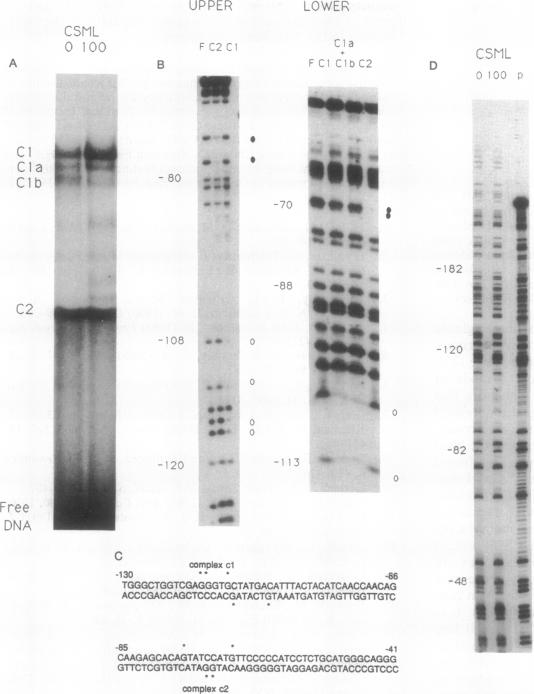
The mts1 gene is specifically expressed in certain metastatic tumors but not in their nonmetastatic counterparts. It is also expressed in several normal cell and tissue types that exhibit the ability to be motile. The gene was cloned from both mouse and human sources and the 5' flanking regions were sequenced. The sequencing data revealed a 135-base-pair region of high homology between the mouse and human mts1 gene. This homology was observed in the vicinity of the TATA box. The 5' region of the mts1 gene was also observed to have a high degree of homology to some known promoter and enhancer sequences. To determine the role this region plays in regulating the transcription of mts1, promoter analysis was performed. Sixteen constructs were prepared in which the chloramphenicol acetyltransferase gene was fused to different regions of the mouse mts1 promoter. These constructs were analyzed in transient transfection assays in two related cell lines derived from mouse mammary adenosarcomas: CSML-0, a nonmetastatic cell line with low levels of mts1 expression, and CSML-100, a metastatic cell line with high levels of mts1 expression. Results of our transient transfection assays in conjunction with results obtained from in vitro and in vivo footprinting of the promoter region show no evidence of cis-acting control elements important for the transcriptional regulation of mts1 in these cell lines. A few nucleotides upstream of the TATA box are sufficient for maximal levels of mts1 transcription. Because no cis-acting control elements were found, restriction of mts1 transcription in CSML-0 cells must exist on some other level. mts1 was found to be hypermethylated in CSML-0 cells but not in CSML-100 cells. The possible role of methylation in progression of the nonmetastatic CSML-0 adenosarcoma cell line toward the metastatic CSML-100 adenosarcoma cell line is discussed.
mts1基因在某些转移性肿瘤中特异性表达,但在其非转移性对应物中不表达。它也在几种具有运动能力的正常细胞和组织类型中表达。该基因已从小鼠和人类来源克隆,并对其5'侧翼区域进行了测序。测序数据显示,小鼠和人类mts1基因之间有一个135个碱基对的高度同源区域。在TATA框附近观察到了这种同源性。还观察到mts1基因的5'区域与一些已知的启动子和增强子序列有高度同源性。为了确定该区域在调节mts1转录中所起的作用,进行了启动子分析。制备了16种构建体,其中氯霉素乙酰转移酶基因与小鼠mts1启动子的不同区域融合。在源自小鼠乳腺腺肉瘤的两种相关细胞系中进行瞬时转染分析:CSML-0,一种mts1表达水平低的非转移性细胞系,和CSML-100,一种mts1表达水平高的转移性细胞系。我们的瞬时转染分析结果与从启动子区域的体外和体内足迹分析获得的结果相结合,表明在这些细胞系中没有证据表明存在对mts1转录调控重要的顺式作用控制元件。TATA框上游的几个核苷酸足以实现mts1转录的最大水平。由于未发现顺式作用控制元件,CSML-0细胞中mts1转录的限制必定存在于其他某个水平。发现mts1在CSML-0细胞中高度甲基化,但在CSML-100细胞中未甲基化。讨论了甲基化在非转移性CSML-0腺肉瘤细胞系向转移性CSML-100腺肉瘤细胞系进展中的可能作用。