Goltsov A A, Eisensmith R C, Konecki D S, Lichter-Konecki U, Woo S L
Howard Hughes Medical Institute, Department of Cell Biology, Baylor College of Medicine, Houston, TX 77030.
Am J Hum Genet. 1992 Sep;51(3):627-36.
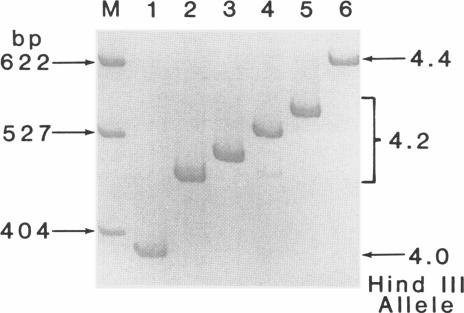
The HindIII RFLP in the human phenylalanine hydroxylase (PAH) gene is caused by the presence of an AT-rich (70%) minisatellite region. This region contains various multiple of 30-bp tandem repeats and is located 3 kb downstream of the final exon of the gene. PCR-mediated amplification of this region from haplotyped PAH chromosomes indicates that the previously reported 4.0-kb HindIII allele contains three of these repeats, while the 4.4-kb HindIII allele contains 12 of these repeats. The 4.2-kb HindIII fragment can contain six, seven, eight, or nine copies of this repeat. These variations permit more detailed analysis of mutant haplotypes 1, 5, 6, and, possibly, others. Kindred analysis in phenylketonuria families demonstrates Mendelian segregation of these VNTR alleles, as well as associations between these alleles and certain PAH mutations. The R261Q mutation, associated with haplotype 1, is associated almost exclusively with an allele containing eight repeats; the R408W mutation, when occurring on a haplotype 1 background, may also be associated with the eight-repeat VNTR allele. Other PAH mutations associated with haplotype 1, R252W and P281L, do not appear to segregate with specific VNTR alleles. The IVS-10 mutation, when associated with haplotype 6, is associated exclusively with an allele containing seven repeats. The combined use of this VNTR system and the existing RFLP haplotype system will increase the performance of prenatal diagnostic tests based on haplotype analysis. In addition, this VNTR may prove useful in studies concerning the origins and distributions of PAH mutations in different human populations.
人类苯丙氨酸羟化酶(PAH)基因中的HindIII限制性片段长度多态性(RFLP)是由富含AT(70%)的小卫星区域的存在引起的。该区域包含多个30bp串联重复序列的不同倍数,位于该基因最后一个外显子下游3kb处。从单倍型PAH染色体对该区域进行PCR介导的扩增表明,先前报道的4.0kb HindIII等位基因包含三个这些重复序列,而4.4kb HindIII等位基因包含12个这些重复序列。4.2kb HindIII片段可包含该重复序列的六个、七个、八个或九个拷贝。这些变异允许对突变单倍型1、5、6以及可能的其他单倍型进行更详细的分析。苯丙酮尿症家族的系谱分析表明这些可变数目串联重复(VNTR)等位基因呈孟德尔分离,以及这些等位基因与某些PAH突变之间的关联。与单倍型1相关的R261Q突变几乎仅与包含八个重复序列的等位基因相关;R408W突变,当发生在单倍型1背景上时,也可能与八个重复序列的VNTR等位基因相关。与单倍型1相关的其他PAH突变,R252W和P281L,似乎不与特定的VNTR等位基因分离。IVS-10突变,当与单倍型6相关时,仅与包含七个重复序列的等位基因相关。这个VNTR系统与现有的RFLP单倍型系统联合使用将提高基于单倍型分析的产前诊断测试的效能。此外,这个VNTR可能在关于不同人群中PAH突变的起源和分布的研究中证明是有用的。