King P A, Horton E D, Hirshman M F, Horton E S
Department of Medicine, University of Vermont, Burlington 05405.
J Clin Invest. 1992 Oct;90(4):1568-75. doi: 10.1172/JCI116025.
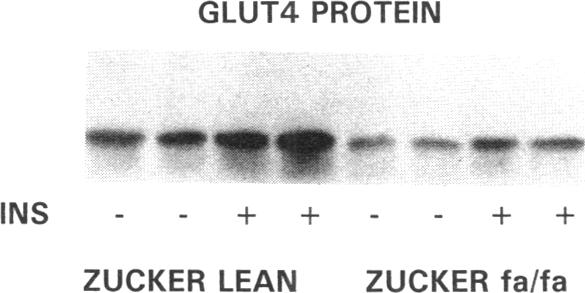
The genetically obese Zucker rat (fa/fa) is characterized by a severe resistance to the action of insulin to stimulate skeletal muscle glucose transport. The goal of the present study was to identify whether the defect associated with this insulin resistance involves an alteration of transporter translocation and/or transporter activity. Various components of the muscle glucose transport system were investigated in plasma membranes isolated from basal or maximally insulin-treated skeletal muscle of lean and obese Zucker rats. Measurements of D- and L-glucose uptake by membrane vesicles under equilibrium exchange conditions indicated that insulin treatment resulted in a four-fold increase in the Vmax for carrier-mediated transport for lean animals [from 4.5 to 17.5 nmol/(mg.s)] but only a 2.5-fold increase for obese rats [from 3.6 to 9.1 nmol/(mg.s)]. In the lean animals, this increase in glucose transport function was associated with a 1.8-fold increase in the transporter number as indicated by cytochalasin B binding, a 1.4-fold increase in plasma membrane GLUT4 protein, and a doubling of the average carrier turnover number (intrinsic activity). In the obese animals, there was no change in plasma membrane transporter number measured by cytochalasin B binding, or in GLUT4 or GLUT1 protein. However, there was an increase in carrier turnover number similar to that seen in the lean litter mates. Measurements of GLUT4 mRNA in red gastrocnemius muscle showed no difference between lean and obese rats. We conclude that the insulin resistance of the obese rats involves the failure of translocation of transporters, while the action of insulin to increase the average carrier turnover number is normal.
遗传性肥胖的 Zucker 大鼠(fa/fa)的特征是对胰岛素刺激骨骼肌葡萄糖转运的作用具有严重抗性。本研究的目的是确定与这种胰岛素抵抗相关的缺陷是否涉及转运体易位和/或转运体活性的改变。在从瘦型和肥胖型 Zucker 大鼠的基础状态或最大胰岛素处理的骨骼肌中分离的质膜中,研究了肌肉葡萄糖转运系统的各种成分。在平衡交换条件下对膜囊泡摄取 D-葡萄糖和 L-葡萄糖的测量表明,胰岛素处理使瘦型动物载体介导转运的 Vmax 增加了四倍[从 4.5 增加到 17.5 nmol/(mg·s)],而肥胖大鼠仅增加了 2.5 倍[从 3.6 增加到 9.1 nmol/(mg·s)]。在瘦型动物中,如细胞松弛素 B 结合所示,这种葡萄糖转运功能的增加与转运体数量增加 1.8 倍、质膜 GLUT4 蛋白增加 1.4 倍以及平均载体周转数(内在活性)加倍有关。在肥胖动物中,通过细胞松弛素 B 结合测量的质膜转运体数量、GLUT4 或 GLUT1 蛋白均无变化。然而,载体周转数增加,与瘦型同窝动物相似。红腓肠肌中 GLUT4 mRNA 的测量显示瘦型和肥胖大鼠之间没有差异。我们得出结论,肥胖大鼠的胰岛素抵抗涉及转运体易位失败,而胰岛素增加平均载体周转数的作用是正常的。