Quelle D E, Quelle F W, Wojchowski D M
Department of Molecular and Cell Biology, Pennsylvania State University, University Park 16802.
Mol Cell Biol. 1992 Oct;12(10):4553-61. doi: 10.1128/mcb.12.10.4553-4561.1992.
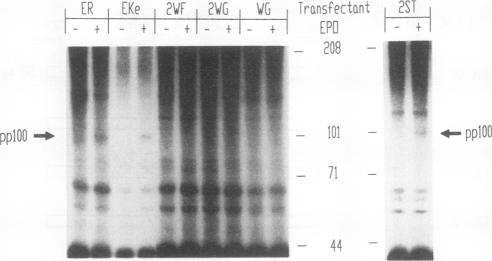
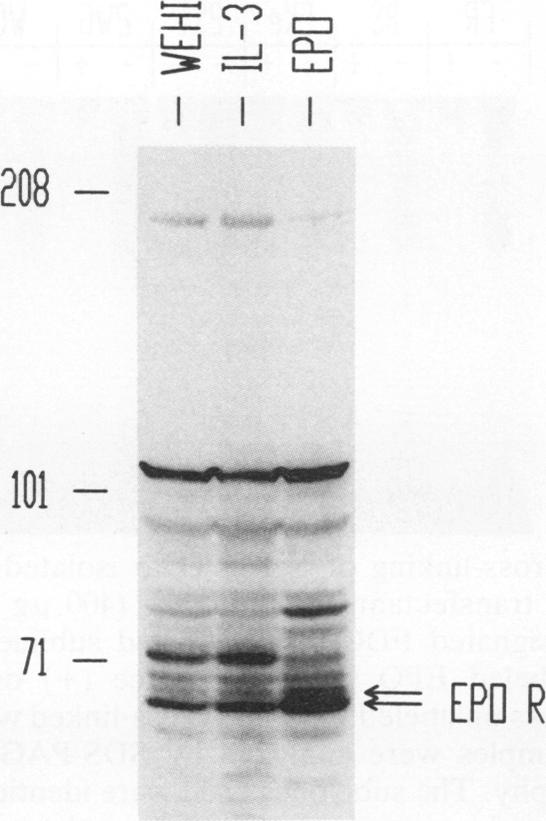
The terminal development of erythroid progenitor cells is promoted in part through the interaction of erythropoietin (EPO) with its cell surface receptor. This receptor and a growing family of related cytokine receptors share homologous extracellular features, including a well-conserved WSXWS motif. To explore the functional significance of this motif in the murine EPO receptor, five WSAWSE mutants were prepared and their signal-transducing, ligand binding, and endocytotic properties were compared. EPO receptors mutated at tryptophan residues (W-232, W-235----G; W-235----G; W-235----F) failed to mediate EPO-induced growth or pp100 phosphorylation, while S-236----T and E-237----K mutants exhibited partial to full activity (50 to 100% of wild-type growth and induced phosphorylation). Ligand affinity was reduced for mutant receptors (two- to fivefold), yet expression at the cell surface for all receptors was nearly equivalent. Also, the ability of mutated receptors to internalize ligand was either markedly reduced or abolished (W-235----F), indicating a role for the WSAWSE region in hormone internalization. Interestingly, receptor forms lacking 97% of the cytosolic domain (no signal-transducing capacity; binding affinity reduced two- to threefold) internalized EPO efficiently. This and all WSAWSE receptor forms studied also mediated specific cross-linking of 125I-EPO to three accessory membrane proteins (M(r)s, 120,000, 105,000, and 93,000). These findings suggest that the WSAWSE domain of the EPO receptor is important for EPO-induced signal transduction and ligand internalization. In contrast, although the cytosolic domain is required for growth signaling, it appears nonessential for efficient endocytosis.
红系祖细胞的终末发育部分是通过促红细胞生成素(EPO)与其细胞表面受体的相互作用来促进的。该受体以及越来越多的相关细胞因子受体家族具有同源的细胞外特征,包括一个保守性良好的WSXWS基序。为了探究该基序在小鼠EPO受体中的功能意义,制备了五个WSAWSE突变体,并比较了它们的信号转导、配体结合和内吞特性。在色氨酸残基处突变的EPO受体(W-232、W-235→G;W-235→G;W-235→F)无法介导EPO诱导的生长或pp100磷酸化,而S-236→T和E-237→K突变体表现出部分至完全活性(野生型生长和诱导磷酸化的50%至100%)。突变受体的配体亲和力降低(两至五倍),但所有受体在细胞表面的表达几乎相同。此外,突变受体内化配体的能力要么显著降低,要么丧失(W-235→F),表明WSAWSE区域在激素内化中起作用。有趣的是,缺乏97%胞质结构域的受体形式(无信号转导能力;结合亲和力降低两至三倍)能有效地内化EPO。研究的所有WSAWSE受体形式还介导了125I-EPO与三种辅助膜蛋白(分子量分别为120,000、105,000和93,000)的特异性交联。这些发现表明,EPO受体的WSAWSE结构域对于EPO诱导的信号转导和配体内化很重要。相比之下,虽然胞质结构域对于生长信号传导是必需的,但它似乎对于有效的内吞作用并非必不可少。