Willey R L, Maldarelli F, Martin M A, Strebel K
Laboratory of Molecular Microbiology, National Institute of Allergy and Infectious Diseases, Bethesda, Maryland 20892.
J Virol. 1992 Dec;66(12):7193-200. doi: 10.1128/JVI.66.12.7193-7200.1992.
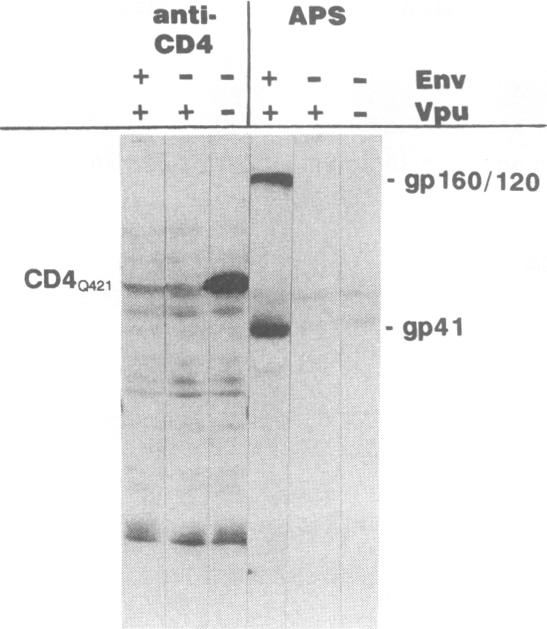
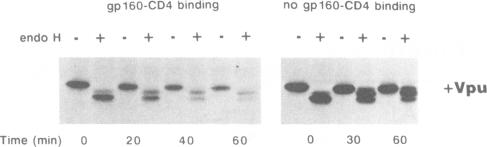
CD4 is an integral membrane glycoprotein which is known as the human immunodeficiency virus (HIV) receptor for infection of human cells. The protein is synthesized in the endoplasmic reticulum (ER) and subsequently transported to the cell surface via the Golgi complex. HIV infection of CD4+ cells leads to downmodulation of cell surface CD4, due at least in part to the formation of stable intracellular complexes between CD4 and the HIV type 1 (HIV-1) Env precursor polyprotein gp160. This process "traps" both proteins in the ER, leading to reduced surface expression of CD4 and reduced processing of gp160 to gp120 and gp41. We have recently demonstrated that the presence of the HIV-1-encoded integral membrane protein Vpu can reduce the formation of Env-CD4 complexes, resulting in increased gp160 processing and decreased CD4 stability. We have studied the effect of Vpu on CD4 stability and found that Vpu induces rapid degradation of CD4, reducing the half-life of CD4 from 6 h to 12 min. By using a CD4-binding mutant of gp160, we were able to show that this Vpu-induced degradation of CD4 requires retention of CD4 in the ER, which is normally accomplished through its binding to gp160. The involvement of gp160 in the induction of CD4 degradation is restricted to its function as a CD4 trap, since, in the absence of Env, an ER retention mutant of CD4, as well as wild-type CD4 in cultures treated with brefeldin A, a drug that blocks transport of proteins from the ER, is degraded in the presence of Vpu.
CD4是一种整合膜糖蛋白,被称为人类免疫缺陷病毒(HIV)感染人类细胞的受体。该蛋白在内质网(ER)中合成,随后通过高尔基体复合体转运至细胞表面。CD4+细胞被HIV感染会导致细胞表面CD4下调,至少部分原因是CD4与HIV-1包膜前体多蛋白gp160之间形成了稳定的细胞内复合物。这一过程将两种蛋白“捕获”在内质网中,导致CD4的表面表达减少以及gp160加工为gp120和gp41的过程减少。我们最近证明,HIV-1编码的整合膜蛋白Vpu的存在可减少Env-CD4复合物的形成,从而导致gp160加工增加以及CD4稳定性降低。我们研究了Vpu对CD4稳定性的影响,发现Vpu可诱导CD4快速降解,将CD4的半衰期从6小时缩短至12分钟。通过使用gp160的CD4结合突变体,我们能够证明这种Vpu诱导的CD4降解需要CD4保留在内质网中,这通常是通过其与gp160的结合来实现的。gp160参与CD4降解的诱导仅限于其作为CD4陷阱的功能,因为在没有Env的情况下,CD4的内质网保留突变体以及在用布雷菲德菌素A(一种阻断蛋白质从内质网转运的药物)处理的培养物中的野生型CD4在Vpu存在的情况下会被降解。