Cong Feng, Zhang Jianxuan, Pao William, Zhou Pengbo, Varmus Harold
Program in Cell Biology, Sloan-Kettering Institute, Memorial Sloan-Kettering Cancer Center, New York, NY 10021, USA.
BMC Mol Biol. 2003 Sep 29;4:10. doi: 10.1186/1471-2199-4-10.
The Wnt signaling pathway plays critical roles in cell proliferation and cell fate determination at many stages of development. A critical downstream target of Wnt signaling is the cytosolic beta-catenin, which is stabilized upon Wnt activation and promotes transcription of a variety of target genes including c-myc and cyclin D. Aberrant Wnt signaling, which results from mutations of either beta-catenin or adenomatous polyposis coli (APC), renders beta-catenin resistant to degradation, and has been associated with multiple types of human cancers.
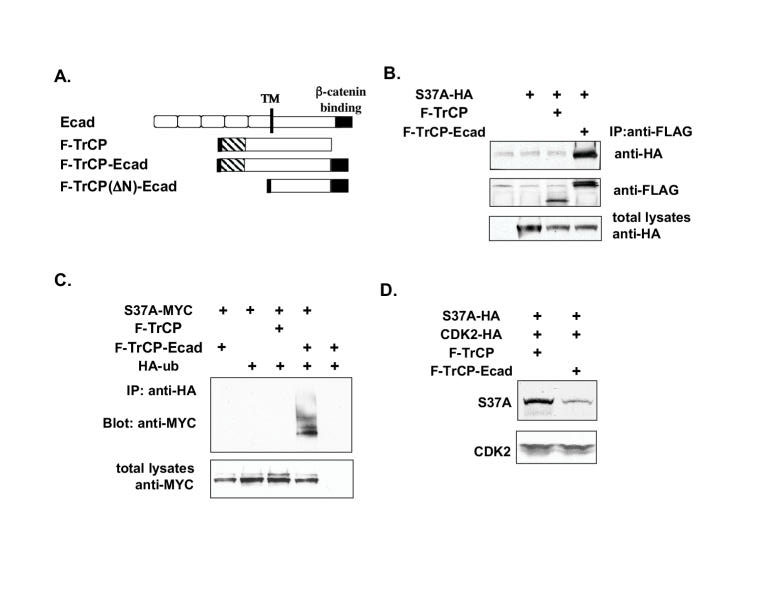
A protein knockdown strategy was designed to reduce the cytosolic beta-catenin levels through accelerating its turnover rate. By engineering a chimeric protein with the beta-catenin binding domain of E-cadherin fused to betaTrCP ubiquitin-protein ligase, the stable beta-catenin mutant was recruited to the cellular SCF (Skp1, Cullin 1, and F-box-containing substrate receptor) ubiquitination machinery for ubiquitination and degradation. The DLD1 colon cancer cells express wild type beta-catenin at abnormally high levels due to loss of APC. Remarkably, conditional expression of betaTrCP-E-cadherin under the control of a tetracycline-repressive promoter in DLD1 cells selectively knocked down the cytosolic, but not membrane-associated subpopulation of beta-catenin. As a result, DLD1 cells were impaired in their growth and clonogenic ability in vitro, and lost their tumorigenic potential in nude mice.
We have designed a novel approach to induce degradation of stabilized/mutated beta-catenin. Our results suggest that a high concentration of cytoplasmic beta-catenin is critical for the growth of colorectal tumor cells. The protein knockdown strategy can be utilized not only as a novel method to dissect the role of oncoproteins in tumorigenesis, but also as a unique tool to delineate the function of a subpopulation of proteins localized to a specific subcellular compartment.
Wnt信号通路在发育的多个阶段对细胞增殖和细胞命运决定起着关键作用。Wnt信号的一个关键下游靶点是胞质β-连环蛋白,它在Wnt激活后被稳定,并促进包括c-myc和细胞周期蛋白D在内的多种靶基因的转录。由β-连环蛋白或腺瘤性息肉病大肠杆菌(APC)突变导致的异常Wnt信号,使β-连环蛋白对降解产生抗性,并与多种人类癌症相关。
设计了一种蛋白质敲低策略,通过加速其周转率来降低胞质β-连环蛋白水平。通过构建一种嵌合蛋白,将E-钙黏蛋白的β-连环蛋白结合结构域与βTrCP泛素-蛋白连接酶融合,稳定的β-连环蛋白突变体被招募到细胞的SCF(Skp1、Cullin 1和含F-box的底物受体)泛素化机制中进行泛素化和降解。由于APC缺失,DLD1结肠癌细胞异常高水平表达野生型β-连环蛋白。值得注意的是,在四环素抑制启动子控制下,βTrCP-E-钙黏蛋白在DLD1细胞中的条件性表达选择性地敲低了胞质β-连环蛋白亚群,而不是膜相关亚群。结果,DLD1细胞在体外的生长和克隆形成能力受损,并且在裸鼠中失去了致瘤潜力。
我们设计了一种新方法来诱导稳定化/突变的β-连环蛋白降解。我们的结果表明,高浓度的细胞质β-连环蛋白对结肠直肠肿瘤细胞的生长至关重要。这种蛋白质敲低策略不仅可以作为一种剖析癌蛋白在肿瘤发生中作用的新方法,还可以作为一种独特的工具来描绘定位于特定亚细胞区室的蛋白质亚群的功能。