Aravind L, Iyer Lakshminarayan M, Anantharaman Vivek
National Center for Biotechnology Information, National Library of Medicine, National Institutes of Health, Bethesda, MD 20894, USA.
Genome Biol. 2003;4(10):R64. doi: 10.1186/gb-2003-4-10-r64. Epub 2003 Sep 8.
There is considerable heterogeneity in the phyletic patterns of major chromosomal DNA-binding proteins in archaea. Alba is a well-characterized chromosomal protein from the crenarchaeal genus Sulfolobus. While Alba has been detected in most archaea and some eukaryotic taxa, its exact functions in these taxa are not clear. Here we use comparative genomics and sequence profile analysis to predict potential alternative functions of the Alba proteins.
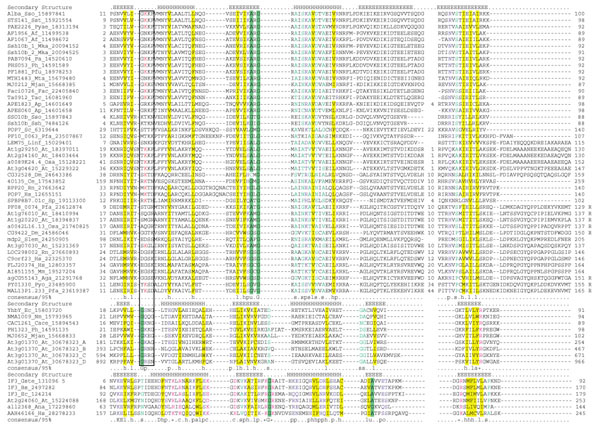
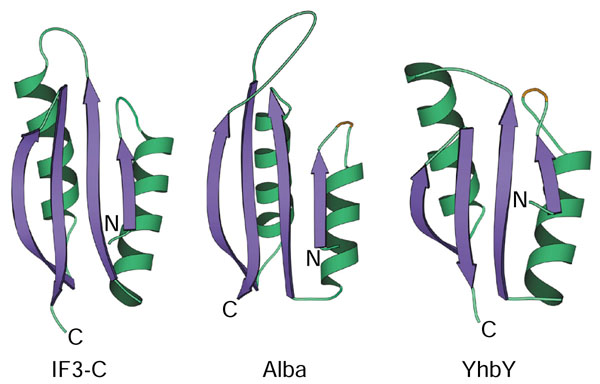
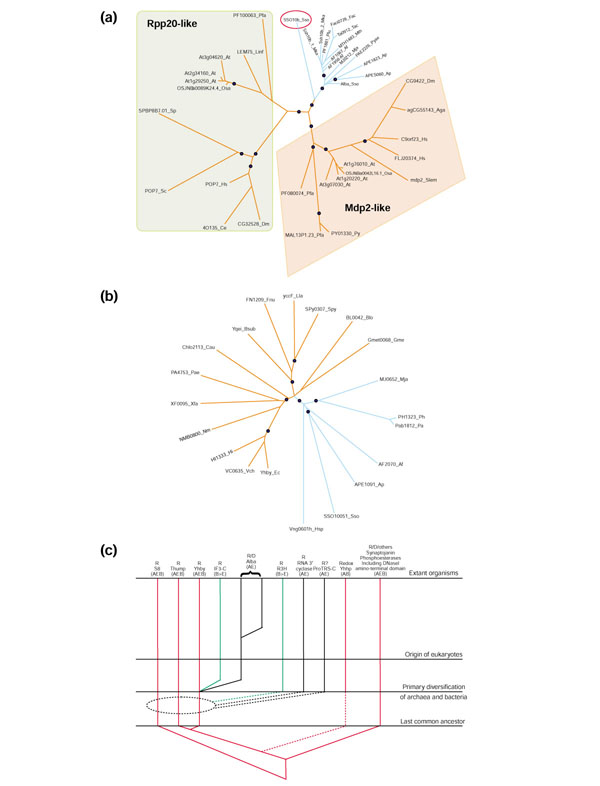
Using sequence-profile searches, we were able to unify the Alba proteins with RNase P/MRP subunit Rpp20/Pop7, human RNase P subunit Rpp25, and the ciliate Mdp2 protein, which is implicated in macronuclear development. The Alba superfamily contains two eukaryote-specific families and one archaeal family. We present different lines of evidence to show that both eukaryotic families perform functions related to RNA metabolism. Several members of one of the eukaryotic families, typified by Mdp2, are combined in the same polypeptide with RNA-binding RGG repeats. We also investigated the relationships of the unified Alba superfamily within the ancient RNA-binding IF3-C fold, and show that it is most closely related to other RNA-binding members of this fold, such as the YhbY and IF3-C superfamilies. Based on phyletic patterns and the principle of phylogenetic bracketing, we predict that at least some of the archaeal members may also possess a role in RNA metabolism.
The Alba superfamily proteins appear to have originated as RNA-binding proteins which formed various ribonucleoprotein complexes, probably including RNase P. It was recruited as a chromosomal protein possibly only within the crenarchaeal lineage. The evolutionary connections reported here suggest how a diversity of functions based on a common biochemical basis emerged in proteins of the Alba superfamily.
古菌中主要染色体DNA结合蛋白的系统发育模式存在相当大的异质性。阿尔巴蛋白(Alba)是一种来自泉古菌属嗜硫叶菌(Sulfolobus)的特征明确的染色体蛋白。虽然在大多数古菌和一些真核生物类群中都检测到了阿尔巴蛋白,但其在这些类群中的具体功能尚不清楚。在这里,我们使用比较基因组学和序列谱分析来预测阿尔巴蛋白的潜在替代功能。
通过序列谱搜索,我们能够将阿尔巴蛋白与核糖核酸酶P/MRP亚基Rpp20/Pop7、人类核糖核酸酶P亚基Rpp25以及与大核发育有关的纤毛虫Mdp2蛋白统一起来。阿尔巴超家族包含两个真核生物特有的家族和一个古菌家族。我们提供了不同的证据表明这两个真核生物家族都执行与RNA代谢相关的功能。以Mdp2为代表的一个真核生物家族的几个成员在同一多肽中与RNA结合的RGG重复序列结合。我们还研究了统一的阿尔巴超家族在古老的RNA结合IF3-C折叠中的关系,并表明它与该折叠的其他RNA结合成员,如YhbY和IF3-C超家族关系最为密切。基于系统发育模式和系统发育括号原则,我们预测至少一些古菌成员也可能在RNA代谢中发挥作用。
阿尔巴超家族蛋白似乎起源于RNA结合蛋白,它们形成了各种核糖核蛋白复合物,可能包括核糖核酸酶P。它可能仅在泉古菌谱系中被招募为染色体蛋白。这里报道的进化联系表明了基于共同生化基础的多种功能是如何在阿尔巴超家族蛋白中出现的。