M'ikantha Nkuchia M, Southwell Brian, Lautenbach Ebbing
Pennsylvania Department of Health, Harrisburg 17108, USA.
Emerg Infect Dis. 2003 Sep;9(9):1053-7. doi: 10.3201/eid0909.020486.
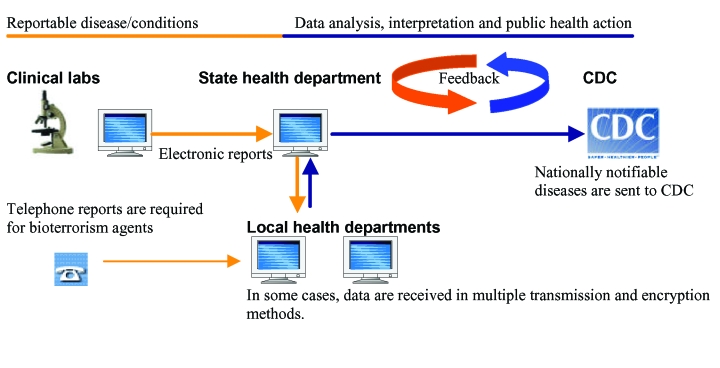
While newly available electronic transmission methods can increase timeliness and completeness of infectious disease reports, limitations of this technology may unintentionally compromise detection of, and response to, bioterrorism and other outbreaks. We reviewed implementation experiences for five electronic laboratory systems and identified problems with data transmission, sensitivity, specificity, and user interpretation. The results suggest a need for backup transmission methods, validation, standards, preserving human judgment in the process, and provider and end-user involvement. As illustrated, challenges encountered in deployment of existing electronic laboratory reporting systems could guide further refinement and advances in infectious disease surveillance.
虽然新出现的电子传输方法可以提高传染病报告的及时性和完整性,但这项技术的局限性可能会无意中影响对生物恐怖主义和其他疫情的检测及应对。我们回顾了五个电子实验室系统的实施经验,并确定了数据传输、敏感性、特异性及用户解读方面的问题。结果表明需要有备用传输方法、验证、标准,在这个过程中保留人为判断,以及让提供者和终端用户参与进来。如图所示,现有电子实验室报告系统在部署过程中遇到的挑战可以为传染病监测的进一步完善和发展提供指导。