Fischer-Stenger K, Marciano-Cabral F
Department of Microbiology and Immunology, Medical College of Virginia, Virginia Commonwealth University, Richmond 23298-0678.
Infect Immun. 1992 Dec;60(12):5126-31. doi: 10.1128/iai.60.12.5126-5131.1992.
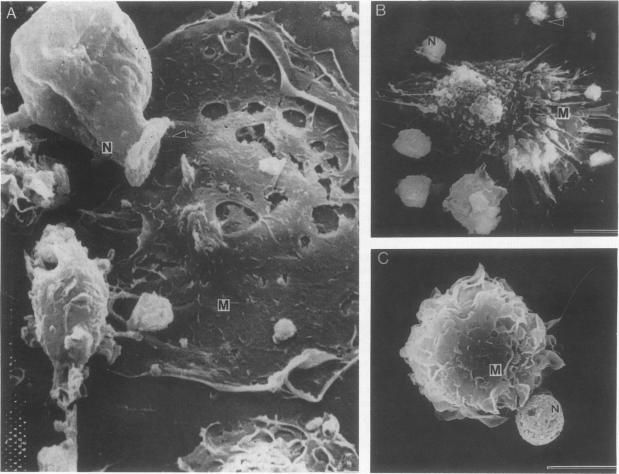
Mouse peritoneal macrophages activated by different immunomodulators (Mycobacterium bovis bacillus Calmette-Guérin or Propionibacterium acnes) destroy Naegleria fowleri amoebae by a contact-dependent process and by soluble cytolytic molecules secreted by macrophages in response to lipopolysaccharide. The goal of this study was to determine whether the arginine-dependent cytolytic mechanism which results in the production of nitric oxide from arginine by activated macrophages destroys the amoebae. Amoebicidal activity of activated macrophages was determined by coculturing macrophages with N. fowleri amoebae radiolabeled with 3H-uridine. The percent specific release of radiolabel was used as an index of cytolysis of the amoebae. The inhibitors NG-monomethyl-L-arginine and arginase were used to determine whether the arginine pathway was a major effector mechanism responsible for amoebicidal activity of activated macrophages. Both the arginine analog NG-monomethyl-L-arginine and arginase, which breaks down arginine, decreased macrophage amoebicidal activity. Addition of arginine to arginine-free medium restores amoebicidal activity to activated macrophage cultures. These results demonstrate that the arginine pathway is an important mechanism for the destruction of susceptible N. fowleri amoebae.
由不同免疫调节剂(卡介苗或痤疮丙酸杆菌)激活的小鼠腹腔巨噬细胞,通过接触依赖性过程以及巨噬细胞响应脂多糖分泌的可溶性溶细胞分子来破坏福氏耐格里阿米巴。本研究的目的是确定激活的巨噬细胞通过依赖精氨酸的溶细胞机制从精氨酸产生一氧化氮是否能破坏阿米巴。通过将巨噬细胞与用³H-尿苷放射性标记的福氏耐格里阿米巴共培养来测定激活的巨噬细胞的杀阿米巴活性。放射性标记的特异性释放百分比用作阿米巴细胞溶解的指标。使用抑制剂NG-单甲基-L-精氨酸和精氨酸酶来确定精氨酸途径是否是激活的巨噬细胞杀阿米巴活性的主要效应机制。精氨酸类似物NG-单甲基-L-精氨酸和分解精氨酸的精氨酸酶均降低了巨噬细胞的杀阿米巴活性。向无精氨酸培养基中添加精氨酸可恢复激活的巨噬细胞培养物的杀阿米巴活性。这些结果表明,精氨酸途径是破坏易感福氏耐格里阿米巴的重要机制。