Blouin Jean-Sébastien, Corbeil Philippe, Teasdale Normand
Université Laval, Division de kinésiologie, Faculté de Médecine, Québec, Canada.
BMC Musculoskelet Disord. 2003 Oct 17;4:23. doi: 10.1186/1471-2474-4-23.
It is now recognized that large diameter myelinated afferents provide the primary source of lower limb proprioceptive information for maintaining an upright standing position. Small diameter afferents transmitting noxious stimuli, however, can also influence motor behaviors. Despite the possible influence of pain on motor behaviors, the effects of pain on the postural control system have not been well documented.
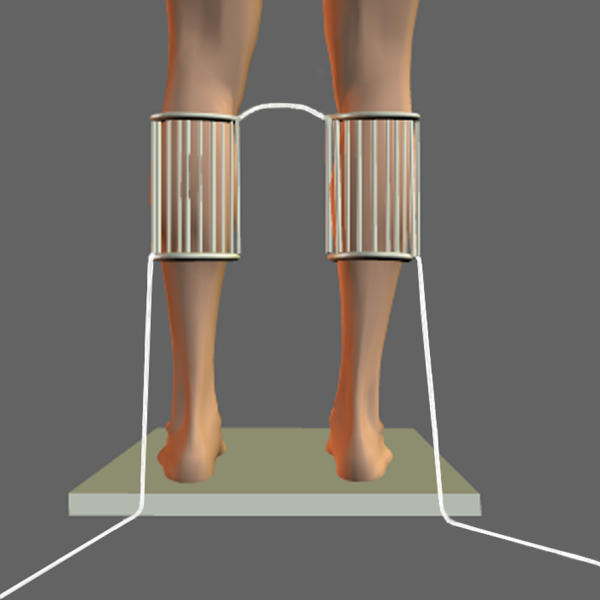
Two cutaneous heat stimulations (experiment 1: non-noxious 40 degrees C; experiment 2: noxious 45 degrees C) were applied bilaterally on the calves of the subject with two thermal grills to stimulate A delta and C warm receptors and nociceptors in order to examine their effects on postural stability. The non-noxious stimulation induced a gentle sensation of warmth and the noxious stimulation induced a perception of heat pain (visual analogue scores of 0 and 46 mm, respectively). For both experiments, ten healthy young adults were tested with and without heat stimulations of the lower limbs while standing upright on a force platform with eyes open, eyes closed and eyes closed with tendon co-vibration of tibialis anterior and triceps surae muscles. The center of pressure displacements were analyzed to examine how both stimulations affected the regulation of quiet standing and if the effects were exacerbated when vision was removed or ankle proprioception perturbed.
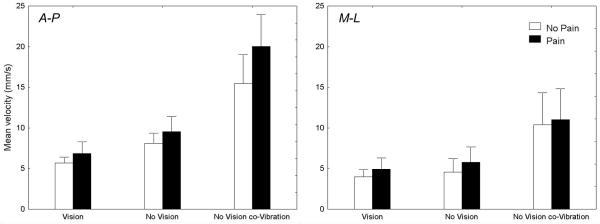
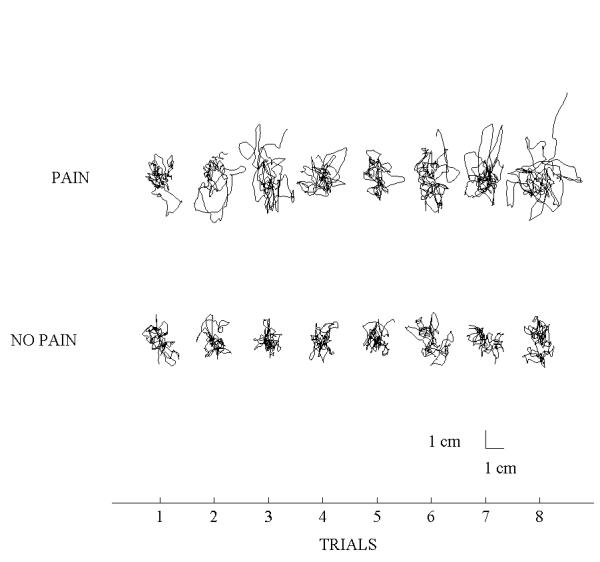
The stimulation of the warm receptors (40 degrees C) did not induce any postural deterioration. With pain (45 degrees C), subjects showed a significant increase in standard deviation, range and mean velocity of postural oscillations as well as standard deviation of the center of pressure velocity. The effects of heat pain were exacerbated when subjects had both their eyes closed and ankle tendons vibrated (increased standard deviation of the center of pressure velocity and mean velocity of the center of pressure).
A non-noxious stimulation (40 degrees C) of the small diameter afferents is not a sufficiently intense sensory stimulation to alter the control of posture. A painful stimulation (45 degrees C) of the skin thermoreceptors, however, yielded a deterioration of the postural control system. The observed deteriorating effects of the combined stimulation of nociceptors and Ia afferents (when ankle tendons were vibrated) could result from the convergence of these afferents at the spinal level. This could certainly lead to the hypothesis that individuals suffering from lower limb pain present alterations of the postural control mechanisms; especially populations already at risk of falling (for example, frail elderly) or populations suffering from concomitant lower limb pain and sensory deficits (for example, diabetic polyneuropathy).
目前已认识到,大直径有髓传入神经是维持直立站立姿势的下肢本体感觉信息的主要来源。然而,传递有害刺激的小直径传入神经也会影响运动行为。尽管疼痛可能对运动行为有影响,但疼痛对姿势控制系统的影响尚未得到充分记录。
使用两个热烤架对受试者的双侧小腿进行两次皮肤热刺激(实验1:无害的40摄氏度;实验2:有害的45摄氏度),以刺激Aδ和C类温觉感受器及伤害感受器,从而检查它们对姿势稳定性的影响。无害刺激引起轻微的温暖感,有害刺激引起热痛觉(视觉模拟评分分别为0和46毫米)。对于这两个实验,10名健康的年轻成年人在睁眼、闭眼以及闭眼同时进行胫骨前肌和腓肠肌肌腱协同振动的情况下,在测力平台上站立时接受或不接受下肢热刺激测试。分析压力中心位移,以检查两种刺激如何影响安静站立的调节,以及当视觉被去除或踝关节本体感觉受到干扰时,这些影响是否会加剧。
温觉感受器刺激(40摄氏度)未引起任何姿势恶化。在疼痛刺激(45摄氏度)下,受试者姿势摆动的标准差、范围和平均速度以及压力中心速度的标准差均显著增加。当受试者闭眼且踝关节肌腱振动时,热痛的影响加剧(压力中心速度的标准差和压力中心平均速度增加)。
小直径传入神经的无害刺激(40摄氏度)强度不足以改变姿势控制。然而,皮肤温度感受器的疼痛刺激(45摄氏度)会导致姿势控制系统恶化。伤害感受器和Ia传入神经联合刺激(当踝关节肌腱振动时)观察到的恶化效应可能是由于这些传入神经在脊髓水平的汇聚。这无疑可以引出这样的假设,即患有下肢疼痛的个体存在姿势控制机制的改变;尤其是那些已经有跌倒风险的人群(例如体弱的老年人)或患有下肢疼痛并伴有感觉缺陷的人群(例如糖尿病性多发性神经病患者)。