Doyen Virginie, Rubio Manuel, Braun Deborah, Nakajima Toshiaru, Abe Jun, Saito Hirohisa, Delespesse Guy, Sarfati Marika
Centre Hospitalier de l'Université de Montréal Research Center, Hospital Notre-Dame, 1560 Sherbrooke Street East, Montreal, Quebec H2L 4M1, Canada.
J Exp Med. 2003 Oct 20;198(8):1277-83. doi: 10.1084/jem.20030705.
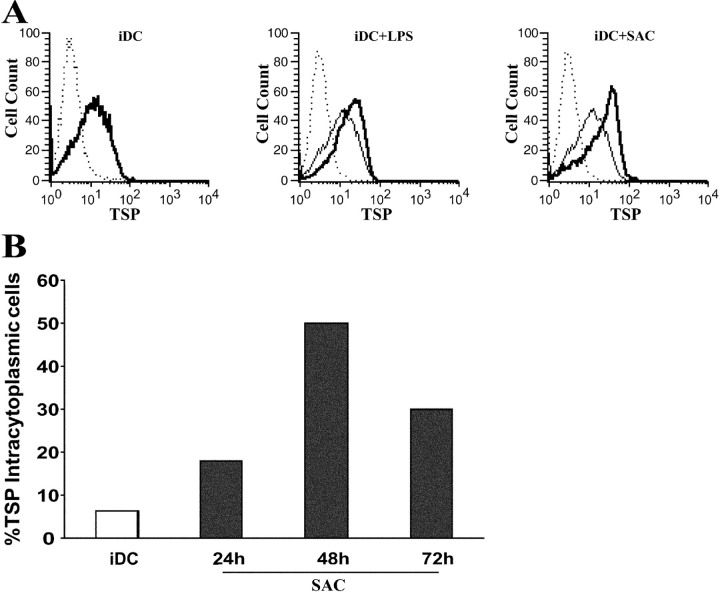
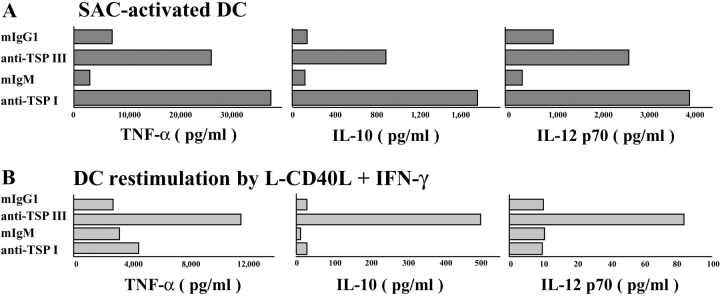
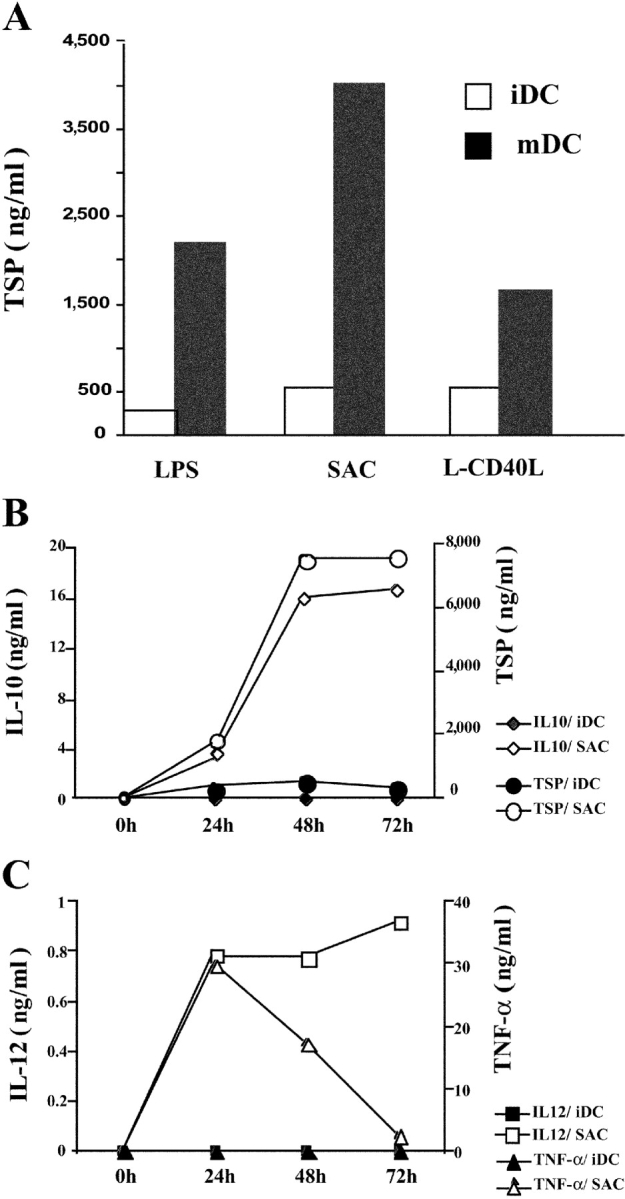
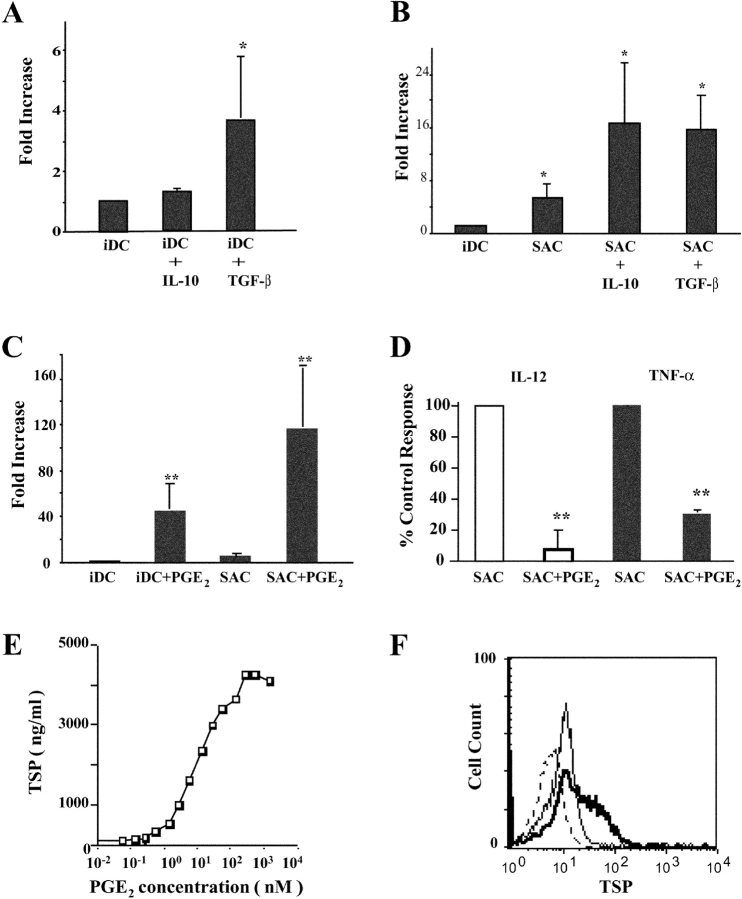
Thrombospondin 1 (TSP) elicits potent antiinflammatory activities in vivo, as evidenced by persistent, multiorgan inflammation in TSP null mice. Herein, we report that DCs represent an abundant source of TSP at steady state and during activation. Human monocyte-derived immature dendritic cells (iDCs) spontaneously produce TSP, which is strongly enhanced by PGE2 and to a lesser extent by transforming growth factor (TGF) beta, two soluble mediators secreted by macrophages after engulfment of damaged tissues. Shortly after activation via danger signals, DCs transiently produce interleukin (IL) 12 and tumor necrosis factor (TNF) alpha, thereby eliciting protective and inflammatory immune responses. Microbial stimuli increase TSP production, which is further enhanced by IL-10 or TGF-beta. The endogenous TSP produced during early DC activation negatively regulates IL-12, TNF-alpha, and IL-10 release through its interactions with CD47 and CD36. After prolonged activation, DCs extinguish their cytokine synthesis and become refractory to subsequent stimulation, thereby favoring the return to steady state. Such "exhausted" DCs continue to release TSP but not IL-10. Disrupting TSP-CD47 interactions during their restimulation restores their cytokine production. We conclude that DC-derived TSP serves as a previously unappreciated negative regulator contributing to arrest of cytokine production, further supporting its fundamental role in vivo in the active resolution of inflammation and maintenance of steady state.
血小板反应蛋白1(TSP)在体内引发强大的抗炎活性,TSP基因敲除小鼠中持续存在的多器官炎症就证明了这一点。在此,我们报告树突状细胞(DCs)在稳态和激活过程中是TSP的丰富来源。人单核细胞来源的未成熟树突状细胞(iDCs)自发产生TSP,巨噬细胞吞噬受损组织后分泌的两种可溶性介质前列腺素E2(PGE2)可强烈增强TSP的产生,转化生长因子(TGF)β在较小程度上也有增强作用。通过危险信号激活后不久,DCs短暂产生白细胞介素(IL)-12和肿瘤坏死因子(TNF)α,从而引发保护性和炎症性免疫反应。微生物刺激会增加TSP的产生,IL-10或TGF-β会进一步增强这种作用。DC早期激活过程中产生的内源性TSP通过与CD47和CD36相互作用,负向调节IL-12、TNF-α和IL-10的释放。长时间激活后,DCs停止细胞因子合成,对后续刺激变得不敏感,从而有利于恢复到稳态。这种“耗竭”的DCs继续释放TSP,但不释放IL-10。在再次刺激过程中破坏TSP-CD47相互作用可恢复其细胞因子产生。我们得出结论,DC来源的TSP作为一种此前未被重视的负调节因子,有助于阻止细胞因子的产生,进一步支持了其在体内炎症主动消退和稳态维持中的重要作用。