Robey R W, Honjo Y, Morisaki K, Nadjem T A, Runge S, Risbood M, Poruchynsky M S, Bates S E
National Institutes of Health, Center for Cancer Research, Cancer Therapeutics Branch, Bethesda, MD 20892, USA.
Br J Cancer. 2003 Nov 17;89(10):1971-8. doi: 10.1038/sj.bjc.6601370.
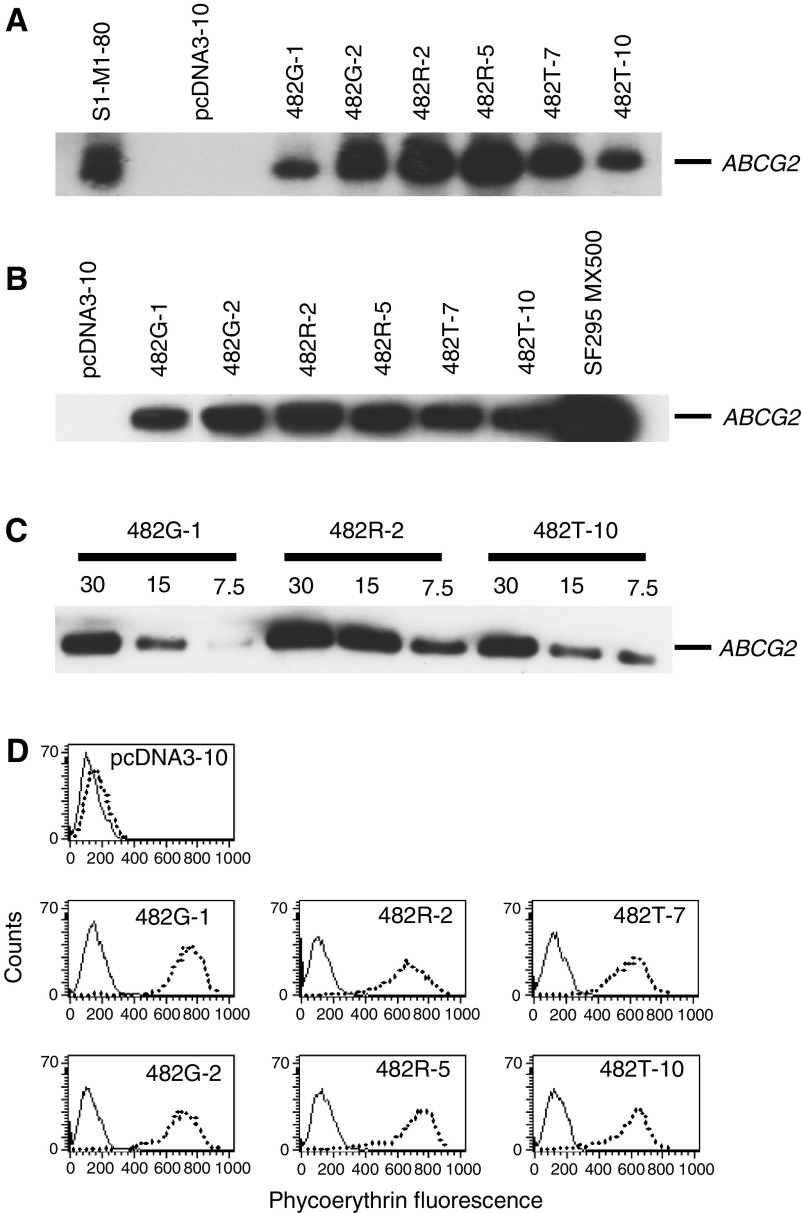
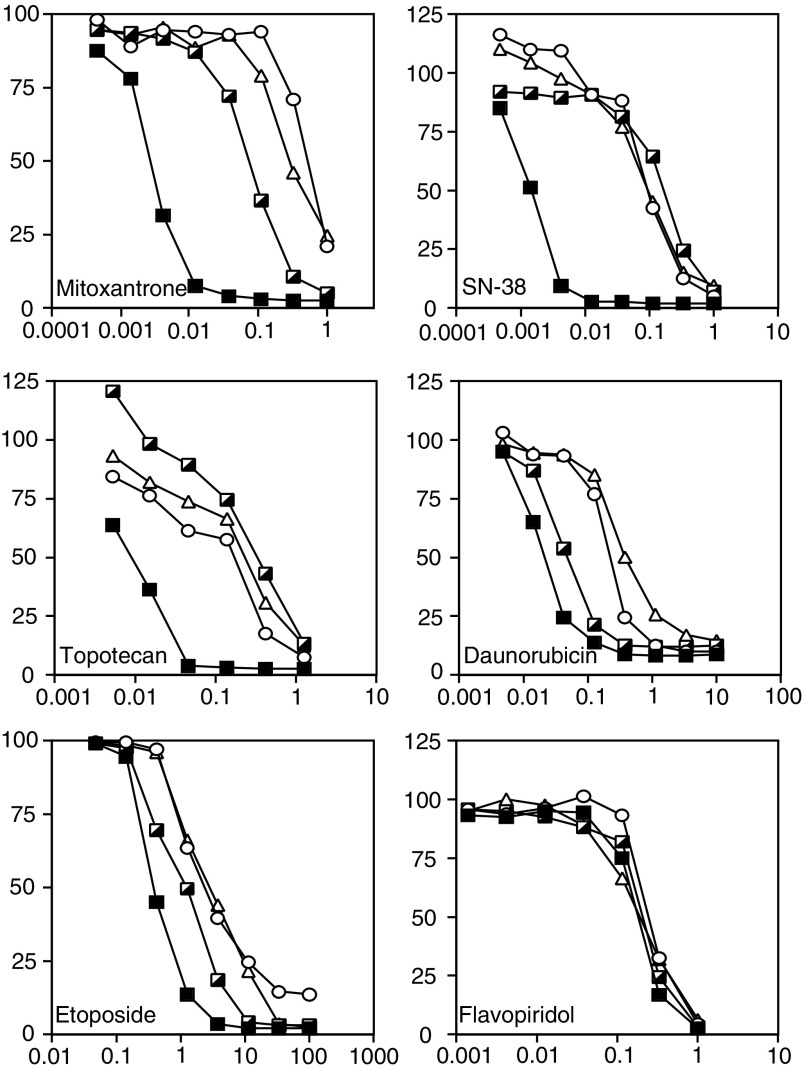
Recent studies have shown that mutations at amino-acid 482 in the ABCG2 gene affect the substrate specificity of the protein. To delineate the effects of these mutations clearly, human embryonic kidney cells (HEK-293) were stably transfected with wild-type 482R or mutant 482G and 482T ABCG2. By flow cytometry, mitoxantrone, BODIPY-prazosin, and Hoechst 33342 were found to be substrates of all ABCG2 proteins, while rhodamine 123, daunorubicin, and LysoTracker Green were transported only by mutant ABCG2. In cytotoxicity assays, all ABCG2 proteins conferred high levels of resistance to mitoxantrone, SN-38, and topotecan, while mutant ABCG2 also exhibited a gain of function for mitoxantrone as they conferred a four-fold greater resistance compared to wild type. Cells transfected with mutant ABCG2 were 13- to 71- fold resistant to the P-glycoprotein substrates doxorubicin, daunorubicin, epirubicin, bisantrene, and rhodamine 123 compared to cells transfected with wild-type ABCG2, which were only three- to four-fold resistant to these compounds. ABCG2 did not confer appreciable resistance to etoposide, taxol or the histone deacetylase inhibitor depsipeptide. None of the transfected cell lines demonstrated resistance to flavopiridol despite our previous observation that ABCG2-overexpressing cell lines are cross-resistant to the drug. Recently reported inhibitors of ABCG2 were evaluated and 50 microM novobiocin was found to reverse wild-type ABCG2 completely, but only reverse mutant ABCG2 partially. The studies presented here serve to underscore the importance of amino-acid 482 in defining the substrate specificity of the ABCG2 protein and raise the possibility that amino-acid 482 mutations in human cancers could affect the clinical application of antagonists for ABCG2.
最近的研究表明,ABCG2基因中第482位氨基酸的突变会影响该蛋白质的底物特异性。为了清楚地描述这些突变的影响,将野生型482R或突变型482G和482T的ABCG2稳定转染到人胚肾细胞(HEK-293)中。通过流式细胞术发现,米托蒽醌、BODIPY-哌唑嗪和Hoechst 33342是所有ABCG2蛋白的底物,而罗丹明123、柔红霉素和溶酶体示踪剂绿色仅由突变型ABCG2转运。在细胞毒性试验中,所有ABCG2蛋白都赋予对米托蒽醌、SN-38和拓扑替康的高水平抗性,而突变型ABCG2对米托蒽醌还表现出功能增强,因为它们赋予的抗性比野生型大四倍。与转染野生型ABCG2的细胞相比,转染突变型ABCG2的细胞对P-糖蛋白底物阿霉素、柔红霉素、表柔比星、比生群和罗丹明123的抗性高13至71倍,而转染野生型ABCG2的细胞对这些化合物的抗性仅为三至四倍。ABCG2对依托泊苷、紫杉醇或组蛋白脱乙酰酶抑制剂缩肽没有明显抗性。尽管我们之前观察到过表达ABCG2的细胞系对该药物有交叉抗性,但所有转染细胞系对黄酮哌啶醇均无抗性。对最近报道的ABCG2抑制剂进行了评估,发现50微摩尔的新生霉素可完全逆转野生型ABCG2,但只能部分逆转突变型ABCG2。此处呈现的研究强调了第482位氨基酸在定义ABCG2蛋白底物特异性方面的重要性,并增加了人类癌症中第482位氨基酸突变可能影响ABCG2拮抗剂临床应用的可能性。