Roth Jacob S, Guo Hui, Chen Lu, Shen Min, Gbadegesin Omotola, Robey Robert W, Gottesman Michael M, Hall Matthew D
National Center for Advancing Translational Sciences, National Institutes of Health, Rockville MD.
Laboratory of Cell Biology, National Cancer Institute, National Institutes of Health, Bethesda, MD, U.S.A.
bioRxiv. 2025 May 27:2025.05.22.651305. doi: 10.1101/2025.05.22.651305.
Antibody-drug conjugates (ADCs) are a form of targeted chemotherapy featuring an antibody recognizing a specific protein on cancer cells joined to a potent toxic payload. Numerous antibody-drug conjugates have received FDA approval; however, clinical resistance arises commonly in tumors. Resistance mechanisms include decreased expression or mutation of the antibody target, failure to release the payload from the ADC, or increased expression of ATP-binding cassette (ABC) efflux transporters associated with multidrug resistance. We therefore sought to characterize the interactions of ABC multidrug transporters with ADC payloads.
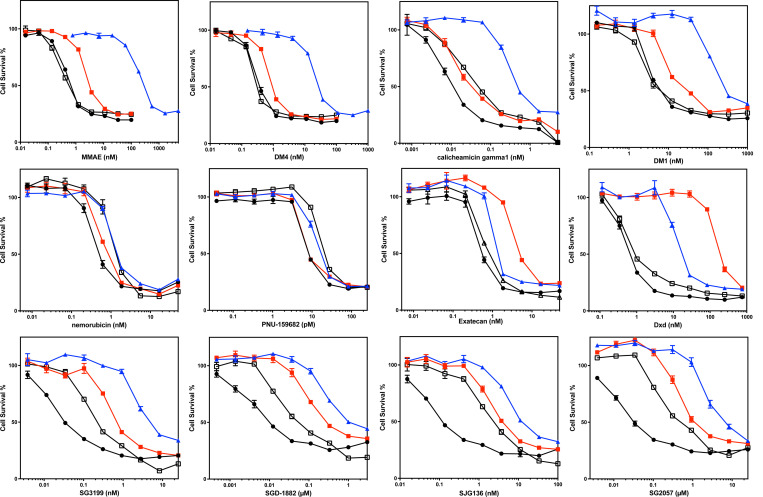
We performed a high-throughput screen with 27 common ADC payloads using cells lines expressing ABC transporters P-glycoprotein (P-gp, encoded by ) or ABCG2 (encoded by ). Confirmatory assays were also performed using cells transfected to express P-gp, ABCG2, or MRP1 (encoded by ).
Several commonly used ADC payloads were found to be avid substrates of P-gp, including calicheamicin gamma1, monomethyl auristatin E, DM1, and DM4. All the pyrrolobenzodiazepines tested - SJG136, SGD-1882, SG2057, and SG3199 - were substrates of P-gp, ABCG2, and MRP1. The modified anthracyclines nemorubicin and its metabolite PNU-159682 were poorly transported by both ABCB1 and ABCG2 and displayed nanomolar to picomolar toxicity. Further, we found that the efficacy of the recently FDA-approved ADC mirvetuximab soravtansine, which has DM4 as the toxic payload, was decreased in cell lines with overexpression of P-gp.
Several commonly used ADC payloads can be effluxed from cells by ABC transporters which may lead to transporter-mediated drug resistance in patients. Future ADCs should be developed using payloads that are not substrates of ABC transporters.
抗体药物偶联物(ADCs)是一种靶向化疗形式,其特征在于一种识别癌细胞上特定蛋白质的抗体与一种强效毒性载荷相连。许多抗体药物偶联物已获得美国食品药品监督管理局(FDA)批准;然而,肿瘤中通常会出现临床耐药性。耐药机制包括抗体靶点的表达降低或突变、无法从ADC释放载荷,或与多药耐药相关的ATP结合盒(ABC)外排转运蛋白的表达增加。因此,我们试图表征ABC多药转运蛋白与ADC载荷之间的相互作用。
我们使用表达ABC转运蛋白P-糖蛋白(P-gp,由 编码)或ABCG2(由 编码)的细胞系,对27种常见的ADC载荷进行了高通量筛选。还使用转染以表达P-gp、ABCG2或MRP1(由 编码)的细胞进行了确证试验。
发现几种常用的ADC载荷是P-gp的有效底物,包括加利车霉素γ1、单甲基奥瑞他汀E、DM1和DM4。所有测试的吡咯并苯二氮卓类药物——SJG136、SGD-1882、SG2057和SG3199——都是P-gp、ABCG2和MRP1的底物。修饰的蒽环类药物奈莫柔比星及其代谢产物PNU-159682在ABCB1和ABCG2中转运不佳,并表现出纳摩尔至皮摩尔的毒性。此外,我们发现最近获得FDA批准的以DM4为毒性载荷的ADC mirvetuximab soravtansine在P-gp过表达的细胞系中的疗效降低。
几种常用的ADC载荷可被ABC转运蛋白从细胞中外排,这可能导致患者出现转运蛋白介导的耐药性。未来应使用不是ABC转运蛋白底物的载荷来开发ADC。