Mietz J A, Unger T, Huibregtse J M, Howley P M
Laboratory of Tumor Virus Biology, National Cancer Institute, Bethesda, MD 20892.
EMBO J. 1992 Dec;11(13):5013-20. doi: 10.1002/j.1460-2075.1992.tb05608.x.
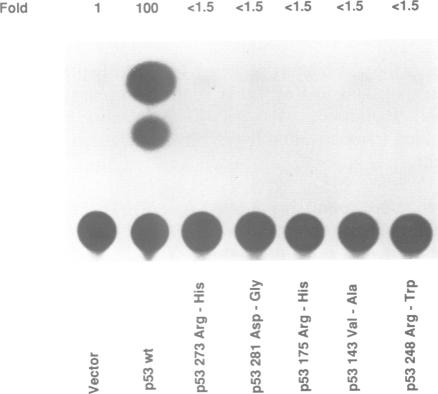
The observed interaction between p53 and the oncoproteins encoded by several DNA tumor viruses suggests that these viruses mediate their transforming activities at least in part by altering the normal growth regulatory function of p53. In this study we examined the effect of viral oncoprotein expression on the transcriptional transactivation function of wild-type p53 in human cells. Plasmids expressing human p53 were cotransfected with either SV40 large T-antigen or human papillomavirus (HPV) type 16 E6 expression plasmids and assayed for transactivation function using a reporter gene driven by a p53-responsive promoter containing multiple copies of the consensus p53 DNA binding motif, TGCCT. Both large T-antigen and E6 were able to inhibit transactivation by wild-type p53. Furthermore, SV40 T-antigen mutants that are defective for p53 binding were not able to inhibit transactivation and HPV E6 proteins that were either mutant or derived from non-oncogenic HPV types and unable to bind p53, had no effect on p53 transactivation. These results demonstrate the physiological relevance of the interaction of SV40 T-antigen and HPV E6 oncoproteins with p53 in vivo and suggest that the transforming functions of these viral oncoproteins may be linked to their ability to inhibit p53-mediated transcriptional activation.
p53与几种DNA肿瘤病毒编码的癌蛋白之间存在明显的相互作用,这表明这些病毒至少部分地通过改变p53的正常生长调节功能来介导其转化活性。在本研究中,我们检测了病毒癌蛋白表达对人细胞中野生型p53转录反式激活功能的影响。将表达人p53的质粒与SV40大T抗原或人乳头瘤病毒(HPV)16型E6表达质粒共转染,并使用由含有多个共有p53 DNA结合基序TGCCT的p53反应性启动子驱动的报告基因检测反式激活功能。大T抗原和E6均能抑制野生型p53的反式激活。此外,对p53结合有缺陷的SV40 T抗原突变体不能抑制反式激活,而突变的或源自非致癌HPV类型且不能结合p53的HPV E6蛋白对p53反式激活没有影响。这些结果证明了SV40 T抗原和HPV E6癌蛋白在体内与p53相互作用的生理相关性,并表明这些病毒癌蛋白的转化功能可能与其抑制p53介导的转录激活的能力有关。