Fox C A, Sheets M D, Wahle E, Wickens M
Department of Biochemistry, University of Wisconsin, Madison 53706.
EMBO J. 1992 Dec;11(13):5021-32. doi: 10.1002/j.1460-2075.1992.tb05609.x.
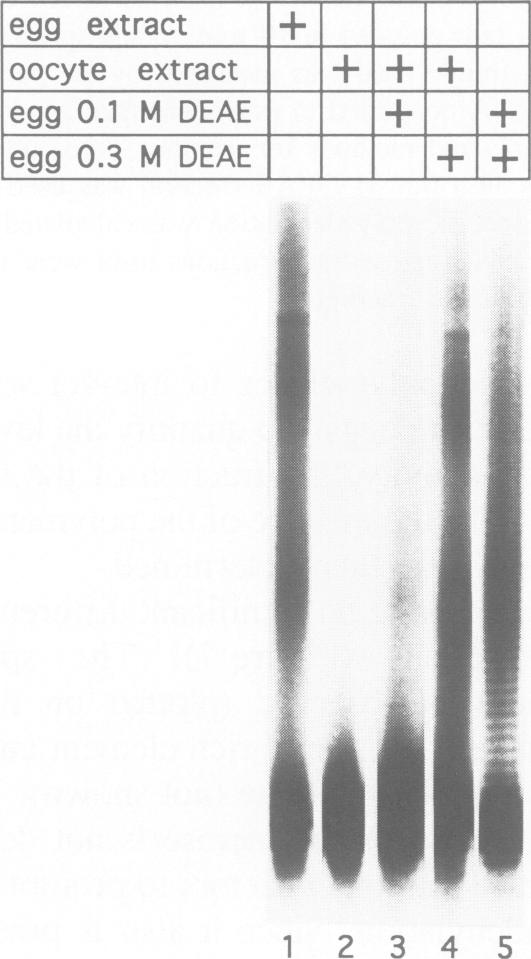
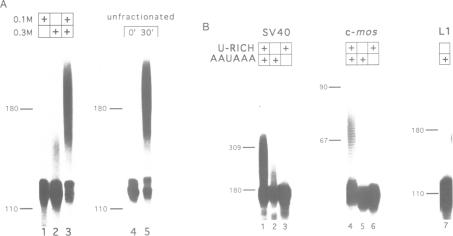
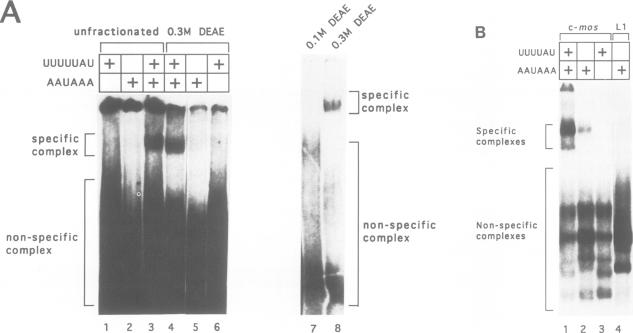
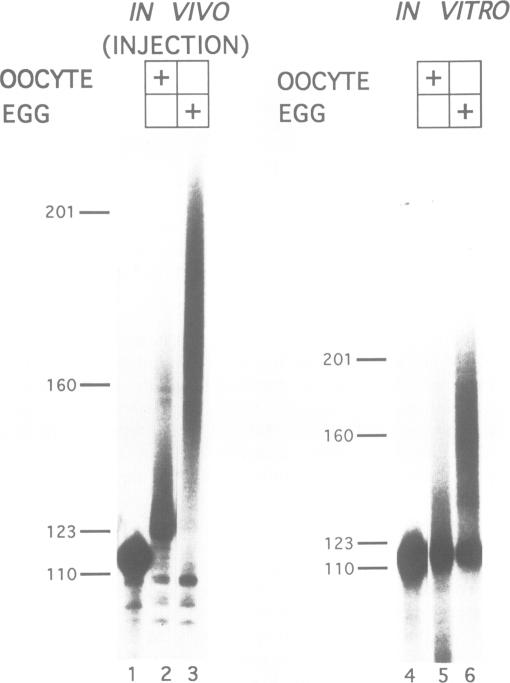
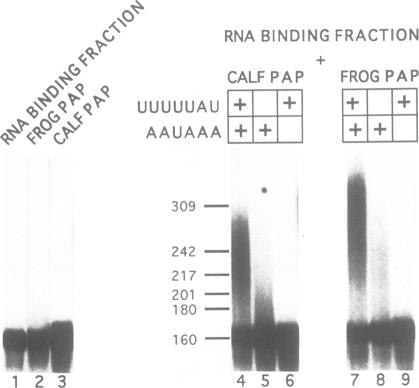
Specific maternal mRNAs receive poly(A) during early development as a means of translational regulation. In this report, we investigated the mechanism and control of poly(A) addition during frog oocyte maturation, in which oocytes advance from first to second meiosis becoming eggs. We analyzed polyadenylation in vitro in oocyte and egg extracts. In vivo, polyadenylation during maturation requires AAUAAA and a U-rich element. The same sequences are required for polyadenylation in egg extracts in vitro. The in vitro reaction requires at least two separable components: a poly(A) polymerase and an RNA binding activity with specificity for AAUAAA and the U-rich element. The poly(A) polymerase is similar to nuclear poly(A) polymerases in mammalian cells. Through a 2000-fold partial purification, the frog egg and mammalian enzymes were found to be very similar. More importantly, a purified calf thymus poly(A) polymerase acquired the sequence specificity seen during frog oocyte maturation when mixed with the frog egg RNA binding fraction, demonstrating the interchangeability of the two enzymes. To determine how polyadenylation is activated during maturation, we compared polymerase and RNA binding activities in oocyte and egg extracts. Although oocyte extracts were much less active in maturation-specific polyadenylation, they contained nearly as much poly(A) polymerase activity. In contrast, the RNA binding activity differed dramatically in oocyte and egg extracts: oocyte extracts contained less binding activity and the activity that was present exhibited an altered mobility in gel retardation assays. Finally, we demonstrate that components present in the RNA binding fraction are rate-limiting in the oocyte extract, suggesting that fraction contains the target that is activated by progesterone treatment. This target may be the RNA binding activity itself. We propose that in spite of the many biological differences between them, nuclear polyadenylation and cytoplasmic polyadenylation during early development may be catalyzed by similar, or even identical, components.
特定的母体mRNA在早期发育过程中会添加多聚腺苷酸(poly(A)),作为一种翻译调控手段。在本报告中,我们研究了蛙卵母细胞成熟过程中多聚腺苷酸化的机制和调控,在此过程中,卵母细胞从第一次减数分裂推进到第二次减数分裂,从而变成卵子。我们分析了卵母细胞和卵子提取物中的体外多聚腺苷酸化情况。在体内,成熟过程中的多聚腺苷酸化需要AAUAAA和一个富含U的元件。体外卵子提取物中的多聚腺苷酸化也需要相同的序列。体外反应至少需要两个可分离的成分:一种多聚(A)聚合酶和一种对AAUAAA及富含U的元件具有特异性的RNA结合活性。这种多聚(A)聚合酶与哺乳动物细胞中的核多聚(A)聚合酶相似。通过2000倍的部分纯化,发现蛙卵和哺乳动物的酶非常相似。更重要的是,当与蛙卵RNA结合部分混合时,纯化的小牛胸腺多聚(A)聚合酶获得了蛙卵母细胞成熟过程中所见的序列特异性,这表明这两种酶具有互换性。为了确定成熟过程中多聚腺苷酸化是如何被激活的,我们比较了卵母细胞和卵子提取物中的聚合酶和RNA结合活性。尽管卵母细胞提取物在成熟特异性多聚腺苷酸化方面活性低得多,但它们所含的多聚(A)聚合酶活性几乎相同。相反,卵母细胞和卵子提取物中的RNA结合活性差异很大:卵母细胞提取物中的结合活性较低,且存在的活性在凝胶阻滞试验中显示出迁移率改变。最后,我们证明RNA结合部分中的成分在卵母细胞提取物中是限速的,这表明该部分含有被孕酮处理激活的靶点。这个靶点可能就是RNA结合活性本身。我们提出,尽管早期发育过程中的核多聚腺苷酸化和细胞质多聚腺苷酸化在生物学上存在许多差异,但它们可能由相似甚至相同的成分催化。