Rodrigues R F, Roque L, Rosa-Santos J, Cid O, Soares J
Cytogenetic Laboratory, CIPM, Portuguese Cancer Institute, R. Prof Lima Basto 1099-023, Lisbon, Portugal.
Br J Cancer. 2004 Jan 26;90(2):492-6. doi: 10.1038/sj.bjc.6601530.
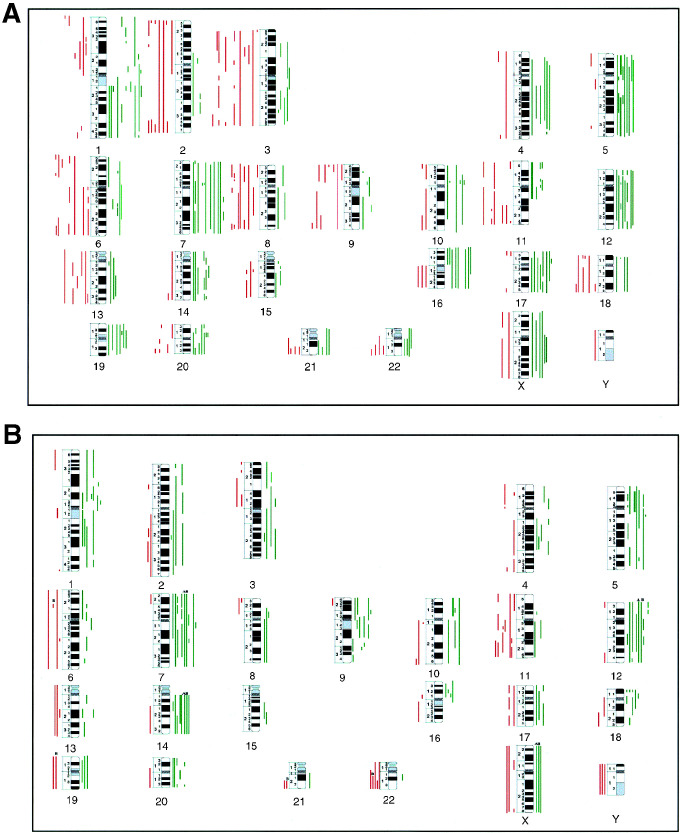
The genetic alterations that underlie the progression of follicular thyroid carcinoma towards anaplasia are still largely uncharacterised. We compared the Comparative Genomic Hybridization (CGH) profiles of 20 follicular (FTCs), 12 poorly differentiated (PDTCs) and seven anaplastic thyroid carcinomas (ATCs), in order to identify the chromosomal imbalances potentially associated with cancer progression. We found: (i) when considering that a 'direct' transformation of FTC towards anaplasia occurs, the defined significantly important alterations were the increase of gains at 3q (P<0.05) and 20q (P<0.01), and the increase of losses at 7q (P<0.05) and Xp (P<0.01); (ii) regarding poorly differentiated carcinomas as an intermediate independent entity in the anaplastic transformation of follicular cancers, evidenced as important alterations towards anaplasia, were the proportional decrease in copy sequences at 7p, 7q, 12q and 13q resulting from the significant decrease of DNA gains at 7p and 12q (P<0.05), and the significant increase of losses at 7q and 13q (P<0.05). These results unveil the chromosomal regions where genes of interest in thyroid anaplastic transformation are to be located, and demonstrate that different gene dosage copy sequence imbalances are associated to the 'direct' pathway of transformation of follicular into anaplastic cancers and to the progressive FTC --> PDTC --> ATC pathway.
滤泡状甲状腺癌向未分化癌进展的潜在基因改变在很大程度上仍未明确。我们比较了20例滤泡状癌(FTC)、12例低分化癌(PDTC)和7例未分化甲状腺癌(ATC)的比较基因组杂交(CGH)图谱,以确定可能与癌症进展相关的染色体失衡。我们发现:(i)若认为FTC向未分化癌发生“直接”转变,明确的显著重要改变是3q(P<0.05)和20q(P<0.01)的增益增加,以及7q(P<0.05)和Xp(P<0.01)的缺失增加;(ii)将低分化癌视为滤泡状癌未分化转变中的一个中间独立实体,作为向未分化癌转变的重要改变,是7p、7q、12q和13q的拷贝序列比例下降,这是由于7p和12q的DNA增益显著减少(P<0.05),以及7q和13q的缺失显著增加(P<0.05)。这些结果揭示了甲状腺未分化转变中相关基因所在的染色体区域,并表明不同的基因剂量拷贝序列失衡与滤泡状癌向未分化癌的“直接”转变途径以及渐进性的FTC→PDTC→ATC途径相关。