Gilad Yoav, Przeworski Molly, Lancet Doron
Max Planck Institute for Evolutionary Anthropology, Leipzig, Germany.
PLoS Biol. 2004 Jan;2(1):E5. doi: 10.1371/journal.pbio.0020005. Epub 2004 Jan 20.
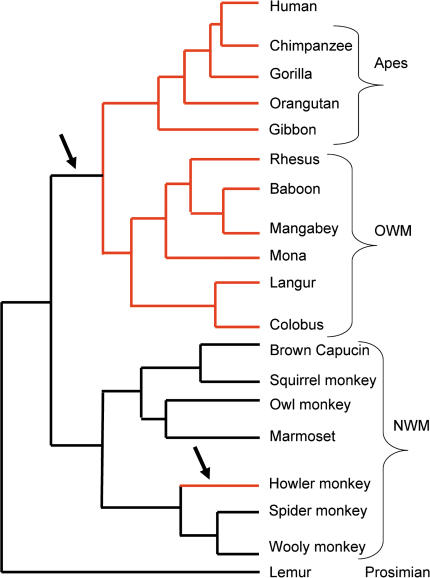
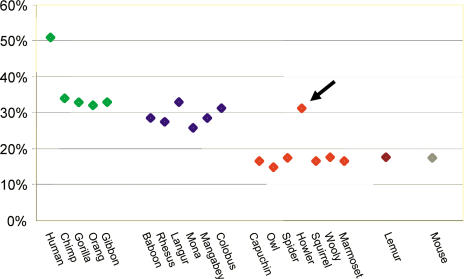
Olfactory receptor (OR) genes constitute the molecular basis for the sense of smell and are encoded by the largest gene family in mammalian genomes. Previous studies suggested that the proportion of pseudogenes in the OR gene family is significantly larger in humans than in other apes and significantly larger in apes than in the mouse. To investigate the process of degeneration of the olfactory repertoire in primates, we estimated the proportion of OR pseudogenes in 19 primate species by surveying randomly chosen subsets of 100 OR genes from each species. We find that apes, Old World monkeys and one New World monkey, the howler monkey, have a significantly higher proportion of OR pseudogenes than do other New World monkeys or the lemur (a prosimian). Strikingly, the howler monkey is also the only New World monkey to possess full trichromatic vision, along with Old World monkeys and apes. Our findings suggest that the deterioration of the olfactory repertoire occurred concomitant with the acquisition of full trichromatic color vision in primates.
嗅觉受体(OR)基因构成了嗅觉的分子基础,并且由哺乳动物基因组中最大的基因家族编码。先前的研究表明,OR基因家族中假基因的比例在人类中比在其他猿类中显著更大,在猿类中比在小鼠中显著更大。为了研究灵长类动物嗅觉功能退化的过程,我们通过调查从每个物种中随机选择的100个OR基因子集,估算了19种灵长类动物中OR假基因的比例。我们发现,猿类、旧世界猴以及一种新世界猴——吼猴,其OR假基因的比例显著高于其他新世界猴或狐猴(一种原猴亚目动物)。引人注目的是,吼猴也是唯一拥有与旧世界猴和猿类一样的全色盲视觉的新世界猴。我们的研究结果表明,灵长类动物嗅觉功能的退化与全色盲视觉的获得是同时发生的。