Marjon Philip L, Bobrovnikova-Marjon Ekaterina V, Abcouwer Steve F
University of New Mexico, School of Medicine, Department of Biochemistry and Molecular Biology, Albuquerque, NM 87131, USA.
Mol Cancer. 2004 Jan 22;3:4. doi: 10.1186/1476-4598-3-4.
The expression of pro-angiogenic cytokines, such as vascular endothelial growth factor (VEGF) and interleukin-8/CXCL8 (IL-8), plays an important role in tumor growth and metastasis. Low oxygen tension within poorly-vascularized tumors is thought to be the prime stimulus causing the secretion of VEGF. The expression of IL-8 by solid tumors is thought to be primarily due to intrinsic influences, such as constitutive activation of nuclear factor kappa B (NF-kappaB). However, VEGF expression is responsive to glucose deprivation, suggesting that low concentrations of nutrients other than oxygen may play a role in triggering the pro-angiogenic phenotype. Glucose deprivation causes endoplasmic reticulum (ER) stress and alters gene expression through the unfolded protein response (UPR) signaling pathway. A branch of the UPR, known as the ER overload response (EOR), can cause NF-kappaB activation. Thus, we hypothesized that treatments that cause ER stress and deprivation of other nutrients, such as amino acids, would trigger the expression of angiogenic cytokines by breast cancer cell lines.
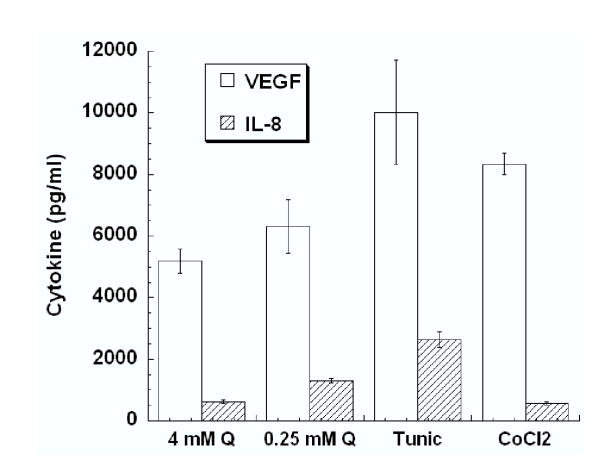
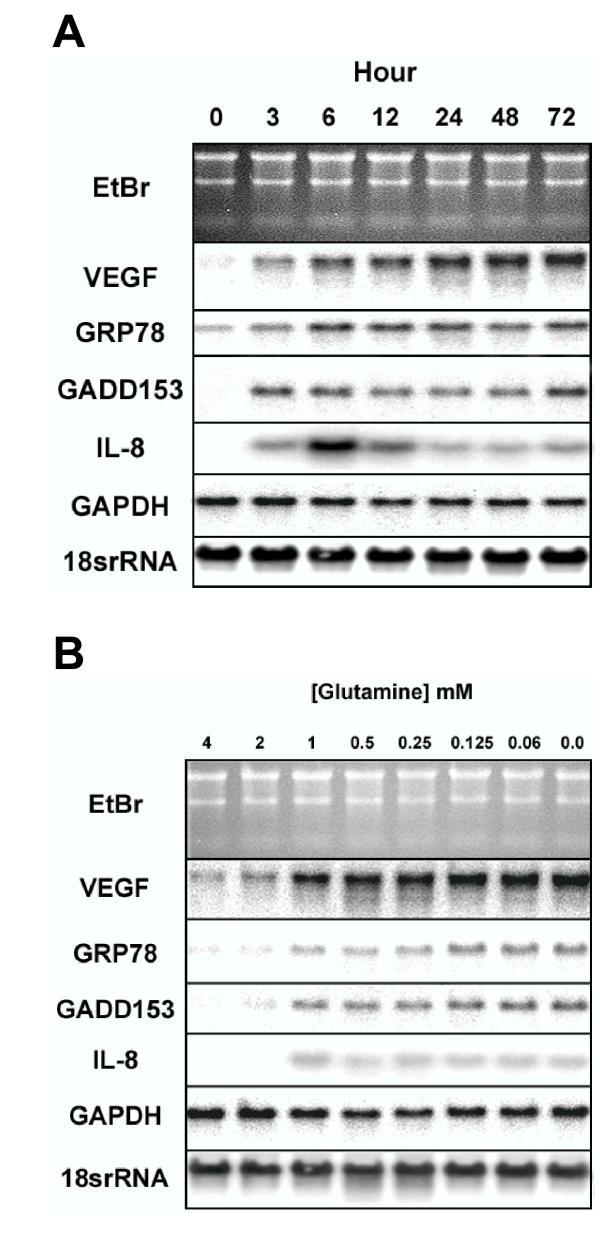
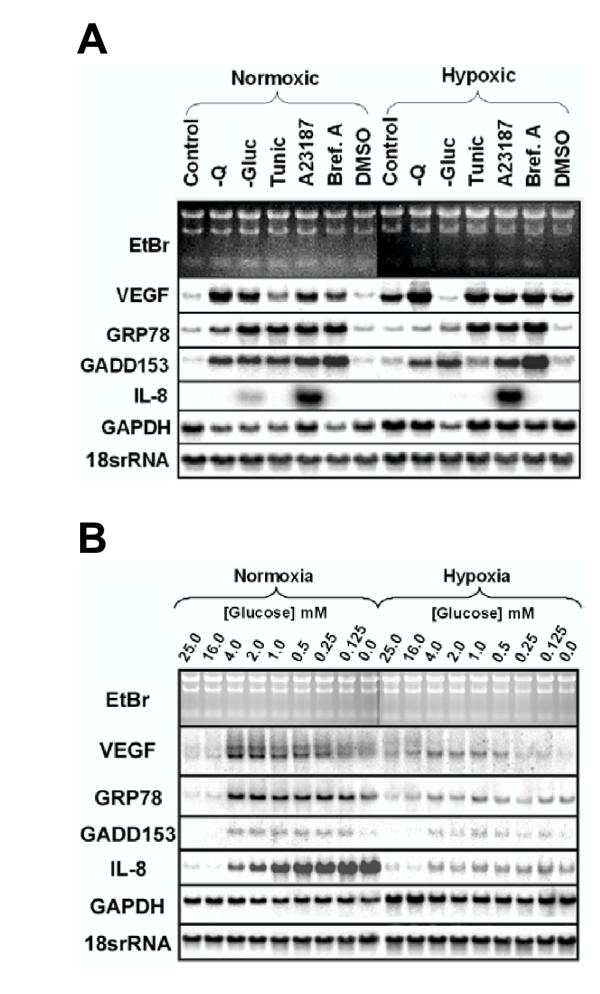
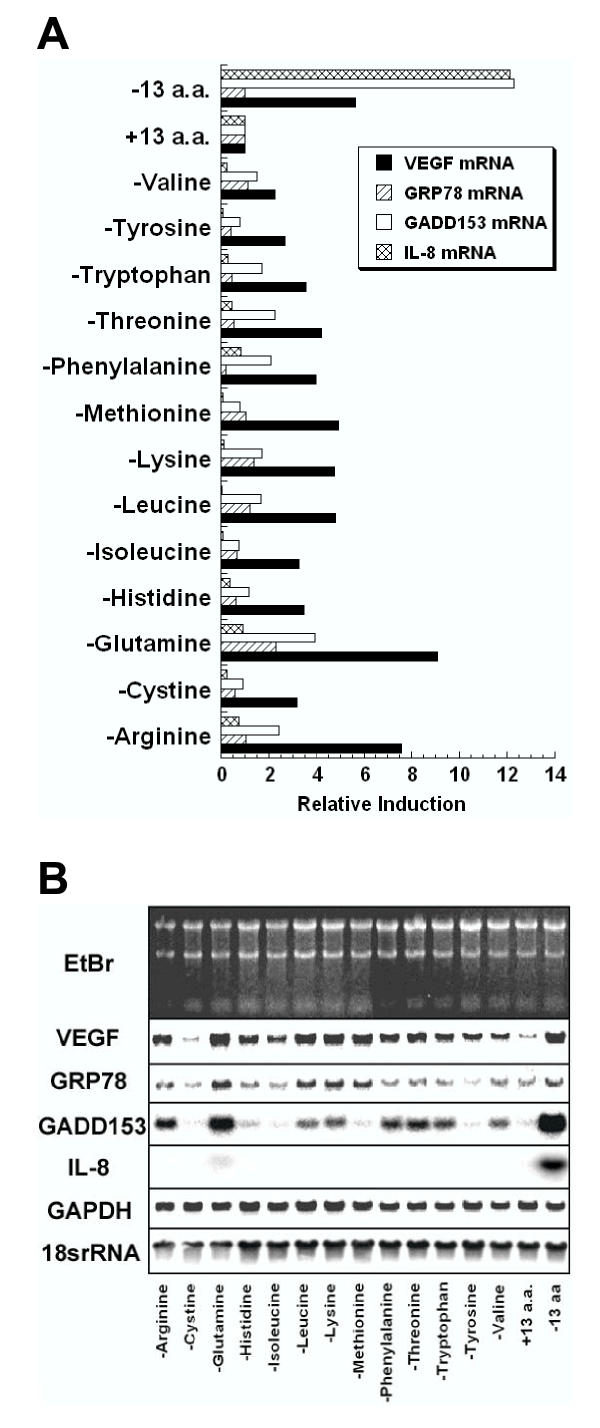
We found that glutamine deprivation and treatment with a chemical inducer of ER stress (tunicamycin) caused a marked induction of the secretion of both VEGF and IL-8 protein by a human breast adenocarcinoma cell line (TSE cells). Glutamine deprivation, glucose deprivation and several chemical inducers of ER stress increased VEGF and IL-8 mRNA expression in TSE and other breast cancer cell lines cultured under both normoxic and hypoxic conditions, though hypoxia generally diminished the effects of glucose deprivation. Of all amino acids tested, ambient glutamine availability had the largest effect on VEGF and IL-8 mRNA expression. The induction of VEGF mRNA expression, but not IL-8, was sustained and closely corresponded with the upregulated expression of the ER stress-responsive genes glucose-regulated protein 78 (GRP78) and growth arrest and DNA damage inducible gene 153 (GADD153).
These results suggest that nutrient deprivation within the solid tumor microenvironment might contribute to the activation of a pro-angiogenic phenotype. The angiogenic switch may act to increase blood supply in response to nutrient deprivation as well as hypoxia.
促血管生成细胞因子的表达,如血管内皮生长因子(VEGF)和白细胞介素-8/CXCL8(IL-8),在肿瘤生长和转移中起重要作用。血管生成不良的肿瘤内低氧张力被认为是导致VEGF分泌的主要刺激因素。实体瘤中IL-8的表达被认为主要是由于内在影响,如核因子κB(NF-κB)的组成性激活。然而,VEGF表达对葡萄糖剥夺有反应,这表明除氧气外的低浓度营养物质可能在触发促血管生成表型中起作用。葡萄糖剥夺会导致内质网(ER)应激,并通过未折叠蛋白反应(UPR)信号通路改变基因表达。UPR的一个分支,即内质网过载反应(EOR),可导致NF-κB激活。因此,我们假设导致ER应激和剥夺其他营养物质(如氨基酸)的处理会触发乳腺癌细胞系中血管生成细胞因子的表达。
我们发现谷氨酰胺剥夺和用ER应激化学诱导剂(衣霉素)处理会导致人乳腺腺癌细胞系(TSE细胞)中VEGF和IL-8蛋白分泌显著增加。谷氨酰胺剥夺、葡萄糖剥夺和几种ER应激化学诱导剂增加了在常氧和低氧条件下培养的TSE细胞系和其他乳腺癌细胞系中VEGF和IL-8 mRNA的表达,尽管低氧通常会减弱葡萄糖剥夺的作用。在所有测试的氨基酸中,环境中谷氨酰胺的可用性对VEGF和IL-8 mRNA表达的影响最大。VEGF mRNA表达的诱导是持续的,且与ER应激反应基因葡萄糖调节蛋白78(GRP78)和生长停滞及DNA损伤诱导基因153(GADD153)的上调表达密切相关,但IL-8的诱导并非如此。
这些结果表明实体瘤微环境中的营养剥夺可能有助于促血管生成表型的激活。血管生成开关可能会对营养剥夺以及低氧作出反应,增加血液供应。