Scheungraber C, Kleekamp N, Schneider A
Department of Obstetrics and Gynecology, Friedrich Schiller University, Jena, Germany.
Br J Cancer. 2004 Mar 8;90(5):975-8. doi: 10.1038/sj.bjc.6601415.
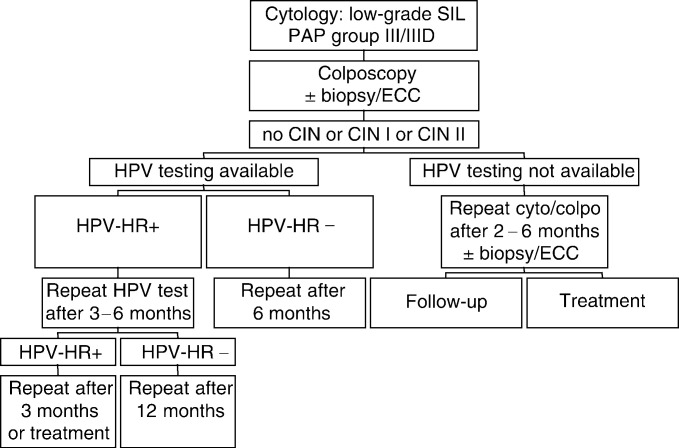
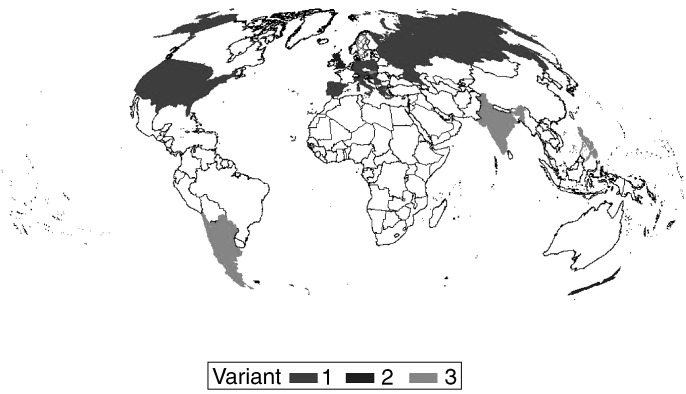
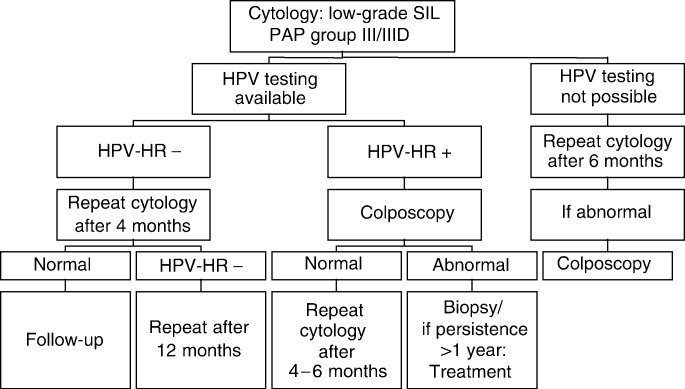
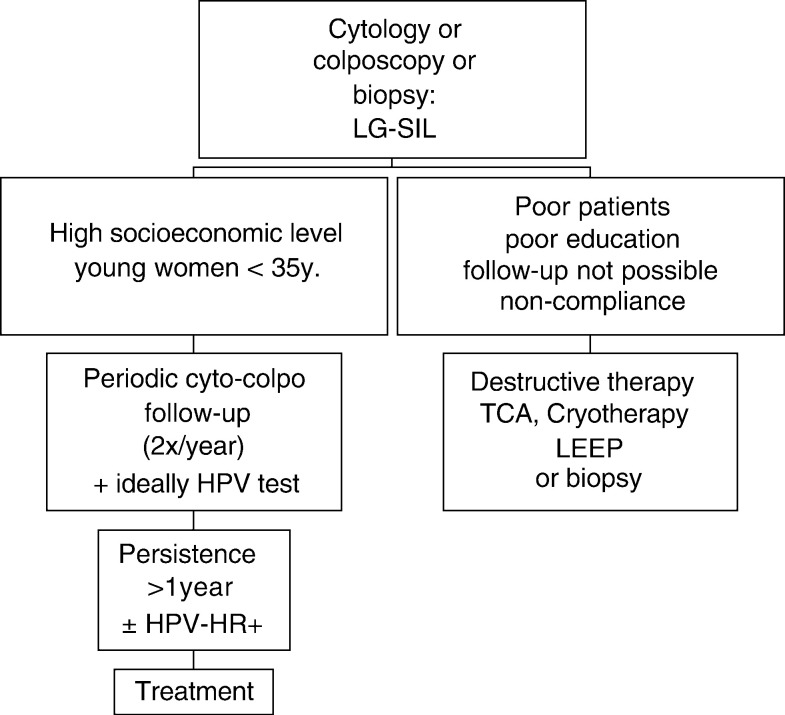
Strategies of management for low-grade squamous intraepithelial lesion (SIL) vary even on a national level. We evaluated the diversity of management algorithms. This should serve as a source to find a common basis for the management of low-grade SIL. A total of 38 representatives and specialists for colposcopy and cervical pathology were contacted to provide national guidelines, recommendations or consensus for the management of patients diagnosed with the cytologic diagnosis of low-grade SIL. In all, 23 addressees (60%) responded. The algorithms provided varied considerably. Three variants of algorithms could be defined. Variant 1 was proposed in 14 countries and recommended colposcopy immediately after cytologic diagnosis of low-grade SIL or at the same time the smear is taken. If available, HPV testing was recommended as a triage option in some countries. Variant 2 is used in three countries and colposcopy is only performed after a repeated abnormal cytologic result within a 6-month interval or after an optional test positive for high-risk HPV. Variant 3, as proposed in six countries, takes into account the socio-economic status of the patient: In patients with poor compliance, 'see and treat' management is recommended; in patients where compliance can be assured, follow-up is carried out by cytology and colposcopy. Global policy of management of patients with low-grade SIL can be summarised in three algorithms. Quality standards and outcome parameters must be defined in order to improve the management of women with low-grade SIL.
低级别鳞状上皮内病变(SIL)的管理策略即使在国家层面也存在差异。我们评估了管理算法的多样性。这应作为为低级别SIL管理找到共同基础的一个来源。我们联系了总共38位阴道镜检查和宫颈病理学方面的代表及专家,以获取关于诊断为低级别SIL细胞学诊断患者管理的国家指南、建议或共识。总共有23位收件人(60%)做出了回应。所提供的算法差异很大。可以定义三种算法变体。14个国家提出了变体1,建议在低级别SIL细胞学诊断后立即或在采集涂片的同时进行阴道镜检查。在一些国家,如果可行,建议将HPV检测作为一种分流选择。变体2在三个国家使用,仅在6个月内重复出现异常细胞学结果或高危HPV选择性检测呈阳性后才进行阴道镜检查。六个国家提出的变体3考虑了患者的社会经济状况:对于依从性差的患者,建议采用“即诊即治”管理;对于能够确保依从性的患者,通过细胞学和阴道镜检查进行随访。低级别SIL患者的全球管理策略可归纳为三种算法。必须定义质量标准和结果参数,以改善对低级别SIL女性的管理。