Akabayashi Akira, Slingsby Brian T, Kai Ichiro, Nishimura Tadashi, Yamagishi Akiko
Department of Biomedical Ethics, School of Health Science and Nursing, University of Tokyo Graduate School of Medicine, 7-3-1 Hongo, Bunkyo-ku, Tokyo 113-0033, Japan.
BMC Med Ethics. 2004 Jan 29;5:E1. doi: 10.1186/1472-6939-5-1.
Most medical schools in Japan have incorporated mandatory courses on medical ethics. To this date, however, there is no established means of evaluating medical ethics education in Japan. This study looks 1) To develop a brief, objective method of evaluation for moral sensitivity and reasoning; 2) To conduct a test battery for the PIT and the DIT on medical students who are either currently in school or who have recently graduated (residents); 3) To investigate changes in moral sensitivity and reasoning between school years among medical students and residents.
Questionnaire survey: Two questionnaires were employed, the Problem Identification Test (PIT) for evaluation of moral sensitivity and a portion of the Defining Issues Test (DIT) for moral reasoning. Subjects consisted of 559 medical school students and 272 residents who recently graduated from the same medical school located in an urban area of Japan.
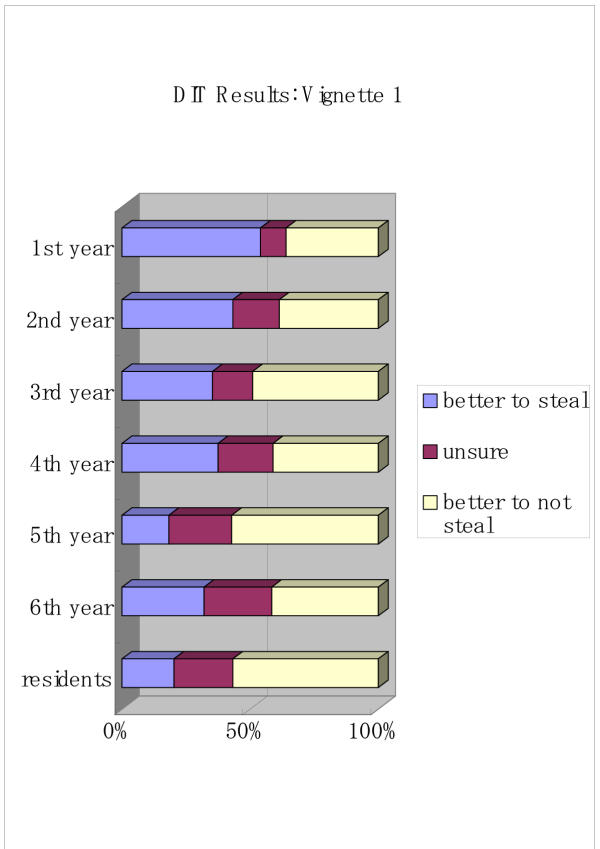
PIT results showed an increase in moral sensitivity in 4th and 5th year students followed by a decrease in 6th year students and in residents. No change in moral development stage was observed. However, DIT results described a gradual rising shift in moral decision-making concerning euthanasia between school years. No valid correlation was observed between PIT and DIT questionnaires.
This study's questionnaire survey, which incorporates both PIT and DIT, could be used as a brief and objective means of evaluating medical students' moral sensitivity and reasoning in Japan.
日本的大多数医学院校都开设了医学伦理学必修课。然而,迄今为止,日本尚无评估医学伦理学教育的既定方法。本研究旨在:1)开发一种简短、客观的道德敏感性和推理能力评估方法;2)对在校或刚毕业的医学生(住院医师)进行道德问题识别测试(PIT)和界定问题测试(DIT)的综合测试;3)调查医学生和住院医师在不同学年之间道德敏感性和推理能力的变化。
问卷调查:采用了两份问卷,即用于评估道德敏感性的道德问题识别测试(PIT)和用于道德推理的界定问题测试(DIT)的一部分。研究对象包括559名医学生和272名刚从位于日本城市地区的同一所医学院毕业的住院医师。
PIT结果显示,四年级和五年级学生的道德敏感性有所提高,而六年级学生和住院医师的道德敏感性则有所下降。道德发展阶段未观察到变化。然而,DIT结果表明,不同学年之间在安乐死道德决策方面呈逐渐上升趋势。PIT和DIT问卷之间未观察到有效相关性。
本研究的问卷调查,包括PIT和DIT,可以作为评估日本医学生道德敏感性和推理能力的一种简短、客观的方法。