Orth K, Madison E L, Gething M J, Sambrook J F, Herz J
Department of Biochemistry, University of Texas Southwestern Medical Center, Dallas 75235.
Proc Natl Acad Sci U S A. 1992 Aug 15;89(16):7422-6. doi: 10.1073/pnas.89.16.7422.
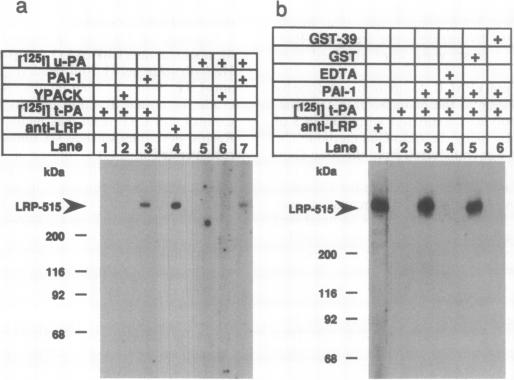
Tissue-type plasminogen activator and urokinase are serine proteases secreted by many cell types that participate in biological processes, such as tissue restructuring, cell migration, and tumor metastasis. Clinically, these proteases are used to dissolve coronary fibrin clots that are the proximal causes of acute myocardial infarction. In vivo, the activity of these enzymes is controlled by plasminogen-activator inhibitors, members of the serpin family of protease inhibitors. This study shows that tissue-type plasminogen activator-inhibitor complexes bind in solution to low density lipoprotein receptor-related protein (LRP), a large heterodimeric ubiquitous membrane receptor. In cultured cells, endocytosis and degradation of these complexes is reduced by polyclonal antibodies directed against LRP and inhibited by a M(r) 39,000 protein that binds to LRP and inhibits its interaction with previously known ligands, including apolipoprotein E and alpha 2-macroglobulin. We propose a role for LRP in the clearance of plasminogen activator-inhibitor complexes that is analogous to its function in the endocytosis of alpha 2-macroglobulin-protease complexes.
组织型纤溶酶原激活剂和尿激酶是由多种细胞类型分泌的丝氨酸蛋白酶,它们参与组织重塑、细胞迁移和肿瘤转移等生物学过程。临床上,这些蛋白酶用于溶解作为急性心肌梗死近端病因的冠状动脉纤维蛋白凝块。在体内,这些酶的活性受纤溶酶原激活剂抑制剂控制,后者是丝氨酸蛋白酶抑制剂丝氨酸蛋白酶抑制剂家族的成员。本研究表明,组织型纤溶酶原激活剂-抑制剂复合物在溶液中与低密度脂蛋白受体相关蛋白(LRP)结合,LRP是一种大型异源二聚体普遍存在的膜受体。在培养细胞中,针对LRP的多克隆抗体可减少这些复合物的内吞作用和降解,一种分子量为39000的蛋白质可抑制其与LRP的结合,并抑制其与包括载脂蛋白E和α2-巨球蛋白在内的先前已知配体的相互作用。我们提出LRP在纤溶酶原激活剂-抑制剂复合物清除中的作用类似于其在α2-巨球蛋白-蛋白酶复合物内吞作用中的功能。