Sacco Maria Grazia, Amicone Laura, Catò Enrica Mira, Filippini Daniela, Vezzoni Paolo, Tripodi Marco
Human Genome Department, Istituto di Tecnologie Biomediche-National Research Council, Segrate, Milano, Italy.
BMC Biotechnol. 2004 Mar 19;4:5. doi: 10.1186/1472-6750-4-5.
Primary hepatocytes, one of the most widely used cell types for toxicological studies, have a very limited life span and must be freshly derived from mice or even humans. Attempts to use stable cell lines maintaining the enzymatic pattern of liver cells have been so far unsatisfactory. Stress proteins (heat shock proteins, HSPs) have been proposed as general markers of cellular injury and their use for environmental monitoring has been suggested. The aim of this work is to develop a bi-transgenic hepatocyte cell line in order to evaluate the ability of various organic and inorganic chemicals to induce the expression of the HSP70 driven reporter gene. We previously described transgenic mice (Hsp70/hGH) secreting high levels of human Growth Hormone (hGH) following exposure to toxic compounds in vivo and in vitro in primary cultures derived from different organs. In addition, we also reported another transgenic model (AT/cytoMet) allowing the reproducible immortalization of untransformed hepatocytes retaining in vitro complex liver functions.
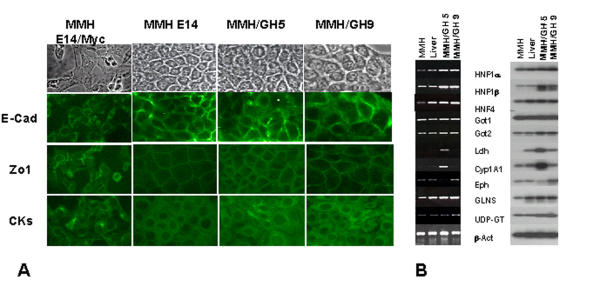
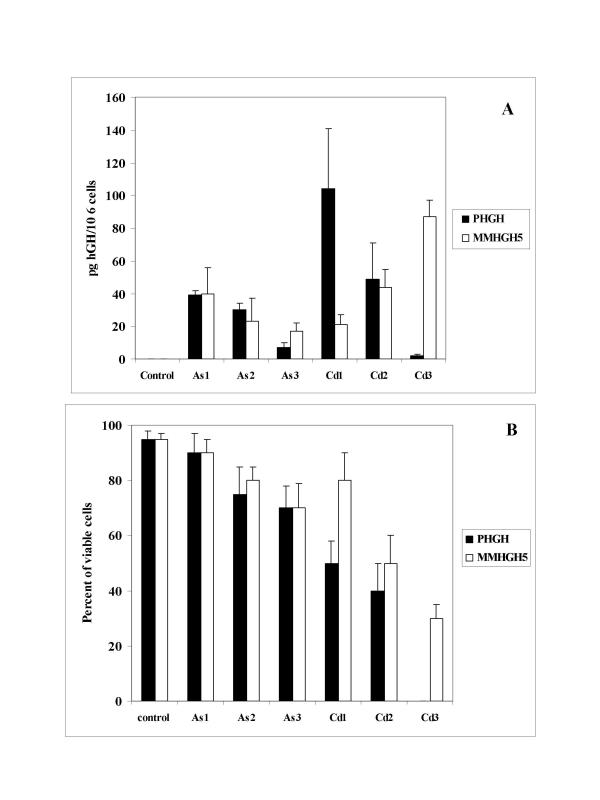
The transgenic mouse line Hsp70/hGH was crossed with the AT/cytoMet transgenic strain permitting the reproducible immortalization of untransformed hepatocytes. From double transgenic animals we derived several stable hepatic cell lines (MMH-GH) which showed a highly-differentiated phenotype as judged from the retention of epithelial cell polarity and the profile of gene expression, including hepatocyte-enriched transcription factors and detoxifying enzymes. In these cell lines, stresses induced by exposure to inorganic [Sodium Arsenite (NaAsO2) and Cadmium Chloride (CdCl2)], and organic [Benzo(a)Pyrene (BaP), PentaChloroPhenol (PCP), TetraChloroHydroQuinone (TCHQ), 1-Chloro-2,4-DiNitro-Benzene (CDNB)] compounds, specifically induced hGH release in the culture medium.
MMH-GH, an innovative model to evaluate the toxic potential of chemical and physical xenobiotics, provides a simple biological system that may reduce the need for animal experimentation and/or continuously deriving fresh hepatocytes.
原代肝细胞是毒理学研究中使用最广泛的细胞类型之一,但其寿命非常有限,必须从小鼠甚至人类新鲜获取。到目前为止,尝试使用维持肝细胞酶模式的稳定细胞系并不令人满意。应激蛋白(热休克蛋白,HSPs)已被提议作为细胞损伤的通用标志物,并有人建议将其用于环境监测。这项工作的目的是开发一种双转基因肝细胞系,以评估各种有机和无机化学物质诱导HSP70驱动的报告基因表达的能力。我们之前描述了转基因小鼠(Hsp70/hGH),其在体内和体外不同器官来源的原代培养物中暴露于有毒化合物后会分泌高水平的人类生长激素(hGH)。此外,我们还报道了另一种转基因模型(AT/cytoMet),它能使未转化的肝细胞可重复永生化,并保留体外复杂的肝功能。
转基因小鼠品系Hsp70/hGH与AT/cytoMet转基因品系杂交,后者能使未转化的肝细胞可重复永生化。我们从双转基因动物中获得了几个稳定的肝细胞系(MMH-GH),从上皮细胞极性的保留和基因表达谱(包括富含肝细胞的转录因子和解毒酶)来看,这些细胞系表现出高度分化的表型。在这些细胞系中,暴露于无机化合物[亚砷酸钠(NaAsO2)和氯化镉(CdCl2)]以及有机化合物[苯并(a)芘(BaP)、五氯苯酚(PCP)、四氯对苯二酚(TCHQ)1-氯-2,4-二硝基苯(CDNB)]所诱导的应激,会特异性地诱导培养基中hGH的释放。
MMH-GH是一种评估化学和物理异源生物毒性潜力的创新模型,它提供了一个简单的生物系统,可能会减少动物实验和/或持续获取新鲜肝细胞的需求。