Nembaware Victoria, Seoighe Cathal, Sayed Muhammed, Gehring Chris
South African National Bioinformatics Institute, Private Bag X17, Bellville, 7535, South Africa.
BMC Evol Biol. 2004 Mar 24;4:10. doi: 10.1186/1471-2148-4-10.
Plant natriuretic peptides (PNPs) are systemically mobile molecules that regulate homeostasis at nanomolar concentrations. PNPs are up-regulated under conditions of osmotic stress and PNP-dependent processes include changes in ion transport and increases of H2O uptake into protoplasts and whole tissue.
The bacterial citrus pathogen Xanthomonas axonopodis pv. Citri str. 306 contains a gene encoding a PNP-like protein. We hypothesise that this bacterial protein can alter plant cell homeostasis and thus is likely to represent an example of molecular mimicry that enables the pathogen to manipulate plant responses in order to bring about conditions favourable to the pathogen such as the induced plant tissue hyper-hydration seen in the wet edged lesions associated with Xanthomonas axonopodis infection.
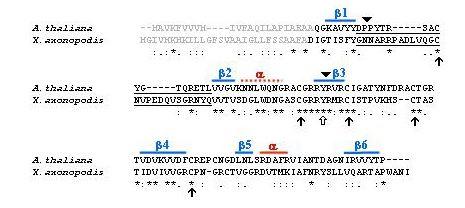
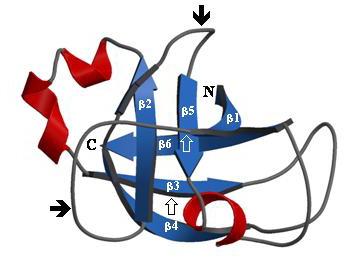
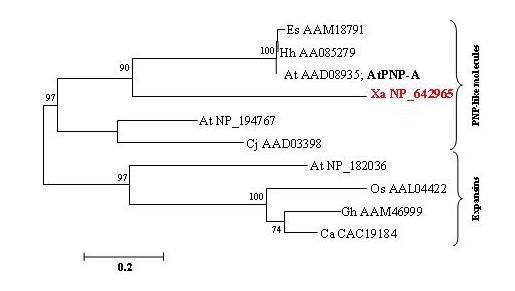
We found a Xanthomonas axonopodis PNP-like protein that shares significant sequence similarity and identical domain organisation with PNPs. We also observed a significant excess of conserved residues between the two proteins within the domain previously identified as being sufficient to induce biological activity. Structural modelling predicts identical six stranded double-psi beta barrel folds for both proteins thus supporting the hypothesis of similar modes of action. No significant similarity between the Xanthomonas axonopodis protein and other bacterial proteins from GenBank was found. Sequence similarity of the Xanthomonas axonopodis PNP-like protein with the Arabidopsis thaliana PNP (AtPNP-A), shared domain organisation and incongruent phylogeny suggest that the PNP-gene may have been acquired by the bacteria in an ancient lateral gene transfer event. Finally, activity of a recombinant Xanthomonas axonopodis protein in plant tissue and changes in symptoms induced by a Xanthomonas axonopodis mutant with a knocked-out PNP-like gene will be experimental proof of molecular mimicry.
If the hypothesis is true, it could at least in part explain why the citrus pathogen Xanthomonas campestris that does not contain a PNP-like gene produces dry corky lesions while the closely related Xanthomonas axonopodis forms lesions with wet edges. It also suggests that genes typically found in the host, horizontally transferred or heterologous, can help to explain aspects of the physiology of the host-pathogen interactions.
植物利尿钠肽(PNPs)是可在体内移动的分子,能在纳摩尔浓度下调节体内平衡。在渗透胁迫条件下,PNPs会上调,且依赖PNP的过程包括离子运输的变化以及原生质体和整个组织对水吸收的增加。
柑橘类细菌病原体野油菜黄单胞菌柑橘致病变种306菌株含有一个编码类PNP蛋白的基因。我们推测这种细菌蛋白可改变植物细胞的体内平衡,因此可能是分子模拟的一个例子,使病原体能够操控植物反应,从而营造有利于病原体的条件,比如在与野油菜黄单胞菌感染相关的湿边病斑中观察到的诱导植物组织过度水合。
我们发现了一种野油菜黄单胞菌类PNP蛋白,它与PNPs具有显著的序列相似性和相同的结构域组织。我们还观察到,在先前确定足以诱导生物活性的结构域内,这两种蛋白质之间存在大量保守残基。结构建模预测这两种蛋白质具有相同的六链双ψβ桶状折叠,从而支持了相似作用模式的假说。未发现野油菜黄单胞菌蛋白与GenBank中的其他细菌蛋白有显著相似性。野油菜黄单胞菌类PNP蛋白与拟南芥PNP(AtPNP-A)序列相似、结构域组织相同但系统发育不一致,这表明PNP基因可能是细菌在古代横向基因转移事件中获得的。最后,重组野油菜黄单胞菌蛋白在植物组织中的活性以及敲除类PNP基因的野油菜黄单胞菌突变体诱导的症状变化将作为分子模拟的实验证据。
如果该假说成立,至少可以部分解释为何不含类PNP基因的柑橘病原体野油菜黄单胞菌会产生干燥的木栓化病斑,而与之密切相关的野油菜黄单胞菌却形成有湿边的病斑。这也表明,通常存在于宿主中的基因,无论是水平转移的还是异源的,都有助于解释宿主-病原体相互作用的生理学方面。