Schramm Christoph, Kriegsmann Jörg, Protschka Martina, Huber Samuel, Hansen Torsten, Schmitt Edgar, Galle Peter Robert, Blessing Manfred
I, Medizinische Klinik, Johannes Gutenberg-Universität Mainz, Mainz, Germany.
Arthritis Res Ther. 2004;6(2):R114-9. doi: 10.1186/ar1039. Epub 2004 Jan 8.
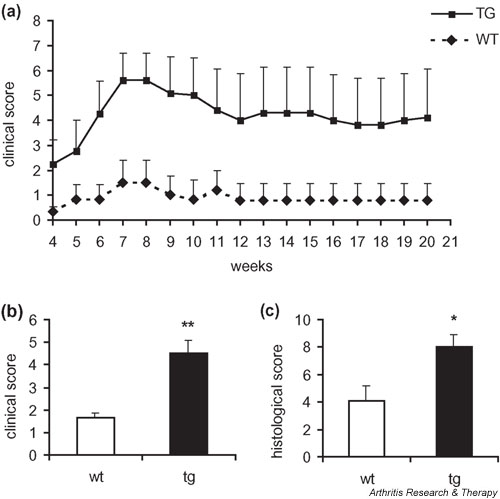
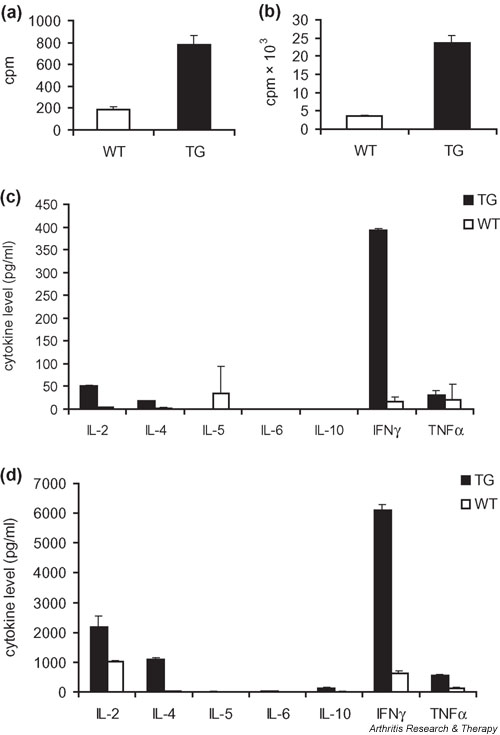
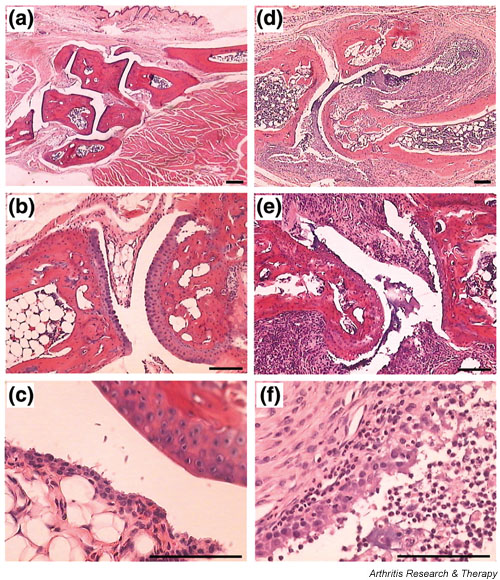
The objective of our study was to determine the regulatory effects that endogenous transforming growth factor beta (TGFbeta) exerts on T cells in the pathogenesis of collagen-induced arthritis (CIA). CIA was induced in transgenic mice expressing a dominant negative TGFbeta type II receptor in T cells under the control of the human CD2 promoter. Clinical and histological arthritis scores were determined and experiments on disease induction and the healing phase of disease were performed. The proliferation and cytokine production of draining lymph node cells in vitro were analyzed. Transgenic mice were more susceptible to induction of CIA. The overall incidence was higher in transgenic mice than in wild-type mice (57% vs 35%, P < 0.05). Affected transgenic animals displayed a significantly higher clinical (4.5 +/- 0.6 vs 1.67 +/- 0.19, P = 0.001) and histological arthritis score (8.01 +/- 0.9 vs 4.06 +/- 1.1, P < 0.05). Draining lymph node cells of transgenic mice secreted more tumor necrosis factor alpha and IFNgamma and proliferated more vigorously in response to collagen type II and upon CD3/CD28 costimulation in vitro. Therefore, the regulation of T cells by endogenous TGFbeta is important for the maintenance of joint integrity after arthritis induction. Defects in TGFbeta-signalling as a susceptibility factor for rheumatoid arthritis may warrant further investigation.
我们研究的目的是确定内源性转化生长因子β(TGFβ)在胶原诱导的关节炎(CIA)发病机制中对T细胞发挥的调节作用。在人CD2启动子控制下,在T细胞中表达显性负性TGFβ II型受体的转基因小鼠诱发了CIA。测定了临床和组织学关节炎评分,并进行了疾病诱导和疾病愈合阶段的实验。分析了体外引流淋巴结细胞的增殖和细胞因子产生情况。转基因小鼠对CIA的诱导更敏感。转基因小鼠的总体发病率高于野生型小鼠(57%对35%,P<0.05)。受影响的转基因动物的临床(4.5±0.6对1.67±0.19,P=0.001)和组织学关节炎评分显著更高(8.01±0.9对4.06±1.1,P<0.05)。转基因小鼠的引流淋巴结细胞分泌更多的肿瘤坏死因子α和IFNγ,并且在体外对II型胶原以及CD3/CD28共刺激反应时增殖更旺盛。因此,内源性TGFβ对T细胞的调节对于关节炎诱导后关节完整性的维持很重要。TGFβ信号缺陷作为类风湿关节炎的一个易感因素可能值得进一步研究。