Ryu Jeong-Ah, Kim Bohyun, Lee Jongmee, Kim Sooah, Lee Sang Hoon
Department of Radiology, Samsung Medical Center, Sungkyunkwan University School of Medicine, Seoul, Korea.
Korean J Radiol. 2004 Jan-Mar;5(1):39-46. doi: 10.3348/kjr.2004.5.1.39.
To assess the utility of hysterosonography (HS) as a screening method in patients with abnormal uterine bleeding.
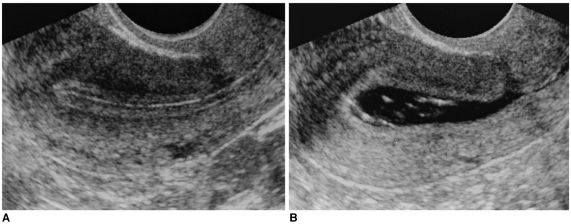
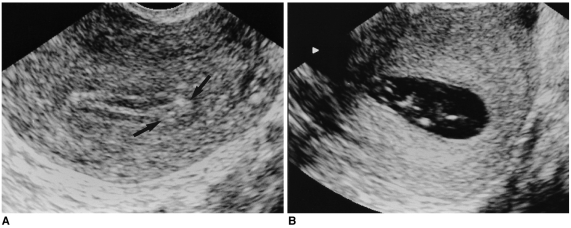
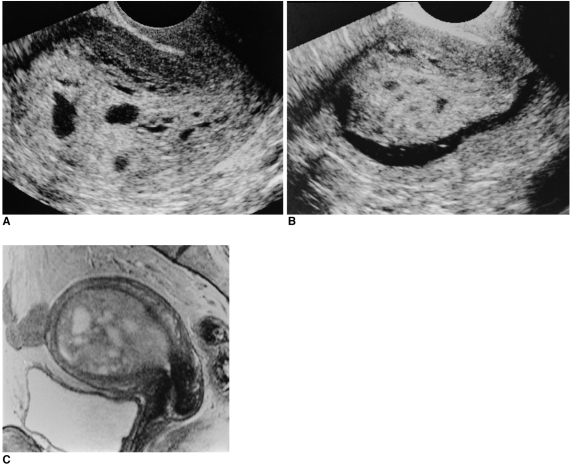
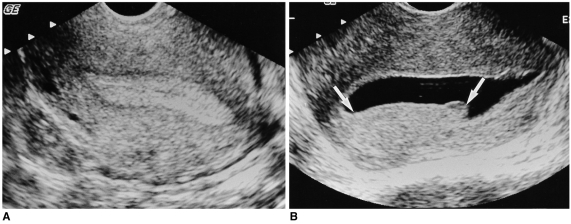
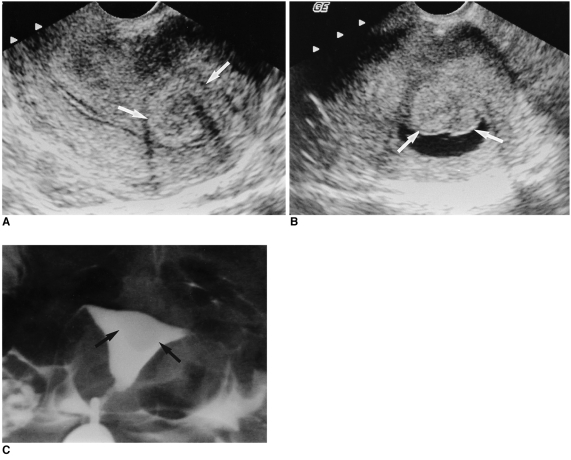
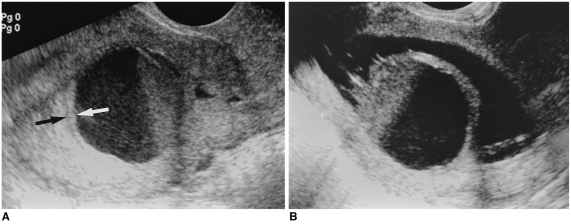
We retrospectively reviewed transvaginal ultrasonography (TVS) and HS for 105 patients whose diagnosis was confirmed pathologically. All 105 patients were initially evaluated on the same day with both TVS and HS. On TVS and HS examination, endometrial cavitary lesions were classified as diffuse hyperplasia, endometrial polyp, endometrial cancer, uterine synechia and submucosal leiomyoma. Hysteroscopy with biopsy (n=35), curettage (n=60) or hysterectomy (n=10) was performed, and the results of TVS and HS examination were correlated with the pathological findings.
The sensitivity and specificity were 79.0% and 45.8% for TVS, and 95.1% and 83.3% for HS, respectively. The positive and negative predictive values were 83.0% and 39.3% for TVS, and 95.1% and 83.3% for HS, respectively. Twenty-seven showed a discrepancy between the TVS and HS, and eight cases showed a discrepancy between HS and the pathologic diagnosis.
TVS is a sensitive method to evaluate the endometrial cavitary lesions, but it often does not provide the physician with sufficient diagnostic information. With its higher sensitivities, specificities and positive and negative predictive values, HS can be better used than TVS in evaluating those patients with abnormal uterine bleeding.
评估子宫超声造影(HS)作为异常子宫出血患者筛查方法的实用性。
我们回顾性分析了105例经病理确诊患者的经阴道超声检查(TVS)和子宫超声造影检查结果。所有105例患者均在同一天接受了TVS和HS的初始评估。在TVS和HS检查中,子宫内膜腔病变被分类为弥漫性增生、子宫内膜息肉、子宫内膜癌、子宫粘连和黏膜下平滑肌瘤。进行了宫腔镜活检(n = 35)、刮宫术(n = 60)或子宫切除术(n = 10),并将TVS和HS检查结果与病理结果进行了关联。
TVS的敏感性和特异性分别为79.0%和45.8%,HS的敏感性和特异性分别为95.1%和83.3%。TVS的阳性和阴性预测值分别为83.0%和39.3%,HS的阳性和阴性预测值分别为95.1%和83.3%。27例TVS和HS结果存在差异,8例HS与病理诊断结果存在差异。
TVS是评估子宫内膜腔病变的一种敏感方法,但它常常不能为医生提供足够的诊断信息。HS具有更高的敏感性、特异性以及阳性和阴性预测值,在评估异常子宫出血患者方面比TVS更适用。