Kikugawa Kanae, Katoh Kazutaka, Kuraku Shigehiro, Sakurai Hiroshi, Ishida Osamu, Iwabe Naoyuki, Miyata Takashi
Department of Biophysics, Graduate School of Science, Kyoto University, Kyoto 606-8502, Japan.
BMC Biol. 2004 Mar 11;2:3. doi: 10.1186/1741-7007-2-3.
Phylogenetic analyses of jawed vertebrates based on mitochondrial sequences often result in confusing inferences which are obviously inconsistent with generally accepted trees. In particular, in a hypothesis by Rasmussen and Arnason based on mitochondrial trees, cartilaginous fishes have a terminal position in a paraphyletic cluster of bony fishes. No previous analysis based on nuclear DNA-coded genes could significantly reject the mitochondrial trees of jawed vertebrates.
We have cloned and sequenced seven nuclear DNA-coded genes from 13 vertebrate species. These sequences, together with sequences available from databases including 13 jawed vertebrates from eight major groups (cartilaginous fishes, bichir, chondrosteans, gar, bowfin, teleost fishes, lungfishes and tetrapods) and an outgroup (a cyclostome and a lancelet), have been subjected to phylogenetic analyses based on the maximum likelihood method.
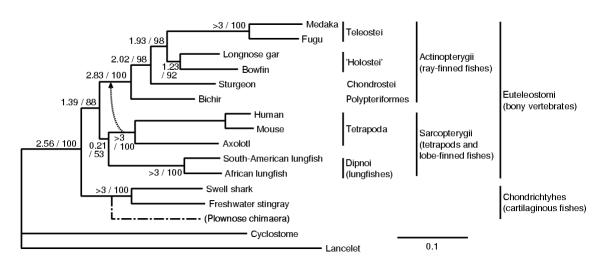
Cartilaginous fishes have been inferred to be basal to other jawed vertebrates, which is consistent with the generally accepted view. The minimum log-likelihood difference between the maximum likelihood tree and trees not supporting the basal position of cartilaginous fishes is 18.3 +/- 13.1. The hypothesis by Rasmussen and Arnason has been significantly rejected with the minimum log-likelihood difference of 123 +/- 23.3. Our tree has also shown that living holosteans, comprising bowfin and gar, form a monophyletic group which is the sister group to teleost fishes. This is consistent with a formerly prevalent view of vertebrate classification, although inconsistent with both of the current morphology-based and mitochondrial sequence-based trees. Furthermore, the bichir has been shown to be the basal ray-finned fish. Tetrapods and lungfish have formed a monophyletic cluster in the tree inferred from the concatenated alignment, being consistent with the currently prevalent view. It also remains possible that tetrapods are more closely related to ray-finned fishes than to lungfishes.
基于线粒体序列对有颌脊椎动物进行系统发育分析,常常会得出令人困惑的推论,这些推论明显与普遍认可的进化树不一致。特别是,在拉斯穆森和阿纳森基于线粒体进化树提出的一个假说中,软骨鱼类在硬骨鱼类的并系群中处于终端位置。此前基于核DNA编码基因的分析均无法显著推翻有颌脊椎动物的线粒体进化树。
我们从13种脊椎动物物种中克隆并测序了7个核DNA编码基因。这些序列,连同从数据库中获取的序列(包括来自八个主要类群的13种有颌脊椎动物:软骨鱼类、多鳍鱼、软骨硬鳞鱼、雀鳝、弓鳍鱼、硬骨鱼类、肺鱼和四足动物)以及一个外类群(一种圆口纲动物和一种文昌鱼),已基于最大似然法进行了系统发育分析。
软骨鱼类被推断为其他有颌脊椎动物的基部类群,这与普遍认可的观点一致。最大似然树与不支持软骨鱼类基部位置的进化树之间的最小对数似然差为18.3±13.1。拉斯穆森和阿纳森的假说已被显著推翻,最小对数似然差为123±23.3。我们的进化树还表明,现存的全骨鱼类(包括弓鳍鱼和雀鳝)构成一个单系群,是硬骨鱼类的姐妹群。这与脊椎动物分类学中以前普遍的观点一致,尽管与当前基于形态学和线粒体序列的进化树均不一致。此外,多鳍鱼已被证明是基部的辐鳍鱼。四足动物和肺鱼在串联比对推断出的进化树中形成了一个单系群,与当前普遍的观点一致。四足动物与辐鳍鱼的关系也有可能比与肺鱼的关系更密切。