Key Laboratory of Aquatic Biodiversity and Conservation of Chinese Academy of Sciences, Institute of Hydrobiology, Chinese Academy of Sciences, Wuhan, People's Republic of China.
PLoS One. 2012;7(4):e36256. doi: 10.1371/journal.pone.0036256. Epub 2012 Apr 27.
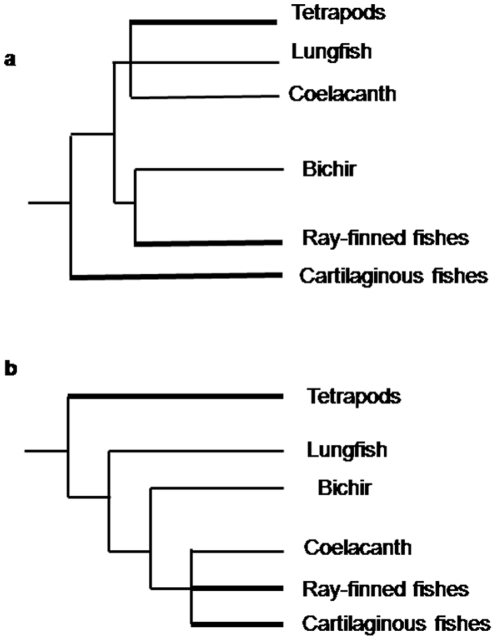
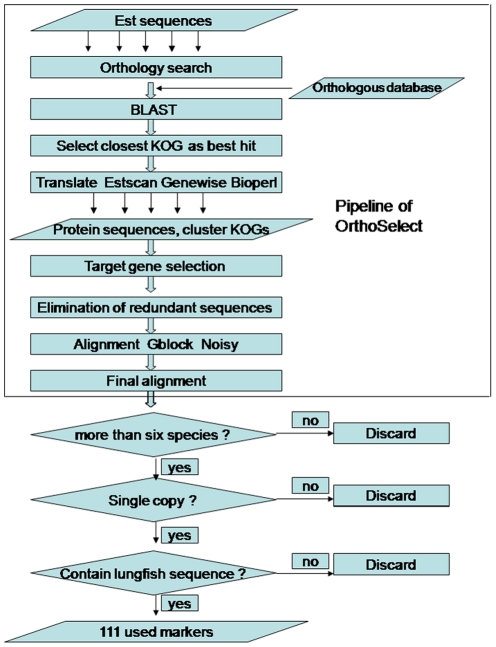
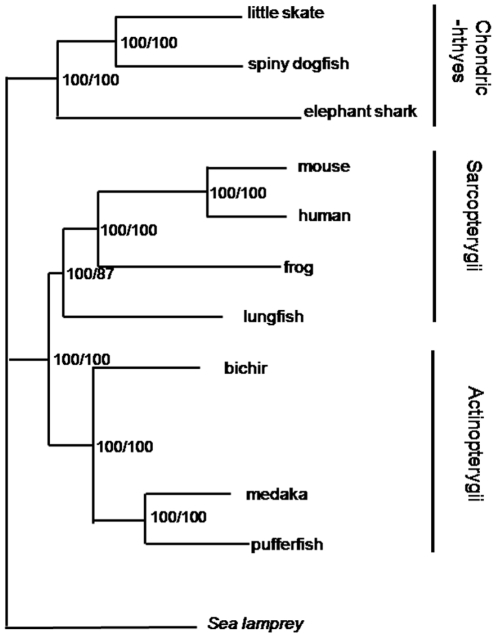
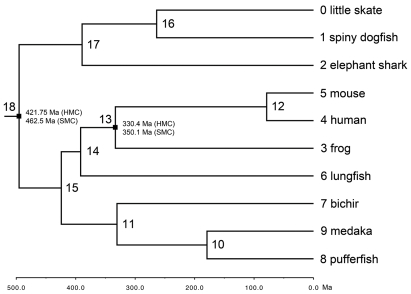
The traditionally accepted relationships among basal jawed vertebrates have been challenged by some molecular phylogenetic analyses based on mitochondrial sequences. Those studies split extant gnathostomes into two monophyletic groups: tetrapods and piscine branch, including Chondrichthyes, Actinopterygii and sarcopterygian fishes. Lungfish and bichir are found in a basal position on the piscine branch. Based on transcriptomes of an armored bichir (Polypterus delhezi) and an African lungfish (Protopterus sp.) we generated, expressed sequences and whole genome sequences available from public databases, we obtained 111 genes to reconstruct the phylogenetic tree of basal jawed vertebrates and estimated their times of divergence. Our phylogenomic study supports the traditional relationship. We found that gnathostomes are divided into Chondrichthyes and the Osteichthyes, both with 100% support values (posterior probabilities and bootstrap values). Chimaeras were found to have a basal position among cartilaginous fishes with a 100% support value. Osteichthyes were divided into Actinopterygii and Sarcopterygii with 100% support value. Lungfish and tetrapods form a monophyletic group with 100% posterior probability. Bichir and two teleost species form a monophyletic group with 100% support value. The previous tree, based on mitochondrial data, was significantly rejected by an approximately unbiased test (AU test, p = 0). The time of divergence between lungfish and tetrapods was estimated to be 391.8 Ma and the divergence of bichir from pufferfish and medaka was estimated to be 330.6 Ma. These estimates closely match the fossil record. In conclusion, our phylogenomic study successfully resolved the relationship of basal jawed vertebrates based on transtriptomes, EST and whole genome sequences.
基于线粒体序列的一些分子系统发育分析对传统上被接受的基干有颌脊椎动物的亲缘关系提出了挑战。这些研究将现生的有颌类分为两个单系群:四足动物和硬骨鱼分支,包括软骨鱼、硬骨鱼和肉鳍鱼。肺鱼和鲟鱼位于硬骨鱼分支的基部位置。基于我们生成的 armored bichir(Polypterus delhezi)和 African lungfish(Protopterus sp.)的转录组,以及从公共数据库获得的表达序列和全基因组序列,我们获得了 111 个基因来重建基干有颌脊椎动物的系统发育树,并估计它们的分歧时间。我们的系统基因组研究支持传统的关系。我们发现,有颌类分为软骨鱼和硬骨鱼,两者都有 100%的支持值(后验概率和自举值)。嵌合体在软骨鱼中处于基部位置,支持值为 100%。硬骨鱼分为硬骨鱼和肉鳍鱼,支持值为 100%。肺鱼和四足动物形成一个单系群,后验概率为 100%。鲟鱼和两种硬骨鱼形成一个单系群,支持值为 100%。基于线粒体数据的前一棵树被近似无偏检验(AU 检验,p = 0)显著拒绝。肺鱼和四足动物的分歧时间估计为 391.8 Ma,鲟鱼与河豚和青鳉的分歧时间估计为 330.6 Ma。这些估计与化石记录非常吻合。总之,我们的系统基因组研究成功地基于转录组、EST 和全基因组序列解决了基干有颌脊椎动物的亲缘关系问题。