Fort Alfredo L, Voltero Lauren
Senior Health Advisor, Demographic and Health Surveys, ORC Macro, Calverton, Maryland, USA.
Hum Resour Health. 2004 Jun 22;2(1):8. doi: 10.1186/1478-4491-2-8.
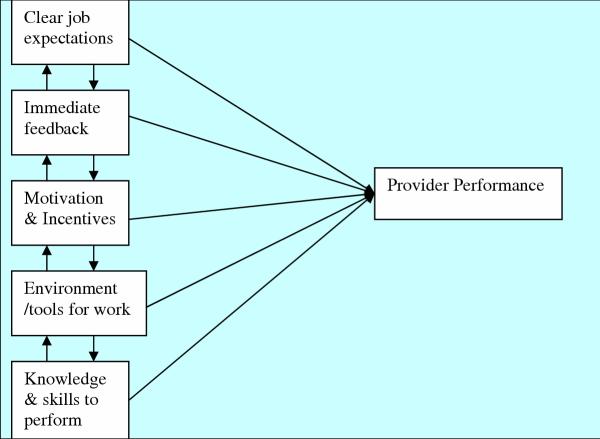
Over the last five years, international development organizations began to modify and adapt the conventional Performance Improvement Model for use in low-resource settings. This model outlines the five key factors believed to influence performance outcomes: job expectations, performance feedback, environment and tools, motivation and incentives, and knowledge and skills. Each of these factors should be supplied by the organization in which the provider works, and thus, organizational support is considered as an overarching element for analysis. Little research, domestically or internationally, has been conducted on the actual effects of each of the factors on performance outcomes and most PI practitioners assume that all the factors are needed in order for performance to improve. This study presents a unique exploration of how the factors, individually as well as in combination, affect the performance of primary reproductive health providers (nurse-midwives) in two regions of Armenia. METHODS: Two hundred and eighty-five nurses and midwives were observed conducting real or simulated antenatal and postpartum/neonatal care services and interviewed about the presence or absence of the performance factors within their work environment. Results were analyzed to compare average performance with the existence or absence of the factors; then, multiple regression analysis was conducted with the merged datasets to obtain the best models of "predictors" of performance within each clinical service. RESULTS: Baseline results revealed that performance was sub-standard in several areas and several performance factors were deficient or nonexistent. The multivariate analysis showed that (a) training in the use of the clinic tools; and (b) receiving recognition from the employer or the client/community, are factors strongly associated with performance, followed by (c) receiving performance feedback in postpartum care. Other - extraneous - variables such as the facility type (antenatal care) and whether observation was on simulated vs. real patients (postpartum care) also had a role in observed performance. CONCLUSION: This study concludes that the antenatal and postpartum care performance of health providers in Armenia is strongly associated with having the practical knowledge and skills to use everyday tools of the trade and with receiving recognition for their work, as well as having performance feedback. The paper recognized several limitations and expects further studies will illuminate this important topic further.
在过去五年中,国际发展组织开始对传统的绩效改进模型进行调整和修改,以便在资源匮乏的环境中使用。该模型概述了被认为会影响绩效结果的五个关键因素:工作期望、绩效反馈、环境与工具、动机与激励以及知识与技能。这些因素中的每一个都应由提供者所在的组织提供,因此,组织支持被视为分析的首要要素。国内外很少有研究探讨这些因素各自对绩效结果的实际影响,大多数绩效改进从业者认为,为了提高绩效,所有因素都是必需的。本研究对这些因素单独以及组合起来如何影响亚美尼亚两个地区的初级生殖健康提供者(助产士)的绩效进行了独特的探索。
观察了285名护士和助产士进行实际或模拟的产前及产后/新生儿护理服务,并就其工作环境中绩效因素的存在与否进行了访谈。分析结果以比较平均绩效与因素的存在与否;然后,对合并后的数据集进行多元回归分析,以获得每种临床服务中绩效“预测因素”的最佳模型。
基线结果显示,几个领域的绩效未达标准,几个绩效因素存在缺陷或根本不存在。多变量分析表明:(a)诊所工具使用方面的培训;以及(b)得到雇主或客户/社区的认可,是与绩效密切相关的因素,其次是(c)产后护理中获得绩效反馈。其他无关变量,如机构类型(产前护理)以及观察的是模拟患者还是真实患者(产后护理),在观察到的绩效中也起到了作用。
本研究得出结论,亚美尼亚医疗服务提供者的产前和产后护理绩效与拥有使用日常行业工具的实践知识和技能、因工作获得认可以及得到绩效反馈密切相关。本文认识到了几个局限性,并期望进一步的研究能进一步阐明这一重要课题。