Cahour A, Falgout B, Lai C J
Molecular Viral Biology Section, National Institute of Allergy and Infectious Diseases, Bethesda, Maryland 20892.
J Virol. 1992 Mar;66(3):1535-42. doi: 10.1128/JVI.66.3.1535-1542.1992.
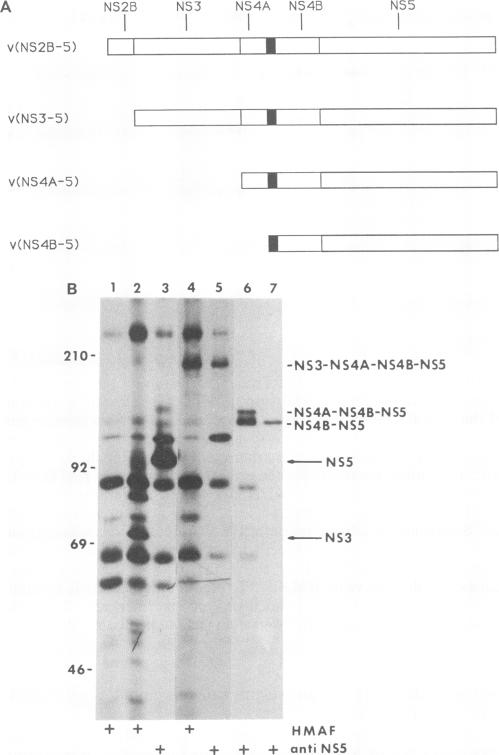
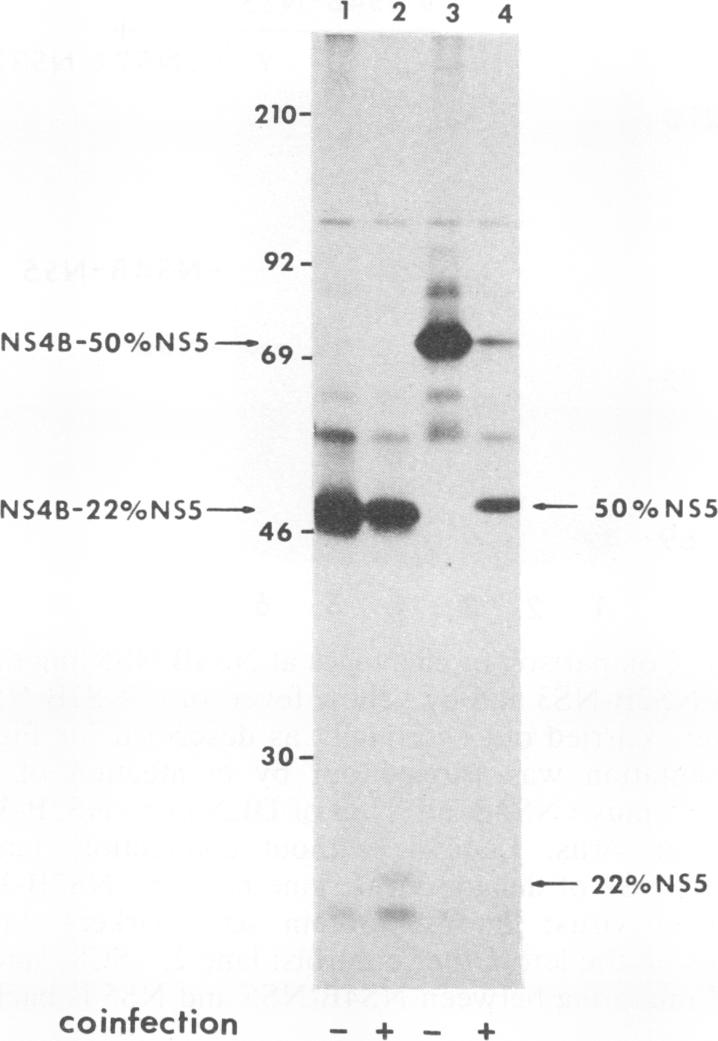
The cleavage mechanism utilized for processing of the NS3-NS4A-NS4B-NS5 domain of the dengue virus polyprotein was studied by using the vaccinia virus expression system. Recombinant vaccinia viruses vNS2B-NS3-NS4A-NS4B-NS5, vNS3-NS4A-NS4B-NS5, vNS4A-NS4B-NS5, and vNS4B-NS5 were constructed. These recombinants were used to infect cells, and the labeled lysates were analyzed by immunoprecipitation. Recombinant vNS2B-NS3-NS4A-NS4B-NS5 expressed the authentic NS3 and NS5 proteins, but the other recombinants produced uncleaved polyproteins. These findings indicate that NS2B is required for processing of the downstream nonstructural proteins, including the NS3/NS4A and NS4B/NS5 junctions, both of which contain a dibasic amino acid sequence preceding the cleavage site. The flavivirus NS4A/NS4B cleavage site follows a long hydrophobic sequence. The polyprotein NS4A-NS4B-NS5 was cleaved at the NS4A/NS4B junction in the absence of other dengue virus functions. One interpretation for this finding is that NS4A/NS4B cleavage is mediated by a host protease, presumably a signal peptidase. Although vNS3-NS4A-NS4B-NS5 expressed only the polyprotein, earlier results demonstrated that cleavage at the NS4A/NS4B junction occurred when an analogous recombinant, vNS3-NS4A-84%NS4B, was expressed. Thus, it appears that uncleaved NS3 plus NS5 inhibit NS4A/NS4B cleavage presumably because the putative signal sequence is not accessible for recognition by the responsible protease. Finally, recombinants that expressed an uncleaved NS4B-NS5 polyprotein, such as vNS4A-NS4B-NS5 or vNS4B-NS5, produced NS5 when complemented with vNS2B-30%NS3 or with vNS2B plus v30%NS3. These results indicate that cleavage at the NS4B/NS5 junction can be mediated by NS2B and NS3 in trans.
利用痘苗病毒表达系统研究了登革病毒多聚蛋白NS3 - NS4A - NS4B - NS5结构域加工过程中所利用的切割机制。构建了重组痘苗病毒vNS2B - NS3 - NS4A - NS4B - NS5、vNS3 - NS4A - NS4B - NS5、vNS4A - NS4B - NS5和vNS4B - NS5。用这些重组病毒感染细胞,并用免疫沉淀法分析标记的裂解物。重组病毒vNS2B - NS3 - NS4A - NS4B - NS5表达了天然的NS3和NS5蛋白,但其他重组病毒产生了未切割的多聚蛋白。这些发现表明,NS2B是加工下游非结构蛋白所必需的,包括NS3/NS4A和NS4B/NS5连接处,这两个连接处的切割位点之前都含有一个双碱性氨基酸序列。黄病毒NS4A/NS4B切割位点位于一段长的疏水序列之后。在没有其他登革病毒功能的情况下,多聚蛋白NS4A - NS4B - NS5在NS4A/NS4B连接处被切割。对这一发现的一种解释是,NS4A/NS4B切割是由宿主蛋白酶介导的,推测是信号肽酶。虽然vNS3 - NS4A - NS4B - NS5只表达了多聚蛋白,但早期结果表明,当表达类似的重组病毒vNS3 - NS4A - 84%NS4B时,在NS4A/NS4B连接处发生了切割。因此,似乎未切割的NS3加NS5抑制NS4A/NS4B切割,大概是因为假定的信号序列无法被负责的蛋白酶识别。最后,表达未切割的NS4B - NS5多聚蛋白的重组病毒,如vNS4A - NS4B - NS5或vNS4B - NS5,在与vNS2B - 30%NS3或vNS2B加v30%NS3互补时产生了NS5。这些结果表明,NS4B/NS5连接处的切割可以由NS2B和NS3反式介导。