Kielian Tammy
Department of Neurobiology and Developmental Sciences, University of Arkansas for Medical Sciences, Little Rock, Arkansas 72205, USA.
J Neuroinflammation. 2004 Aug 17;1(1):16. doi: 10.1186/1742-2094-1-16.
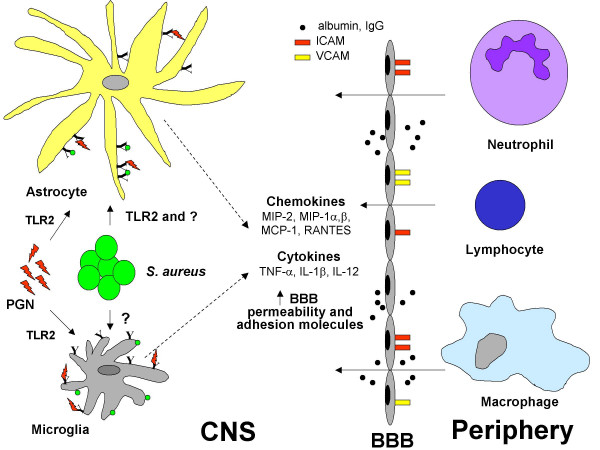
Brain abscess represents a significant medical problem despite recent advances made in detection and therapy. Due to the emergence of multi-drug resistant strains and the ubiquitous nature of bacteria, the occurrence of brain abscess is likely to persist. Our laboratory has developed a mouse experimental brain abscess model allowing for the identification of key mediators in the CNS anti-bacterial immune response through the use of cytokine and chemokine knockout mice. Studies of primary microglia and astrocytes from neonatal mice have revealed that S. aureus, one of the main etiologic agents of brain abscess in humans, is a potent stimulus for proinflammatory mediator production. Recent evidence from our laboratory indicates that Toll-like receptor 2 plays a pivotal role in the recognition of S. aureus and its cell wall product peptidoglycan by glia, although other receptors also participate in the recognition event. This review will summarize the consequences of S. aureus on CNS glial activation and the resultant neuroinflammatory response in the experimental brain abscess model.
尽管在脑脓肿的检测和治疗方面取得了最新进展,但它仍然是一个重大的医学问题。由于多重耐药菌株的出现以及细菌的普遍存在,脑脓肿的发生可能会持续存在。我们的实验室已经开发出一种小鼠实验性脑脓肿模型,通过使用细胞因子和趋化因子基因敲除小鼠,能够识别中枢神经系统抗菌免疫反应中的关键介质。对新生小鼠原代小胶质细胞和星形胶质细胞的研究表明,人类脑脓肿的主要病原体之一金黄色葡萄球菌是促炎介质产生的有效刺激物。我们实验室最近的证据表明,Toll样受体2在神经胶质细胞识别金黄色葡萄球菌及其细胞壁产物肽聚糖中起关键作用,尽管其他受体也参与了识别过程。这篇综述将总结在实验性脑脓肿模型中金黄色葡萄球菌对中枢神经系统神经胶质细胞激活的影响以及由此产生的神经炎症反应。