Wang Yong-Xu, Zhang Chun-Li, Yu Ruth T, Cho Helen K, Nelson Michael C, Bayuga-Ocampo Corinne R, Ham Jungyeob, Kang Heonjoong, Evans Ronald M
Gene Expression Laboratory, Salk Institute, La Jolla, California, USA.
PLoS Biol. 2004 Oct;2(10):e294. doi: 10.1371/journal.pbio.0020294. Epub 2004 Aug 24.
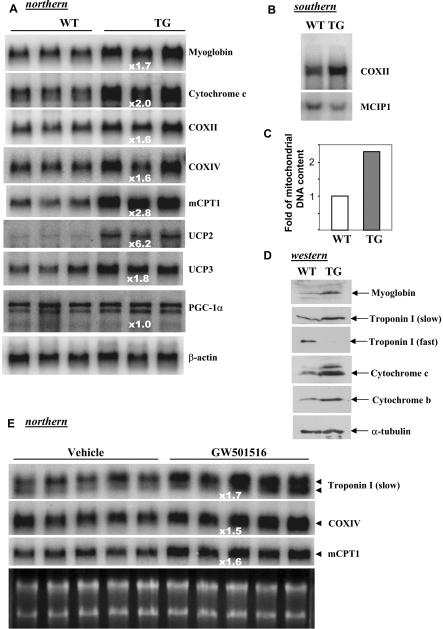
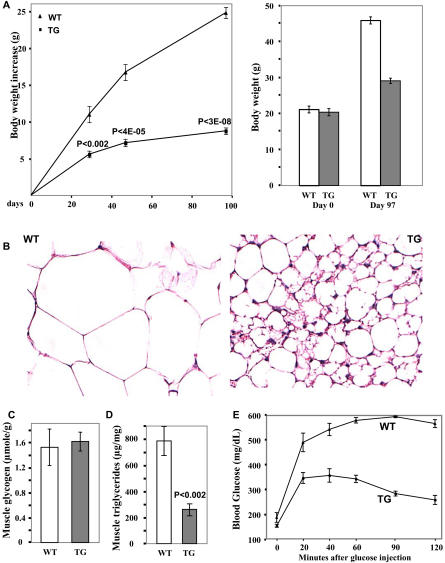
Endurance exercise training can promote an adaptive muscle fiber transformation and an increase of mitochondrial biogenesis by triggering scripted changes in gene expression. However, no transcription factor has yet been identified that can direct this process. We describe the engineering of a mouse capable of continuous running of up to twice the distance of a wild-type littermate. This was achieved by targeted expression of an activated form of peroxisome proliferator-activated receptor delta (PPARdelta) in skeletal muscle, which induces a switch to form increased numbers of type I muscle fibers. Treatment of wild-type mice with PPARdelta agonist elicits a similar type I fiber gene expression profile in muscle. Moreover, these genetically generated fibers confer resistance to obesity with improved metabolic profiles, even in the absence of exercise. These results demonstrate that complex physiologic properties such as fatigue, endurance, and running capacity can be molecularly analyzed and manipulated.
耐力运动训练可通过触发基因表达中的程序性变化来促进适应性肌纤维转化和线粒体生物合成增加。然而,尚未鉴定出能指导这一过程的转录因子。我们描述了一种工程小鼠,其能够持续奔跑的距离可达同窝野生型小鼠的两倍。这是通过在骨骼肌中靶向表达过氧化物酶体增殖物激活受体δ(PPARδ)的激活形式来实现的,该激活形式可诱导转变以形成更多数量的I型肌纤维。用PPARδ激动剂处理野生型小鼠会在肌肉中引发类似的I型纤维基因表达谱。此外,即使在缺乏运动的情况下,这些通过基因工程产生的纤维也能赋予对肥胖的抵抗力,并改善代谢状况。这些结果表明,诸如疲劳、耐力和奔跑能力等复杂的生理特性可以在分子层面进行分析和操控。