Du Qi-Shi, Wang Shu-Qing, Zhu Yu, Wei Dong-Qing, Guo Hong, Sirois Suzanne, Chou Kuo-Chen
Tianjin Normal University and Tianjin Institute of Bioinformatics and Drug Discovery, Tianjin 300074, China.
Peptides. 2004 Nov;25(11):1857-64. doi: 10.1016/j.peptides.2004.06.018.
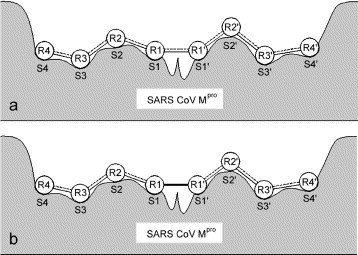
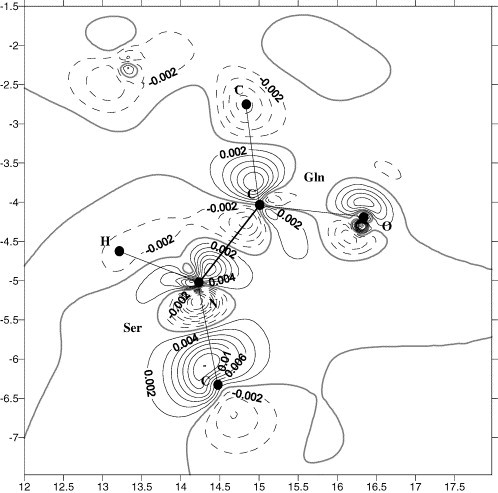
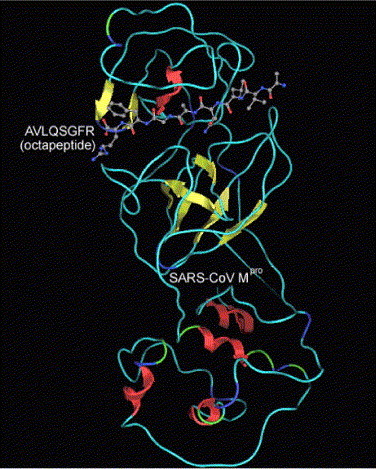
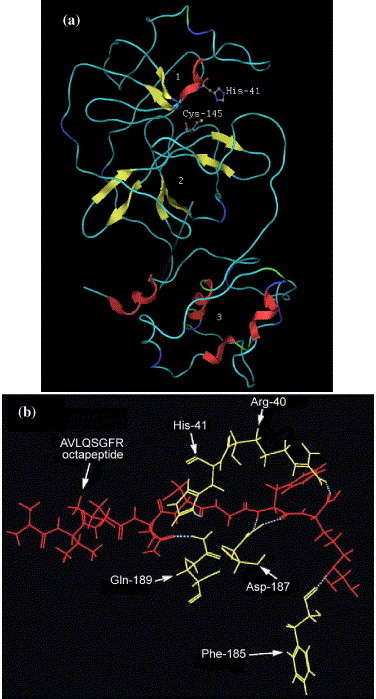
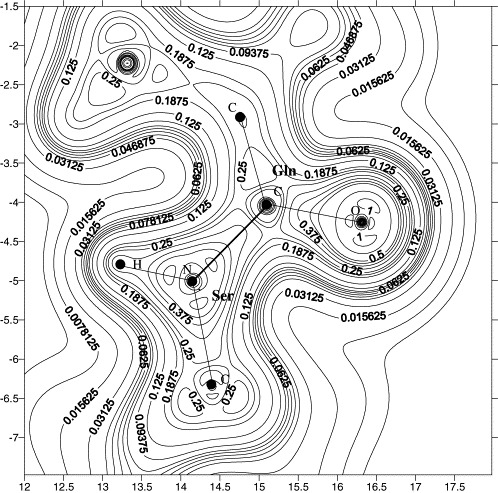
The cleavage mechanism of severe acute respiratory syndrome (SARS) coronavirus main proteinase (M(pro) or 3CL(pro)) for the octapeptide AVLQSGFR is studied using molecular mechanics (MM) and quantum mechanics (QM). The catalytic dyad His-41 and Cys-145 in the active pocket between domain I and II seem to polarize the pi-electron density of the peptide bond between Gln and Ser in the octapeptide, leading to an increase of positive charge on C(CO) of Gln and negative charge on N(NH) of Ser. The possibility of enhancing the chemical bond between Gln and Ser based on the "distorted key" theory [Anal. Biochem. 233 (1996) 1] is examined. The scissile peptide bond between Gln and Ser is found to be solidified through "hybrid peptide bond" by changing the carbonyl group CO of Gln to CH(2) or CF(2). This leads to a break of the pi-bond system for the peptide bond, making the octapeptide (AVLQSGFR) a "distorted key" and a potential starting system for the design of anti SARS drugs.
利用分子力学(MM)和量子力学(QM)研究了严重急性呼吸综合征(SARS)冠状病毒主要蛋白酶(M(pro)或3CL(pro))对八肽AVLQSGFR的切割机制。结构域I和II之间活性口袋中的催化二元组His-41和Cys-145似乎使八肽中Gln和Ser之间肽键的π电子密度极化,导致Gln的C(CO)上正电荷增加,Ser的N(NH)上负电荷增加。基于“扭曲钥匙”理论[《分析生物化学》233(1996)1],研究了增强Gln和Ser之间化学键的可能性。通过将Gln的羰基CO变为CH(2)或CF(2),发现Gln和Ser之间的可裂解肽键通过“杂合肽键”得以固化。这导致肽键的π键系统断裂,使八肽(AVLQSGFR)成为“扭曲钥匙”,并成为设计抗SARS药物的潜在起始系统。