Fraser James A, Diezmann Stephanie, Subaran Ryan L, Allen Andria, Lengeler Klaus B, Dietrich Fred S, Heitman Joseph
Department of Molecular Genetics and Microbiology, Duke University Medical Center, Durham, North Carolina, USA.
PLoS Biol. 2004 Dec;2(12):e384. doi: 10.1371/journal.pbio.0020384. Epub 2004 Nov 9.
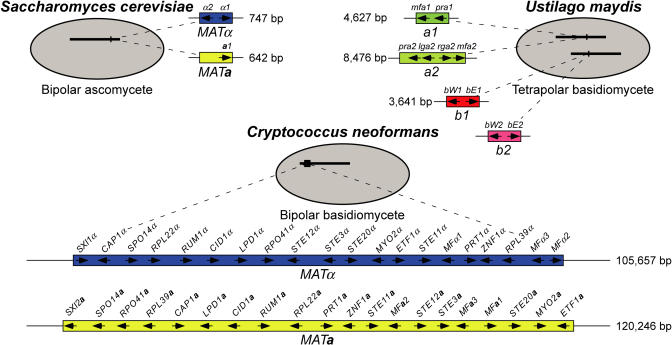
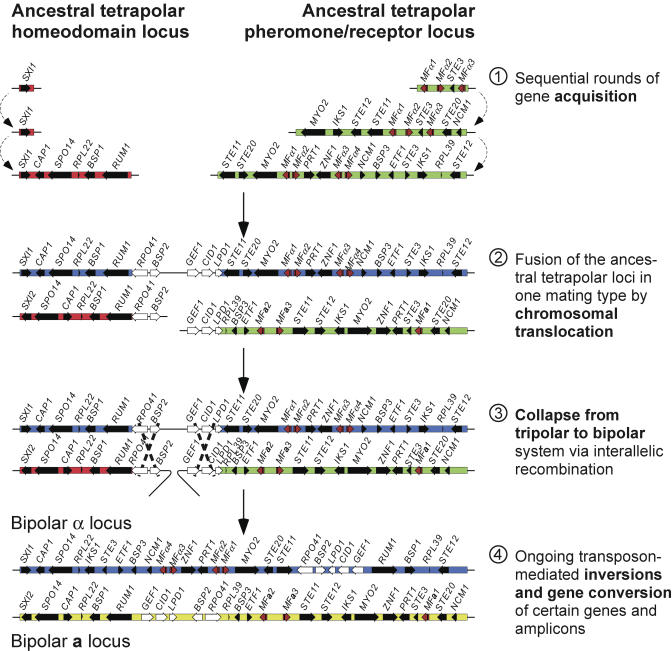
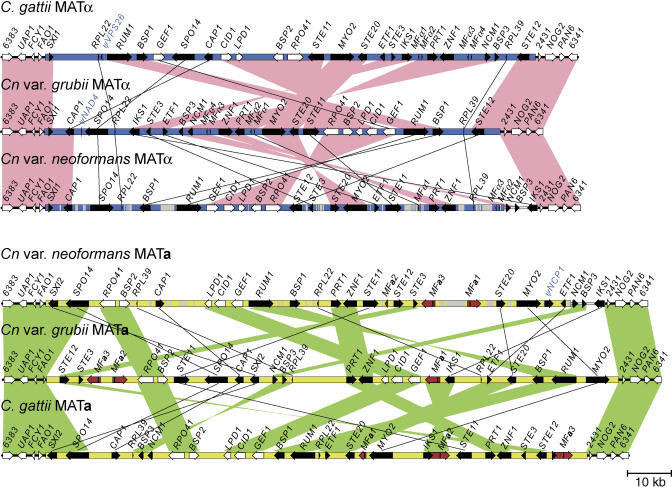
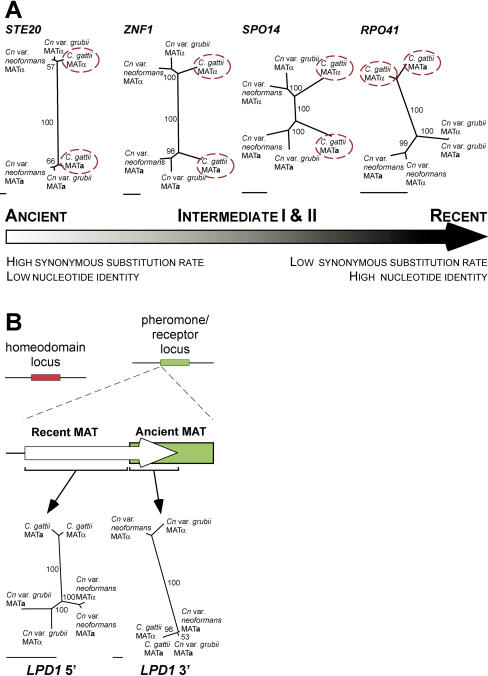
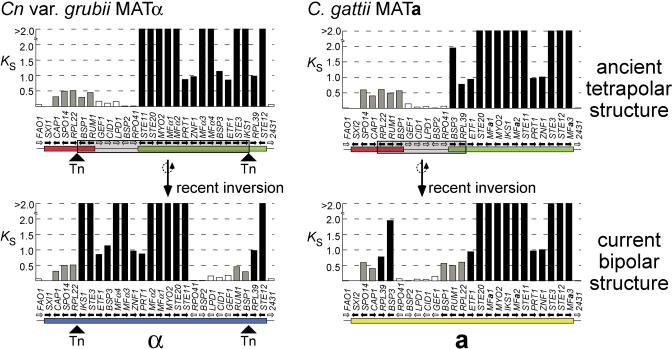
Sexual identity is governed by sex chromosomes in plants and animals, and by mating type (MAT) loci in fungi. Comparative analysis of the MAT locus from a species cluster of the human fungal pathogen Cryptococcus revealed sequential evolutionary events that fashioned this large, highly unusual region. We hypothesize that MAT evolved via four main steps, beginning with acquisition of genes into two unlinked sex-determining regions, forming independent gene clusters that then fused via chromosomal translocation. A transitional tripolar intermediate state then converted to a bipolar system via gene conversion or recombination between the linked and unlinked sex-determining regions. MAT was subsequently subjected to intra- and interallelic gene conversion and inversions that suppress recombination. These events resemble those that shaped mammalian sex chromosomes, illustrating convergent evolution in sex-determining structures in the animal and fungal kingdoms.
在植物和动物中,性别认同由性染色体决定,而在真菌中则由交配型(MAT)基因座决定。对人类真菌病原体新型隐球菌一个物种簇的MAT基因座进行比较分析,揭示了塑造这个庞大且极为特殊区域的一系列连续进化事件。我们推测,MAT的进化主要经历四个步骤,首先是基因进入两个不连锁的性别决定区域,形成独立的基因簇,然后通过染色体易位融合。随后,一个过渡性的三极中间状态通过连锁和不连锁性别决定区域之间的基因转换或重组转变为两极系统。MAT随后经历了等位基因内和等位基因间的基因转换以及抑制重组的倒位。这些事件与塑造哺乳动物性染色体的事件相似,说明了动物界和真菌界性别决定结构的趋同进化。