Zhou Chuan, Chan Heang-Ping, Paramagul Chintana, Roubidoux Marilyn A, Sahiner Berkman, Hadjiiski Labomir M, Petrick Nicholas
Department of Radiology, University of Michigan, Ann Arbor, Michigan 48109, USA.
Med Phys. 2004 Oct;31(10):2871-82. doi: 10.1118/1.1800713.
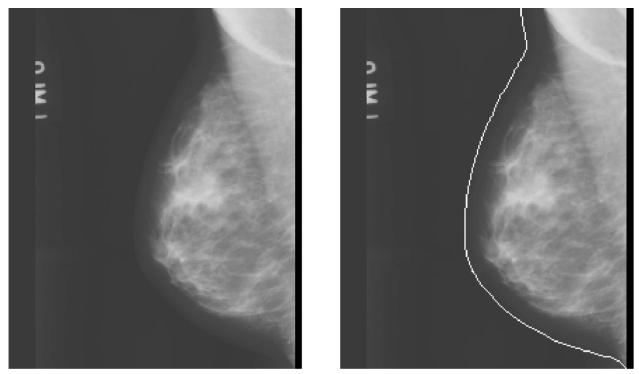
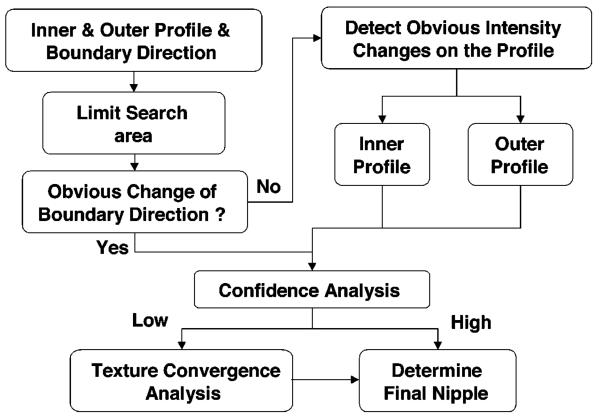
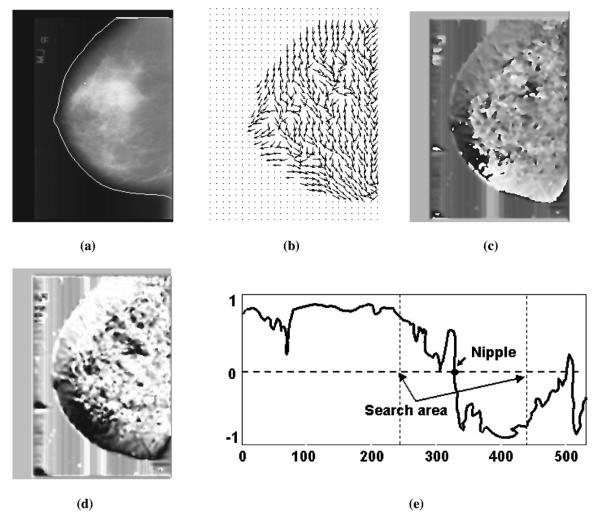
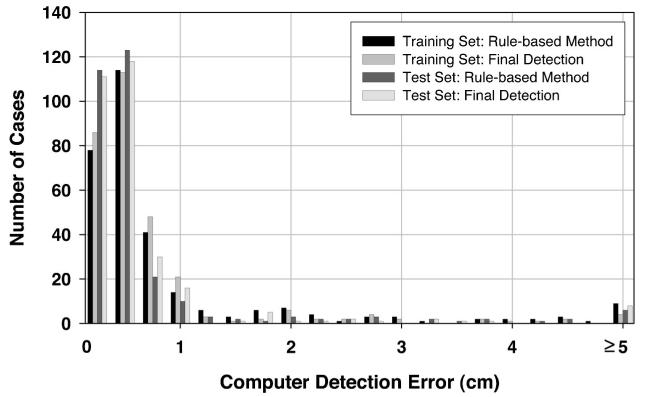
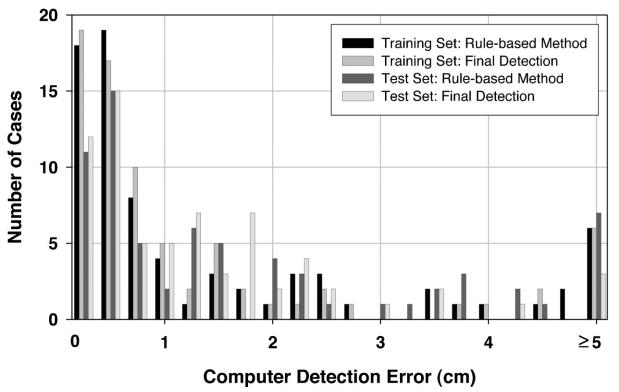
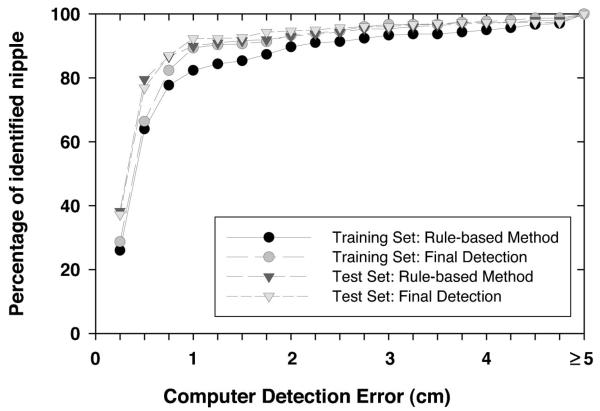
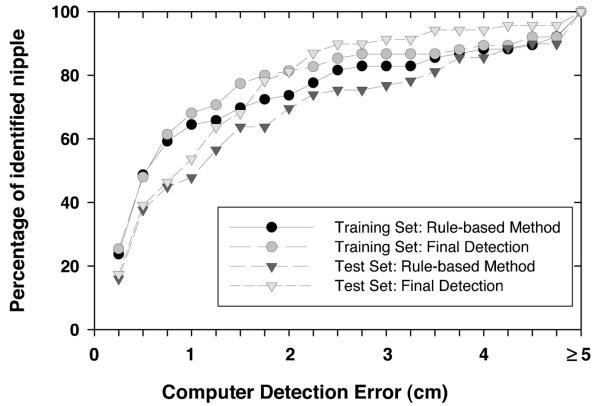
Correlation of information from multiple-view mammograms (e.g., MLO and CC views, bilateral views, or current and prior mammograms) can improve the performance of breast cancer diagnosis by radiologists or by computer. The nipple is a reliable and stable landmark on mammograms for the registration of multiple mammograms. However, accurate identification of nipple location on mammograms is challenging because of the variations in image quality and in the nipple projections, resulting in some nipples being nearly invisible on the mammograms. In this study, we developed a computerized method to automatically identify the nipple location on digitized mammograms. First, the breast boundary was obtained using a gradient-based boundary tracking algorithm, and then the gray level profiles along the inside and outside of the boundary were identified. A geometric convergence analysis was used to limit the nipple search to a region of the breast boundary. A two-stage nipple detection method was developed to identify the nipple location using the gray level information around the nipple, the geometric characteristics of nipple shapes, and the texture features of glandular tissue or ducts which converge toward the nipple. At the first stage, a rule-based method was designed to identify the nipple location by detecting significant changes of intensity along the gray level profiles inside and outside the breast boundary and the changes in the boundary direction. At the second stage, a texture orientation-field analysis was developed to estimate the nipple location based on the convergence of the texture pattern of glandular tissue or ducts towards the nipple. The nipple location was finally determined from the detected nipple candidates by a rule-based confidence analysis. In this study, 377 and 367 randomly selected digitized mammograms were used for training and testing the nipple detection algorithm, respectively. Two experienced radiologists identified the nipple locations which were used as the gold standard. In the training data set, 301 nipples were positively identified and were referred to as visible nipples. Seventy six nipples could not be positively identified and were referred to as invisible nipples. The radiologists provided their estimation of the nipple locations in the latter group for comparison with the computer estimates. The computerized method could detect 89.37% (269/301) of the visible nipples and 69.74% (53/76) of the invisible nipples within 1 cm of the gold standard. In the test data set, 298 and 69 of the nipples were classified as visible and invisible, respectively. 92.28% (275/298) of the visible nipples and 53.62% (37/69) of the invisible nipples were identified within 1 cm of the gold standard. The results demonstrate that the nipple locations on digitized mammograms can be accurately detected if they are visible and can be reasonably estimated if they are invisible. Automated nipple detection will be an important step towards multiple image analysis for CAD.
来自多个视角乳腺钼靶图像(例如,内外斜位和头尾位视图、双侧视图,或当前与之前的乳腺钼靶图像)的信息关联,可提高放射科医生或计算机进行乳腺癌诊断的性能。乳头是乳腺钼靶图像上用于配准多个乳腺钼靶图像的可靠且稳定的标志。然而,由于图像质量和乳头投影的变化,准确识别乳腺钼靶图像上的乳头位置具有挑战性,导致有些乳头在乳腺钼靶图像上几乎不可见。在本研究中,我们开发了一种计算机化方法来自动识别数字化乳腺钼靶图像上的乳头位置。首先,使用基于梯度的边界跟踪算法获取乳房边界,然后识别边界内外的灰度轮廓。采用几何收敛分析将乳头搜索限制在乳房边界的一个区域内。开发了一种两阶段乳头检测方法,利用乳头周围的灰度信息、乳头形状的几何特征以及向乳头汇聚的腺体组织或导管的纹理特征来识别乳头位置。在第一阶段,设计了一种基于规则的方法,通过检测乳房边界内外灰度轮廓上强度的显著变化以及边界方向的变化来识别乳头位置。在第二阶段,开发了一种纹理方向场分析方法,基于腺体组织或导管的纹理模式向乳头的汇聚来估计乳头位置。最后通过基于规则的置信度分析从检测到的乳头候选位置中确定乳头位置。在本研究中,分别使用377张和367张随机选择的数字化乳腺钼靶图像来训练和测试乳头检测算法。两名经验丰富的放射科医生确定乳头位置,将其用作金标准。在训练数据集中,301个乳头被明确识别,称为可见乳头。76个乳头未能被明确识别,称为不可见乳头。放射科医生对后一组乳头位置进行了估计,以便与计算机估计值进行比较。该计算机化方法能够在金标准的1厘米范围内检测出89.37%(269/301)的可见乳头和69.74%(53/76)的不可见乳头。在测试数据集中,分别有298个和69个乳头被分类为可见和不可见。在金标准的1厘米范围内识别出了92.28%(275/298)的可见乳头和53.62%(37/69)的不可见乳头。结果表明,数字化乳腺钼靶图像上的乳头位置如果可见则可以准确检测,如果不可见则可以合理估计。自动乳头检测将是朝着计算机辅助检测(CAD)的多图像分析迈出的重要一步。