Lal Pawan, Singh Lakhvinder, Agarwal P N, Kant Ravi
Maulana Azad Medical College and associated Lok Nayak Hospital, New Delhi-110 002, India.
JSLS. 2004 Oct-Dec;8(4):364-6.
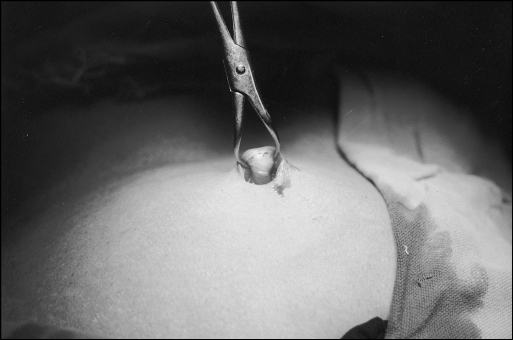
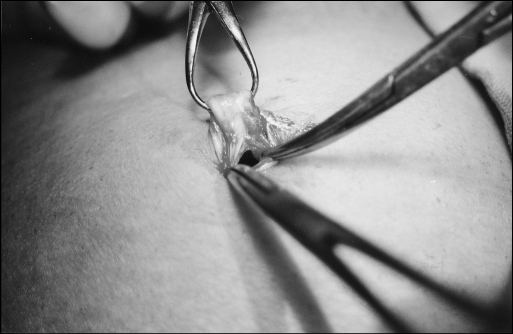
Blind insertion of the Veress needle and of the first trocar is a significant cause of complications in laparoscopic surgery. Despite this risk, the closed technique is still more popular than the open one. Our aim is to report the results of our experience with the routine use of the modified open technique in laparoscopic surgery and to describe the technical details of the creation of pnuemoperitoneum by the open technique that we used.
A prospective study was conducted in the department of surgery at Maulana Azad Medical College and associated Lok Nayak Hospital, New Delhi. A modified method of open laparoscopy was performed on 755 consecutive patients requiring laparoscopy or laparoscopic surgery over a 5-year period from August 1998 to February 2003 in 1 surgical unit.
The mean time taken was 4 minutes (range, 2 to 10). No intraoperative complications occurred during trocar insertion. Forty-nine (6.49%) patients had minor umbilical sepsis, 22 (2.91%) had periumbilical hematoma, but none had umbilical hernia during 3 months of follow-up after surgery.
Based on our own experience, we recommend open laparoscopy as a safe and easy approach for routine laparoscopic interventions.
Veress针和第一套管针的盲目插入是腹腔镜手术并发症的重要原因。尽管存在这种风险,但闭合技术仍比开放技术更受欢迎。我们的目的是报告我们在腹腔镜手术中常规使用改良开放技术的经验结果,并描述我们所采用的开放技术建立气腹的技术细节。
在新德里莫拉纳·阿扎德医学院及附属洛克·纳亚克医院外科进行了一项前瞻性研究。1998年8月至2003年2月的5年期间,在1个手术单元对755例连续需要腹腔镜检查或腹腔镜手术的患者采用了改良的开放腹腔镜检查方法。
平均用时4分钟(范围2至10分钟)。插入套管针期间未发生术中并发症。49例(6.49%)患者有轻微脐部感染,22例(2.91%)有脐周血肿,但术后3个月随访期间无1例发生脐疝。
基于我们自己的经验,我们推荐开放腹腔镜检查作为常规腹腔镜干预的一种安全且简便的方法。