• 文献检索
  • 文档翻译
  • 深度研究
  • 学术资讯
  • Suppr Zotero 插件Zotero 插件
  • 邀请有礼
  • 套餐&价格
  • 历史记录
应用&插件
Suppr Zotero 插件Zotero 插件浏览器插件Mac 客户端Windows 客户端微信小程序
定价
高级版会员购买积分包购买API积分包
服务
文献检索文档翻译深度研究API 文档MCP 服务
关于我们
关于 Suppr公司介绍联系我们用户协议隐私条款
关注我们

Suppr 超能文献

核心技术专利:CN118964589B侵权必究
粤ICP备2023148730 号-1Suppr @ 2026

文献检索

告别复杂PubMed语法,用中文像聊天一样搜索,搜遍4000万医学文献。AI智能推荐,让科研检索更轻松。

立即免费搜索

文件翻译

保留排版,准确专业,支持PDF/Word/PPT等文件格式,支持 12+语言互译。

免费翻译文档

深度研究

AI帮你快速写综述,25分钟生成高质量综述,智能提取关键信息,辅助科研写作。

立即免费体验

隐藏的定位基序:非过氧化物酶体蛋白中天然存在的过氧化物酶体靶向信号

Hidden localization motifs: naturally occurring peroxisomal targeting signals in non-peroxisomal proteins.

作者信息

Neuberger Georg, Kunze Markus, Eisenhaber Frank, Berger Johannes, Hartig Andreas, Brocard Cecile

机构信息

Research Institute of Molecular Pathology (IMP), Dr Bohr-Gasse 7, A-1030 Vienna, Austria.

出版信息

Genome Biol. 2004;5(12):R97. doi: 10.1186/gb-2004-5-12-r97. Epub 2004 Nov 30.

DOI:10.1186/gb-2004-5-12-r97
PMID:15575971
原文链接:https://pmc.ncbi.nlm.nih.gov/articles/PMC545800/
Abstract

BACKGROUND

Can sequence segments coding for subcellular targeting or for posttranslational modifications occur in proteins that are not substrates in either of these processes? Although considerable effort has been invested in achieving low false-positive prediction rates, even accurate sequence-analysis tools for the recognition of these motifs generate a small but noticeable number of protein hits that lack the appropriate biological context but cannot be rationalized as false positives.

RESULTS

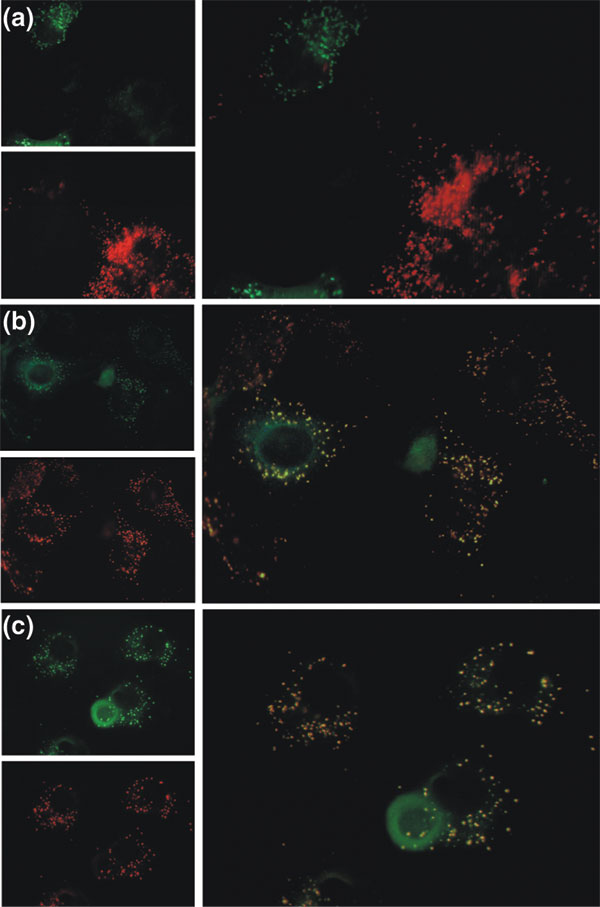
We show that the carboxyl termini of a set of definitely non-peroxisomal proteins with predicted peroxisomal targeting signals interact with the peroxisomal matrix protein receptor peroxin 5 (PEX5) in a yeast two-hybrid test. Moreover, we show that examples of these proteins - chicken lysozyme, human tyrosinase and the yeast mitochondrial ribosomal protein L2 (encoded by MRP7) - are imported into peroxisomes in vivo if their original sorting signals are disguised. We also show that even prokaryotic proteins can contain peroxisomal targeting sequences.

CONCLUSIONS

Thus, functional localization signals can evolve in unrelated protein sequences as a result of neutral mutations, and subcellular targeting is hierarchically organized, with signal accessibility playing a decisive role. The occurrence of silent functional motifs in unrelated proteins is important for the development of sequence-based function prediction tools and the interpretation of their results. Silent functional signals have the potential to acquire importance in future evolutionary scenarios and in pathological conditions.

摘要

背景

编码亚细胞靶向或翻译后修饰的序列片段能否出现在并非这些过程中任何一个的底物的蛋白质中?尽管在实现低假阳性预测率方面投入了大量努力,但即使是用于识别这些基序的精确序列分析工具,也会产生少量但明显的蛋白质命中结果,这些结果缺乏适当的生物学背景,但又不能合理地解释为假阳性。

结果

我们表明,一组具有预测的过氧化物酶体靶向信号的明确非过氧化物酶体蛋白质的羧基末端在酵母双杂交试验中与过氧化物酶体基质蛋白受体过氧化物酶5(PEX5)相互作用。此外,我们表明,如果这些蛋白质的原始分选信号被掩盖,它们的例子——鸡溶菌酶、人酪氨酸酶和酵母线粒体核糖体蛋白L2(由MRP7编码)——在体内会被导入过氧化物酶体。我们还表明,甚至原核生物蛋白质也可以包含过氧化物酶体靶向序列。

结论

因此,由于中性突变,功能定位信号可以在不相关的蛋白质序列中进化,并且亚细胞靶向是分层组织的,信号可及性起决定性作用。不相关蛋白质中沉默功能基序的出现对于基于序列的功能预测工具的开发及其结果的解释很重要。沉默功能信号有可能在未来的进化场景和病理条件下变得重要。
https://cdn.ncbi.nlm.nih.gov/pmc/blobs/cb88/545800/765641274da6/gb-2004-5-12-r97-3.jpg
https://cdn.ncbi.nlm.nih.gov/pmc/blobs/cb88/545800/cc3ac1daa874/gb-2004-5-12-r97-1.jpg
https://cdn.ncbi.nlm.nih.gov/pmc/blobs/cb88/545800/b0502216c7ff/gb-2004-5-12-r97-2.jpg
https://cdn.ncbi.nlm.nih.gov/pmc/blobs/cb88/545800/765641274da6/gb-2004-5-12-r97-3.jpg
https://cdn.ncbi.nlm.nih.gov/pmc/blobs/cb88/545800/cc3ac1daa874/gb-2004-5-12-r97-1.jpg
https://cdn.ncbi.nlm.nih.gov/pmc/blobs/cb88/545800/b0502216c7ff/gb-2004-5-12-r97-2.jpg
https://cdn.ncbi.nlm.nih.gov/pmc/blobs/cb88/545800/765641274da6/gb-2004-5-12-r97-3.jpg

相似文献

1
Hidden localization motifs: naturally occurring peroxisomal targeting signals in non-peroxisomal proteins.隐藏的定位基序:非过氧化物酶体蛋白中天然存在的过氧化物酶体靶向信号
Genome Biol. 2004;5(12):R97. doi: 10.1186/gb-2004-5-12-r97. Epub 2004 Nov 30.
2
Identification of a novel, intraperoxisomal pex14-binding site in pex13: association of pex13 with the docking complex is essential for peroxisomal matrix protein import.在过氧化物酶体生物合成因子13(pex13)中鉴定出一种新的、过氧化物酶体内的pex14结合位点:pex13与对接复合物的结合对于过氧化物酶体基质蛋白的导入至关重要。
Mol Cell Biol. 2005 Apr;25(8):3007-18. doi: 10.1128/MCB.25.8.3007-3018.2005.
3
Peroxisome targeting signal 1: is it really a simple tripeptide?过氧化物酶体靶向信号1:它真的只是一个简单的三肽吗?
Biochim Biophys Acta. 2006 Dec;1763(12):1565-73. doi: 10.1016/j.bbamcr.2006.08.022. Epub 2006 Aug 24.
4
Peroxisomal catalase in the methylotrophic yeast Candida boidinii: transport efficiency and metabolic significance.甲基营养型酵母博伊丁假丝酵母中的过氧化物酶体过氧化氢酶:转运效率和代谢意义
J Bacteriol. 2001 Nov;183(21):6372-83. doi: 10.1128/JB.183.21.6372-6383.2001.
5
The tetratricopeptide repeat-domain of the PAS10 protein of Saccharomyces cerevisiae is essential for binding the peroxisomal targeting signal-SKL.酿酒酵母PAS10蛋白的四肽重复结构域对于结合过氧化物酶体靶向信号-SKL至关重要。
Biochem Biophys Res Commun. 1994 Nov 15;204(3):1016-22. doi: 10.1006/bbrc.1994.2564.
6
Prediction of peroxisomal targeting signal 1 containing proteins from amino acid sequence.基于氨基酸序列预测含过氧化物酶体靶向信号1的蛋白质
J Mol Biol. 2003 May 2;328(3):581-92. doi: 10.1016/s0022-2836(03)00319-x.
7
Human pex19p binds peroxisomal integral membrane proteins at regions distinct from their sorting sequences.人类pex19p在与其分选序列不同的区域结合过氧化物酶体整合膜蛋白。
Mol Cell Biol. 2001 Jul;21(13):4413-24. doi: 10.1128/MCB.21.13.4413-4424.2001.
8
Peroxisomes as dynamic organelles: peroxisomal matrix protein import.过氧化物酶体作为动态细胞器:过氧化物酶体基质蛋白的输入。
FEBS J. 2010 Aug;277(16):3268-78. doi: 10.1111/j.1742-4658.2010.07739.x. Epub 2010 Jul 12.
9
The peroxisomal membrane targeting elements of human peroxin 2 (PEX2).人类过氧化物酶体蛋白2(PEX2)的过氧化物酶体膜靶向元件。
Eur J Cell Biol. 2003 Apr;82(4):155-62. doi: 10.1078/0171-9335-00310.
10
Saccharomyces cerevisiae Pex14p contains two independent Pex5p binding sites, which are both essential for PTS1 protein import.酿酒酵母Pex14p含有两个独立的Pex5p结合位点,这两个位点对于PTS1蛋白的导入均至关重要。
FEBS Lett. 2005 Jun 20;579(16):3416-20. doi: 10.1016/j.febslet.2005.05.011.

引用本文的文献

1
Computational Evaluation of Peroxisomal Targeting Signals in Metazoa.后生动物中过氧化物酶体靶向信号的计算评估
Methods Mol Biol. 2023;2643:391-404. doi: 10.1007/978-1-0716-3048-8_28.
2
Sharing the wealth: The versatility of proteins targeted to peroxisomes and other organelles.共享财富:靶向过氧化物酶体及其他细胞器的蛋白质的多功能性
Front Cell Dev Biol. 2022 Sep 26;10:934331. doi: 10.3389/fcell.2022.934331. eCollection 2022.
3
Insights Into the Peroxisomal Protein Inventory of Zebrafish.斑马鱼过氧化物酶体蛋白质组学研究进展

本文引用的文献

1
Prediction of sequence signals for lipid post-translational modifications: insights from case studies.脂质翻译后修饰序列信号的预测:来自案例研究的见解
Proteomics. 2004 Jun;4(6):1614-25. doi: 10.1002/pmic.200300781.
2
Myristoylation of viral and bacterial proteins.病毒和细菌蛋白质的肉豆蔻酰化作用。
Trends Microbiol. 2004 Apr;12(4):178-85. doi: 10.1016/j.tim.2004.02.006.
3
MYRbase: analysis of genome-wide glycine myristoylation enlarges the functional spectrum of eukaryotic myristoylated proteins.MYRbase:全基因组甘氨酸肉豆蔻酰化分析扩展了真核生物肉豆蔻酰化蛋白的功能谱。
Front Physiol. 2022 Feb 28;13:822509. doi: 10.3389/fphys.2022.822509. eCollection 2022.
4
The similarity between N-terminal targeting signals for protein import into different organelles and its evolutionary relevance.蛋白质导入不同细胞器的N端靶向信号之间的相似性及其进化相关性。
Front Physiol. 2015 Sep 24;6:259. doi: 10.3389/fphys.2015.00259. eCollection 2015.
5
Single-residue posttranslational modification sites at the N-terminus, C-terminus or in-between: To be or not to be exposed for enzyme access.N 端、C 端或中间的单残基翻译后修饰位点:是否暴露以供酶作用。
Proteomics. 2015 Jul;15(14):2525-46. doi: 10.1002/pmic.201400633.
6
Comprehensive proteomics analysis of glycosomes from Leishmania donovani.杜氏利什曼原虫糖体的综合蛋白质组学分析
OMICS. 2015 Mar;19(3):157-70. doi: 10.1089/omi.2014.0163.
7
Leishmania donovani argininosuccinate synthase is an active enzyme associated with parasite pathogenesis.杜氏利什曼原虫精氨琥珀酸合成酶是一种与寄生虫发病机制相关的活性酶。
PLoS Negl Trop Dis. 2012;6(10):e1849. doi: 10.1371/journal.pntd.0001849. Epub 2012 Oct 18.
8
Structural requirements for interaction of peroxisomal targeting signal 2 and its receptor PEX7.过氧化物酶体靶向信号 2 与其受体 PEX7 相互作用的结构要求。
J Biol Chem. 2011 Dec 30;286(52):45048-62. doi: 10.1074/jbc.M111.301853. Epub 2011 Nov 5.
9
Identification of novel plant peroxisomal targeting signals by a combination of machine learning methods and in vivo subcellular targeting analyses.通过机器学习方法和体内亚细胞定位分析相结合鉴定新型植物过氧化物酶体靶向信号。
Plant Cell. 2011 Apr;23(4):1556-72. doi: 10.1105/tpc.111.084095. Epub 2011 Apr 12.
10
OPA3, mutated in 3-methylglutaconic aciduria type III, encodes two transcripts targeted primarily to mitochondria.OPA3,突变导致 3-甲基戊二酸尿症 III 型,编码两种主要靶向线粒体的转录本。
Mol Genet Metab. 2010 Jun;100(2):149-54. doi: 10.1016/j.ymgme.2010.03.005. Epub 2010 Mar 16.
Genome Biol. 2004;5(3):R21. doi: 10.1186/gb-2004-5-3-r21. Epub 2004 Feb 13.
4
The peroxisome: orchestrating important developmental decisions from inside the cell.过氧化物酶体:在细胞内部协调重要的发育决策。
J Cell Biol. 2004 Mar 1;164(5):641-5. doi: 10.1083/jcb.200312081. Epub 2004 Feb 23.
5
LIFEdb: a database for functional genomics experiments integrating information from external sources, and serving as a sample tracking system.LIFEdb:一个用于功能基因组学实验的数据库,整合来自外部来源的信息,并作为一个样本跟踪系统。
Nucleic Acids Res. 2004 Jan 1;32(Database issue):D505-8. doi: 10.1093/nar/gkh022.
6
Interaction of scavenger receptor class B type I with peroxisomal targeting receptor Pex5p.I型B类清道夫受体与过氧化物酶体靶向受体Pex5p的相互作用。
Biochem Biophys Res Commun. 2003 Dec 26;312(4):1325-34. doi: 10.1016/j.bbrc.2003.11.076.
7
Prediction of lipid posttranslational modifications and localization signals from protein sequences: big-Pi, NMT and PTS1.从蛋白质序列预测脂质翻译后修饰和定位信号:大π、N-肉豆蔻酰转移酶和过氧化物酶体靶向信号1
Nucleic Acids Res. 2003 Jul 1;31(13):3631-4. doi: 10.1093/nar/gkg537.
8
Prediction of peroxisomal targeting signal 1 containing proteins from amino acid sequence.基于氨基酸序列预测含过氧化物酶体靶向信号1的蛋白质
J Mol Biol. 2003 May 2;328(3):581-92. doi: 10.1016/s0022-2836(03)00319-x.
9
Motif refinement of the peroxisomal targeting signal 1 and evaluation of taxon-specific differences.过氧化物酶体靶向信号1的基序优化及分类群特异性差异评估。
J Mol Biol. 2003 May 2;328(3):567-79. doi: 10.1016/s0022-2836(03)00318-8.
10
The SWISS-PROT protein knowledgebase and its supplement TrEMBL in 2003.2003年的SWISS-PROT蛋白质知识库及其补充TrEMBL。
Nucleic Acids Res. 2003 Jan 1;31(1):365-70. doi: 10.1093/nar/gkg095.