Liu Xueming, Xiao Gengsheng, Chen Weidong, Xu Yujuan, Wu Jijun
J Biomed Biotechnol. 2004;2004(5):326-331. doi: 10.1155/S1110724304403052.
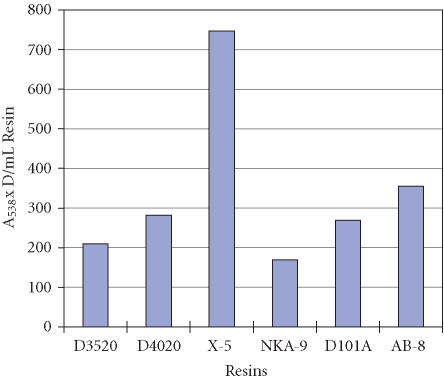
Total anthocyanins in different cultivars of mulberry were measured and a process for the industrial preparation of mulberry anthocyanins as a natural food colorant was studied. In 31 cultivars of mulberry, the total anthocyanins, calculated as cyanidin 3-glucoside, ranged from $147.68$ to $2725.46$ mg/L juice. Extracting and purifying with macroporous resins was found to be an efficient potential method for the industrial production of mulberry anthocyanins as a food colorant. Of six resins tested, X-5 demonstrated the best adsorbent capability for mulberry anthocyanins (91 mg/mL resin). The adsorption capacity of resins increased with the surface area and the pore radius. Residual mulberry fruit juice after extraction of pigment retained most of its nutrients, except for anthocyanins, and may provide a substrate for further processing.
测定了不同品种桑椹中的总花色苷,并研究了将桑椹花色苷作为天然食用色素进行工业化制备的工艺。在31个桑椹品种中,以矢车菊素3-葡萄糖苷计算的总花色苷含量在147.68至2725.46mg/L果汁之间。发现用大孔树脂提取和纯化是将桑椹花色苷作为食用色素进行工业化生产的一种有效潜在方法。在测试的六种树脂中,X-5对桑椹花色苷表现出最佳的吸附能力(91mg/mL树脂)。树脂的吸附容量随表面积和孔径半径的增加而增加。色素提取后剩余的桑椹果汁除了花色苷外保留了大部分营养成分,可为进一步加工提供底物。