Tsurumi Chizuko, Hoffmann Steffen, Geley Stephan, Graeser Ralph, Polanski Zbigniew
Max-Planck-Institut fuer Immunbiologie, Developmental Biology, Freiburg, Germany.
J Cell Biol. 2004 Dec 20;167(6):1037-50. doi: 10.1083/jcb.200405165.
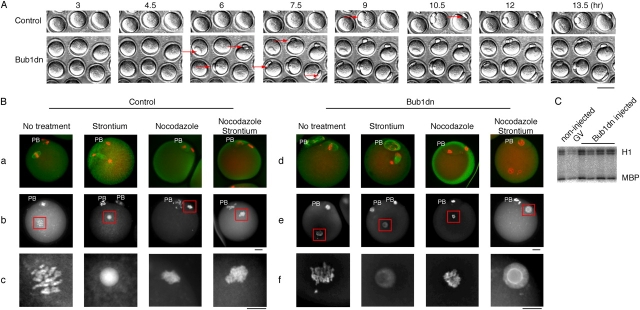
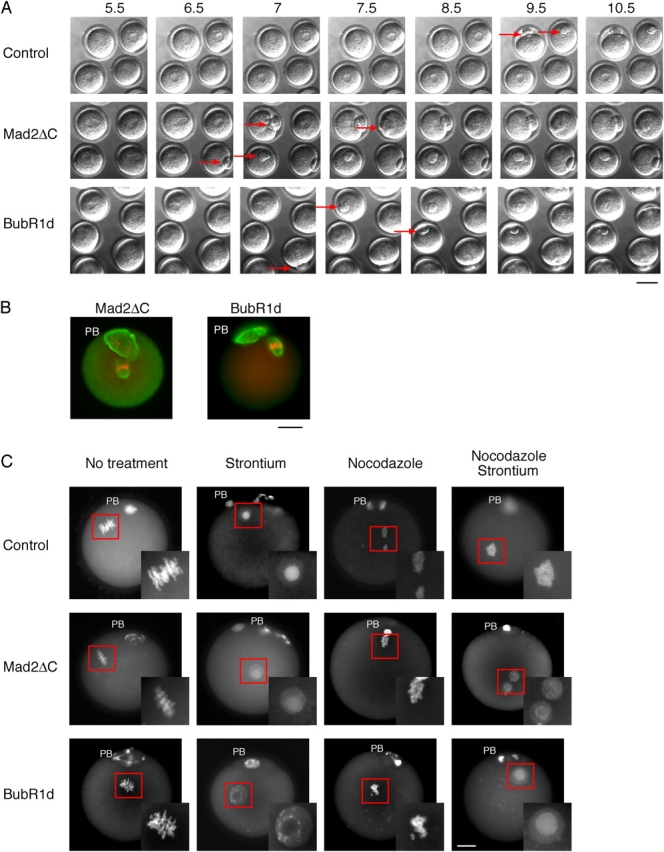
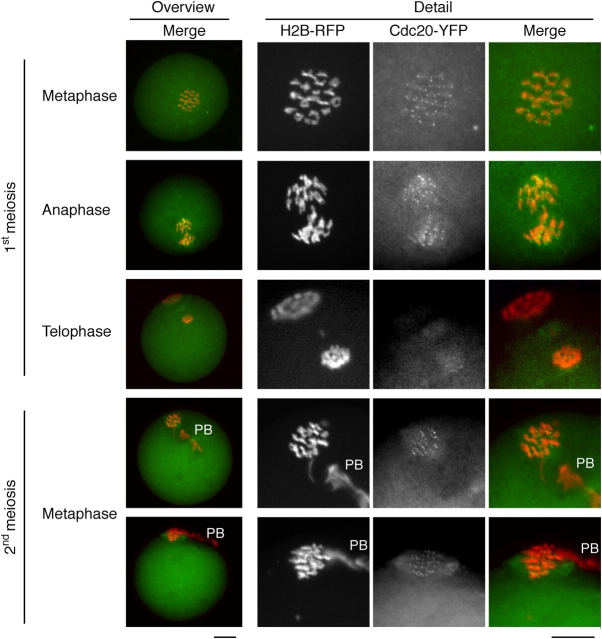
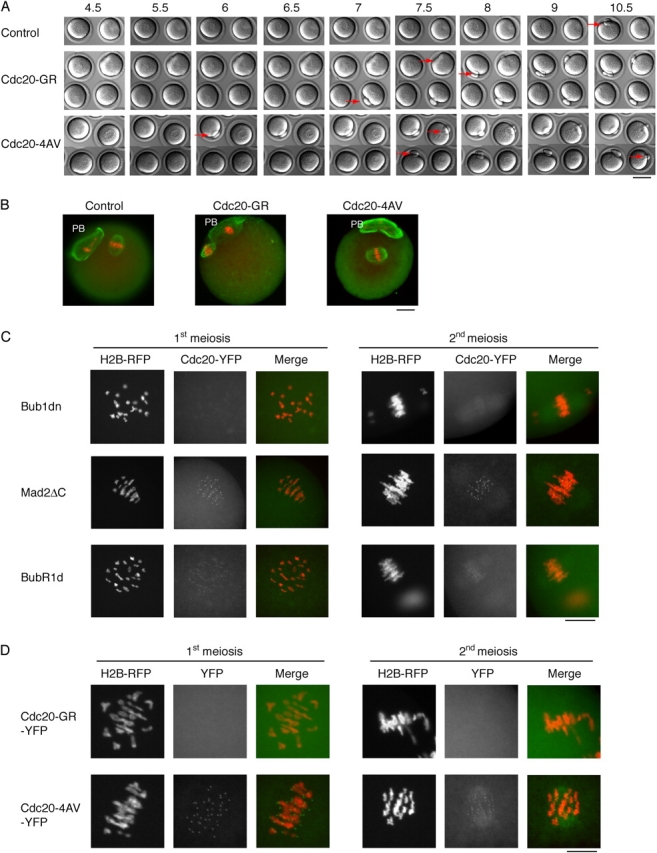
In Xenopus oocytes, the spindle assembly checkpoint (SAC) kinase Bub1 is required for cytostatic factor (CSF)-induced metaphase arrest in meiosis II. To investigate whether matured mouse oocytes are kept in metaphase by a SAC-mediated inhibition of the anaphase-promoting complex/cyclosome (APC/C) complex, we injected a dominant-negative Bub1 mutant (Bub1dn) into mouse oocytes undergoing meiosis in vitro. Passage through meiosis I was accelerated, but even though the SAC was disrupted, injected oocytes still arrested at metaphase II. Bub1dn-injected oocytes released from CSF and treated with nocodazole to disrupt the second meiotic spindle proceeded into interphase, whereas noninjected control oocytes remained arrested at metaphase. Similar results were obtained using dominant-negative forms of Mad2 and BubR1, as well as checkpoint resistant dominant APC/C activating forms of Cdc20. Thus, SAC proteins are required for checkpoint functions in meiosis I and II, but, in contrast to frog eggs, the SAC is not required for establishing or maintaining the CSF arrest in mouse oocytes.
在非洲爪蟾卵母细胞中,纺锤体组装检验点(SAC)激酶Bub1是细胞静止因子(CSF)诱导减数分裂II中期阻滞所必需的。为了研究成熟小鼠卵母细胞是否通过SAC介导的对后期促进复合物/细胞周期体(APC/C)复合物的抑制作用而维持在中期,我们将显性负性Bub1突变体(Bub1dn)注射到体外进行减数分裂的小鼠卵母细胞中。减数分裂I的进程加快,但是尽管SAC被破坏,注射后的卵母细胞仍然阻滞在中期II。从CSF中释放并用诺考达唑处理以破坏第二减数分裂纺锤体的注射了Bub1dn的卵母细胞进入间期,而未注射的对照卵母细胞仍阻滞在中期。使用显性负性形式的Mad2和BubR1以及Cdc20的检验点抗性显性APC/C激活形式也获得了类似的结果。因此,SAC蛋白在减数分裂I和II的检验点功能中是必需的,但是与蛙卵相反,SAC对于在小鼠卵母细胞中建立或维持CSF阻滞不是必需的。