O'Loughlin Aonghus J, O'Sullivan Crochan J, Ravikumar Nandini, Friel Anne M, Elliott John T, Morrison John J
Dept. of Obstetrics & Gynaecology, National University of Ireland Galway, Clinical Science Institute, University College Hospital Galway, Newcastle Road, Galway, Ireland.
Reprod Biol Endocrinol. 2005 Feb 24;3:8. doi: 10.1186/1477-7827-3-8.
The non-thrombotic effects of thrombin in cardiovascular tissues, as mediated via the protease activated receptors (PARs), and particularly PAR-1, have been the focus of much recent research. The aims of this study were to evaluate the effects of thrombin, a specific PAR-1 activating peptide (PAR1-AP), and a PAR-1 antagonist on human umbilical artery tone in vitro.
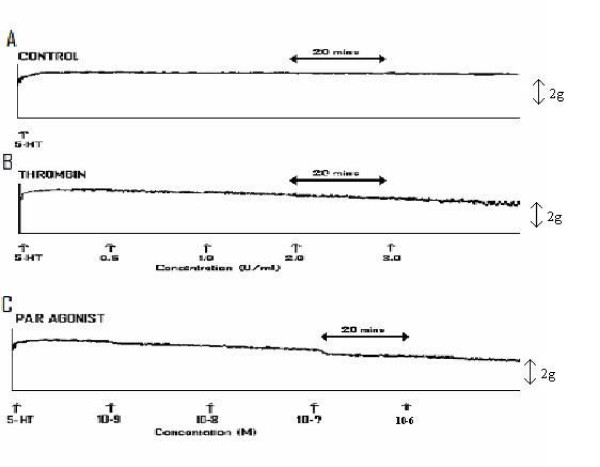
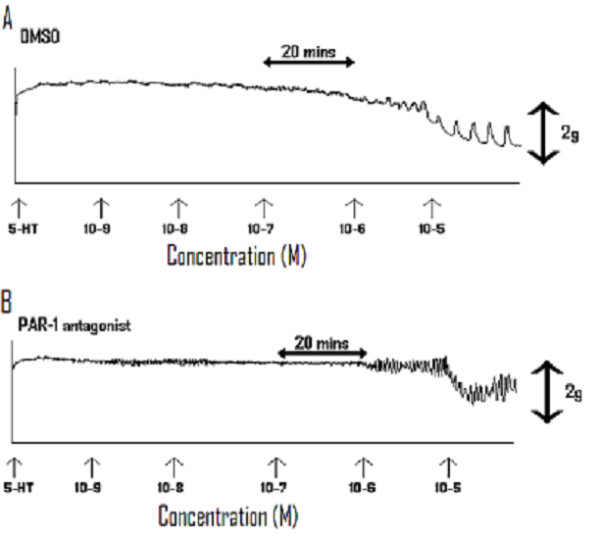
Human umbilical artery samples were obtained from 17 women at term. Arterial rings were suspended under physiologic conditions for isometric recording. The in vitro effects of thrombin (0.5 units/mL to 3 units/mL), PAR1-AP TFLLR-NH2 [10(-9) to 10(-6) M], and PAR-1 antagonist (N-trans cinnamoyl- p-fluoroPhe-p-guanidinoPhe-Leu-Arg-Orn-NH2) [10(-9) M to 10(-5) M] on umbilical artery tone were measured.
Both thrombin and TFLLR-NH2 exerted a potent cumulative vasodilatory effect on human umbilical artery resistance (P < 0.001). The mean net maximal inhibition (MMI) for thrombin was 53.05% (n = 6; SEM = 1.43) at tissue bath concentration of 3 units/mL. The MMI with TFLLR-NH2 was 61.50 % (n = 6; SEM = 1.43) at bath concentration of 10(-6) M. In comparison to vehicle control, the PAR-1 antagonist did not show a significant relaxant or contractile effect (P > 0.05).
These findings highlight a potential role for thrombin and PAR-1 receptors in vascular regulation of feto-placental blood flow in normal pregnancy, and in association with the vascular lesions associated with IUGR and pre-eclampsia.
凝血酶在心血管组织中的非血栓形成作用,通过蛋白酶激活受体(PARs)介导,尤其是PAR-1,一直是近期众多研究的焦点。本研究的目的是评估凝血酶、一种特异性PAR-1激活肽(PAR1-AP)和一种PAR-1拮抗剂对人脐动脉张力的体外影响。
从17名足月孕妇获取人脐动脉样本。将动脉环置于生理条件下进行等长记录。测量凝血酶(0.5单位/毫升至3单位/毫升)、PAR1-AP TFLLR-NH2[10(-9)至10(-6)M]和PAR-1拮抗剂(N-反式肉桂酰-p-氟苯丙氨酸-p-胍基苯丙氨酸-亮氨酸-精氨酸-鸟氨酸-NH2)[10(-9)M至10(-5)M]对脐动脉张力的体外影响。
凝血酶和TFLLR-NH2对人脐动脉阻力均产生显著的累积血管舒张作用(P<0.001)。在组织浴浓度为3单位/毫升时,凝血酶的平均最大净抑制率(MMI)为53.05%(n=6;标准误=1.43)。在浴浓度为10(-6)M时,TFLLR-NH2的MMI为61.50%(n=6;标准误=1.43)。与溶媒对照相比,PAR-1拮抗剂未显示出显著的舒张或收缩作用(P>0.05)。
这些发现突出了凝血酶和PAR-1受体在正常妊娠中胎儿-胎盘血流的血管调节中的潜在作用,以及与宫内生长受限和子痫前期相关的血管病变中的作用。