Banisor Ileana, Leist Thomas P, Kalman Bernadette
SLRHC, Columbia University, New York, NY, USA.
J Neuroinflammation. 2005 Feb 24;2(1):7. doi: 10.1186/1742-2094-2-7.
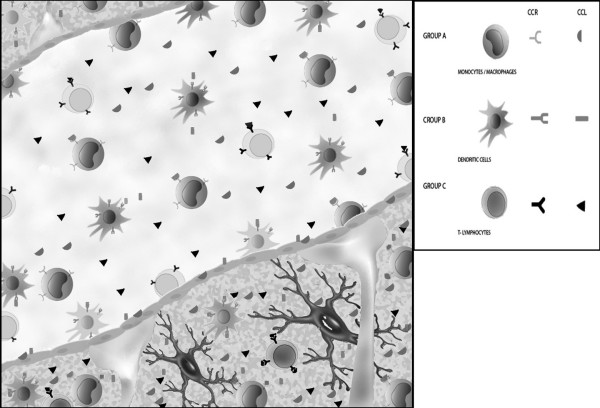
The importance of beta-chemokines (or CC chemokine ligands - CCL) in the development of inflammatory lesions in the central nervous system of patients with multiple sclerosis and rodents with experimental allergic encephalomyelitis is strongly supported by descriptive studies and experimental models. Our recent genetic scans in families identified haplotypes in the genes of CCL2, CCL3 and CCL11-CCL8-CCL13 which showed association with multiple sclerosis. Complementing the genetic associations, we also detected a distinct regional expression regulation for CCL2, CCL7 and CCL8 in correlation with chronic inflammation in multiple sclerosis brains. These observations are in consensus with previous studies, and add new data to support the involvement of CCL2, CCL7, CCL8 and CCL3 in the development of inflammatory demyelination. Along with our own data, here we review the literature implicating CCLs and their receptors (CCRs) in multiple sclerosis and experimental allergic encephalomyelitis. The survey reflects that the field is in a rapid expansion, and highlights some of the pathways which might be suitable to pharmaceutical interventions.
描述性研究和实验模型有力地支持了β-趋化因子(或CC趋化因子配体-CCL)在多发性硬化症患者和实验性变应性脑脊髓炎啮齿动物中枢神经系统炎症性病变发展中的重要性。我们最近在家族中进行的基因扫描在CCL2、CCL3和CCL11-CCL8-CCL13基因中发现了单倍型,这些单倍型与多发性硬化症相关。作为对基因关联的补充,我们还检测到CCL2、CCL7和CCL8在多发性硬化症脑内与慢性炎症相关的独特区域表达调控。这些观察结果与先前的研究一致,并增加了新的数据来支持CCL2、CCL7、CCL8和CCL3参与炎症性脱髓鞘的发展。结合我们自己的数据,在此我们回顾了涉及CCL及其受体(CCR)在多发性硬化症和实验性变应性脑脊髓炎中的文献。该综述反映出该领域正在迅速扩展,并突出了一些可能适合药物干预的途径。