Dhaiban Sarah, Al-Ani Mena, Elemam Noha Mousaad, Maghazachi Azzam A
College of Medicine and Immuno-Oncology Group, Sharjah Institute for Medical Research, University of Sharjah, Sharjah, United Arab Emirates.
J Inflamm Res. 2020 Sep 29;13:619-633. doi: 10.2147/JIR.S270872. eCollection 2020.
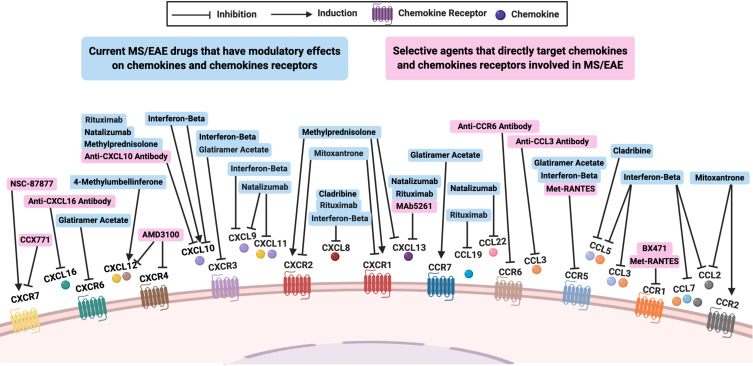
Multiple sclerosis (MS) is an immune-mediated and neurodegenerative disorder that results in inflammation and demyelination of the central nervous system (CNS). MS symptoms include walking difficulties, visual weakening, as well as learning and memory impairment, thus affecting the quality of the patient's life. Chemokines and chemokine receptors are expressed on the immune cells as well as the CNS resident cells. Several sets of chemokine receptors and their ligands tend to be pathogenic players in MS, including CCL2, CCL3, CCL4, CCL5, CCL7, CCL8, CCL11, CCL17, CCL19, CCL21, CCL22, CXCL1, CXCL8, CXCL9, CXCL10, CXCL11, and CXCL16. Furthermore, current modulatory drugs that are used in the treatment of MS and its animal model, the experimental autoimmune encephalomyelitis (EAE), affect the expression of several chemokine and chemokine receptors. In this review, we highlight the pathogenic roles of chemokines and their receptors as well as utilizing them as potential therapeutic targets through selective agents, such as specific antibodies and receptor blockers, or indirectly through MS or EAE immunomodulatory drugs.
多发性硬化症(MS)是一种免疫介导的神经退行性疾病,会导致中枢神经系统(CNS)发生炎症和脱髓鞘。MS症状包括行走困难、视力减弱以及学习和记忆障碍,从而影响患者的生活质量。趋化因子和趋化因子受体在免疫细胞以及CNS驻留细胞上表达。几组趋化因子受体及其配体往往是MS的致病因素,包括CCL2、CCL3、CCL4、CCL5、CCL7、CCL8、CCL11、CCL17、CCL19、CCL21、CCL22、CXCL1、CXCL8、CXCL9、CXCL10、CXCL11和CXCL16。此外,目前用于治疗MS及其动物模型实验性自身免疫性脑脊髓炎(EAE)的调节药物会影响几种趋化因子和趋化因子受体的表达。在本综述中,我们强调趋化因子及其受体的致病作用,并通过选择性药物,如特异性抗体和受体阻滞剂,或通过MS或EAE免疫调节药物间接将它们用作潜在的治疗靶点。