Clair Timothy, Koh Eunjin, Ptaszynska Malgorzata, Bandle Russell W, Liotta Lance A, Schiffmann Elliott, Stracke Mary L
Laboratory of Pathology, National Cancer Institute, National Institutes of Health, Bethesda, Maryland 20892, USA.
Lipids Health Dis. 2005 Feb 28;4:5. doi: 10.1186/1476-511X-4-5.
Autotaxin (ATX, NPP-2), originally purified as a potent tumor cell motility factor, is now known to be the long-sought plasma lysophospholipase D (LPLD). The integrity of the enzymatic active site, including three crucial histidine moieties, is required for motility stimulation, as well as LPLD and 5'nucleotide phosphodiesterase (PDE) activities. Except for relatively non-specific chelation agents, there are no known inhibitors of the ATX LPLD activity.
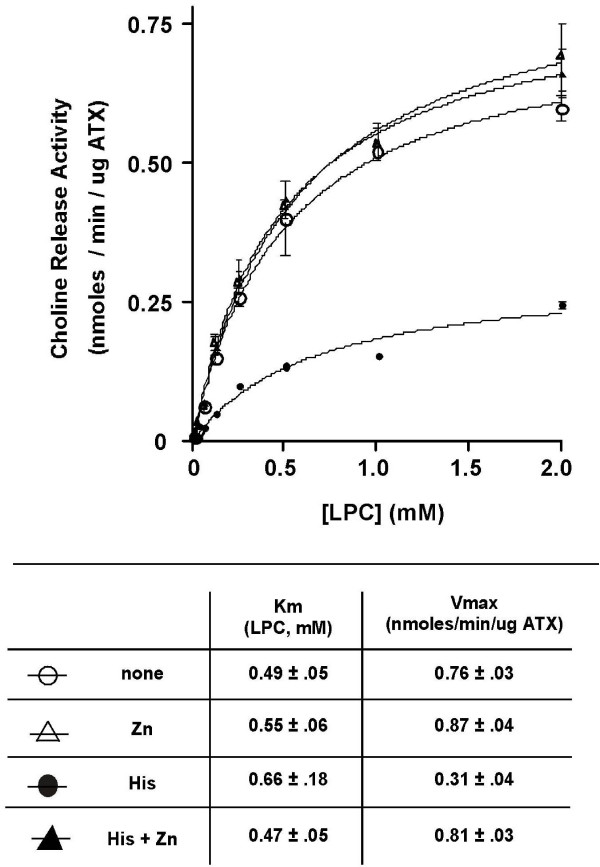
We show that millimolar concentrations of L-histidine inhibit ATX-stimulated but not LPA-stimulated motility in two tumor cell lines, as well as inhibiting enzymatic activities. Inhibition is reversed by 20-fold lower concentrations of zinc salt. L-histidine has no significant effect on the Km of LPLD, but reduces the Vmax by greater than 50%, acting as a non-competitive inhibitor. Several histidine analogs also inhibit the LPLD activity of ATX; however, none has greater potency than L-histidine and all decrease cell viability or adhesion.
L-histidine inhibition of LPLD is not a simple stoichiometric chelation of metal ions but is more likely a complex interaction with a variety of moieties, including the metal cation, at or near the active site. The inhibitory effect of L-histidine requires all three major functional groups of histidine: the alpha amino group, the alpha carboxyl group, and the metal-binding imidazole side chain. Because of LPA's involvement in pathological processes, regulation of its formation by ATX may give insight into possible novel therapeutic approaches.
自分泌运动因子(ATX,NPP-2)最初作为一种有效的肿瘤细胞运动因子被纯化出来,现在已知它就是长期寻找的血浆溶血磷脂酶D(LPLD)。运动刺激以及LPLD和5'核苷酸磷酸二酯酶(PDE)活性需要酶活性位点的完整性,包括三个关键的组氨酸部分。除了相对非特异性的螯合剂外,目前还没有已知的ATX LPLD活性抑制剂。
我们发现,毫摩尔浓度的L-组氨酸在两种肿瘤细胞系中抑制ATX刺激的运动,但不抑制LPA刺激的运动,同时也抑制酶活性。20倍低浓度的锌盐可逆转这种抑制作用。L-组氨酸对LPLD的Km没有显著影响,但使Vmax降低超过50%,起非竞争性抑制剂的作用。几种组氨酸类似物也抑制ATX的LPLD活性;然而,没有一种比L-组氨酸更有效,并且所有类似物都会降低细胞活力或粘附性。
L-组氨酸对LPLD的抑制不是简单的金属离子化学计量螯合,而更可能是与活性位点或其附近的多种部分(包括金属阳离子)发生复杂相互作用。L-组氨酸的抑制作用需要组氨酸的所有三个主要官能团:α氨基、α羧基和金属结合咪唑侧链。由于LPA参与病理过程,通过ATX调节其形成可能有助于深入了解可能的新型治疗方法。