Chou Te-hui W, Wang Shixia, Sakhatskyy Pavlo V, Mboudjeka Innocent, Lawrence John M, Huang Song, Coley Scott, Yang Baoan, Li Jiaming, Zhu Qingyu, Lu Shan
Laboratory of Nucleic Acid Vaccines, Department of Medicine, University of Massachusetts Medical School, 364 Plantation Street, Lazare Research Building, Worcester, MA 01605-2397, USA.
Virology. 2005 Mar 30;334(1):134-43. doi: 10.1016/j.virol.2005.01.035.
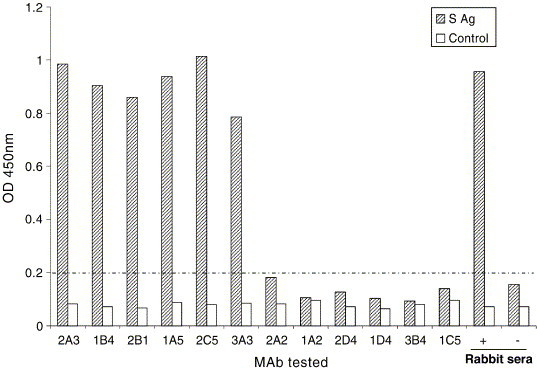
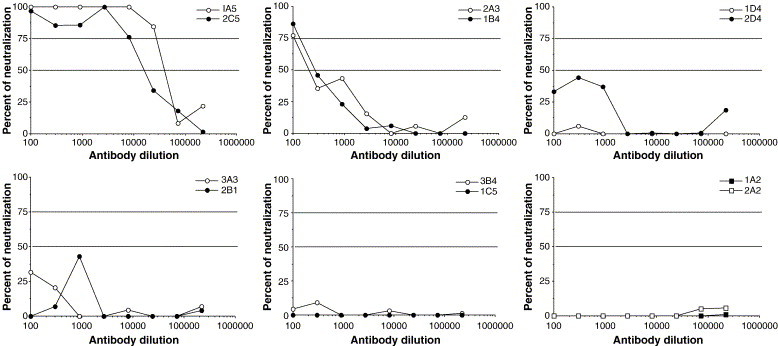
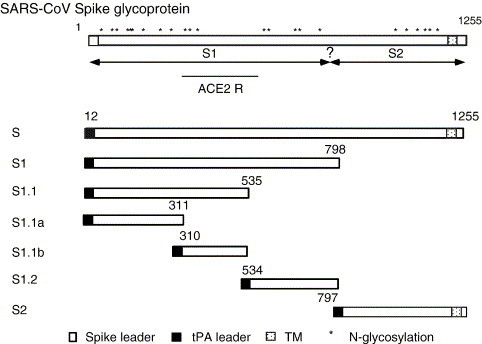
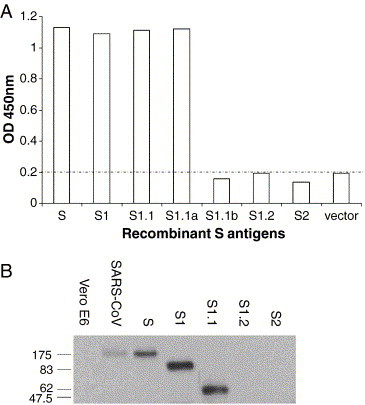
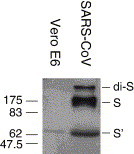
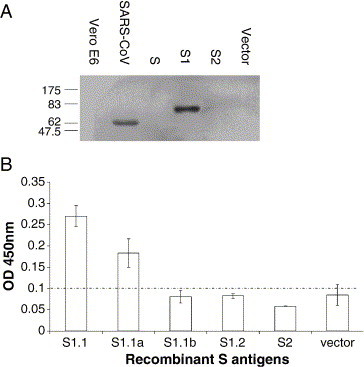
Inactivated severe acute respiratory syndrome-associated coronavirus (SARS-CoV) has been tested as a candidate vaccine against the re-emergence of SARS. In order to understand the efficacy and safety of this approach, it is important to know the antibody specificities generated with inactivated SARS-CoV. In the current study, a panel of twelve monoclonal antibodies (mAbs) was established by immunizing Balb/c mice with the inactivated BJ01 strain of SARS-CoV isolated from the lung tissue of a SARS-infected Chinese patient. These mAbs could recognize SARS-CoV-infected cells by immunofluorescence analysis (IFA). Seven of them were mapped to the specific segments of recombinant spike (S) protein: six on S1 subunit (aa 12-798) and one on S2 subunit (aa 797-1192). High neutralizing titers against SARS-CoV were detected with two mAbs (1A5 and 2C5) targeting at a subdomain of S protein (aa 310-535), consistent with the previous report that this segment of S protein contains the major neutralizing domain. Some of these S-specific mAbs were able to recognize cleaved products of S protein in SARS-CoV-infected Vero E6 cells. None of the remaining five mAbs could recognize either of the recombinant S, N, M, or E antigens by ELISA. This study demonstrated that the inactivated SARS-CoV was able to preserve the immunogenicity of S protein including its major neutralizing domain. The relative ease with which these mAbs were generated against SARS-CoV virions further supports that subunit vaccination with S constructs may also be able to protect animals and perhaps humans. It is somewhat unexpected that no N-specific mAbs were identified albeit anti-N IgG was easily identified in SARS-CoV-infected patients. The availability of this panel of mAbs also provided potentially useful agents with applications in therapy, diagnosis, and basic research of SARS-CoV.
灭活严重急性呼吸综合征相关冠状病毒(SARS-CoV)已作为预防SARS再次出现的候选疫苗进行了测试。为了解这种方法的有效性和安全性,了解用灭活SARS-CoV产生的抗体特异性很重要。在本研究中,通过用从一名感染SARS的中国患者肺组织中分离出的灭活BJ01株SARS-CoV免疫Balb/c小鼠,建立了一组12种单克隆抗体(mAb)。通过免疫荧光分析(IFA),这些mAb能够识别感染SARS-CoV的细胞。其中7种被定位到重组刺突(S)蛋白的特定片段:6种在S1亚基(氨基酸12 - 798)上,1种在S2亚基(氨基酸797 - 1192)上。用两种靶向S蛋白一个亚结构域(氨基酸310 - 535)的mAb(1A5和2C5)检测到针对SARS-CoV的高中和滴度,这与之前关于S蛋白该片段包含主要中和结构域的报道一致。这些S特异性mAb中的一些能够识别SARS-CoV感染的Vero E6细胞中S蛋白的裂解产物。其余5种mAb通过ELISA均不能识别重组S、N、M或E抗原中的任何一种。本研究表明,灭活的SARS-CoV能够保留S蛋白的免疫原性,包括其主要中和结构域。这些mAb针对SARS-CoV病毒粒子产生的相对容易程度进一步支持了用S构建体进行亚单位疫苗接种也可能能够保护动物甚至人类。尽管在感染SARS-CoV的患者中很容易鉴定出抗N IgG,但未鉴定出N特异性mAb,这有点出乎意料。这组mAb的可用性也为SARS-CoV的治疗、诊断和基础研究提供了潜在有用的试剂。